AQA · A-Level · Chemistry
Course version: 7405 · Version from Sept 2016
Separation depends on the balance between solubility in the moving phase…
Full specification wording
Chromatography (A-level only): Separation depends on the balance between solubility in the moving phase and retention by the stationary phase.
A component in chromatography partitions between two states: dissolved in the mobile phase (solvent or gas) and retained by the stationary phase.
Checked against the AQA 7405 specification (opens in a new tab) on .
- Point 3 of 5
- 3 key terms
Study notes
From the checked teaching notes for this specification point.
The idea
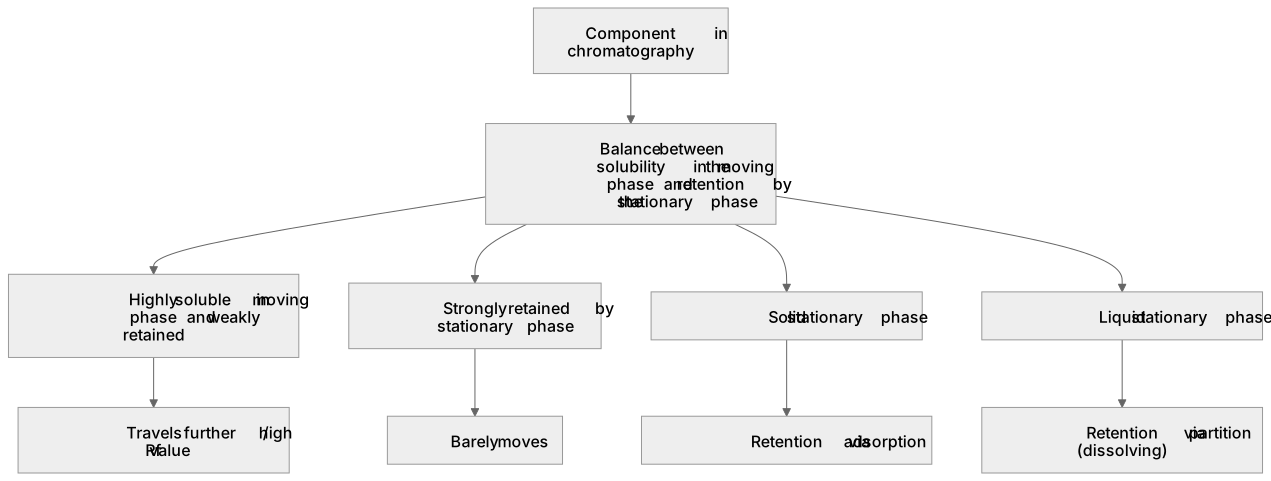
A component in chromatography partitions between two states: dissolved in the mobile phase (solvent or gas) and retained by the stationary phase. The proportion of time spent in each determines its travel distance or retention time. A substance highly soluble in the mobile phase but weakly retained by the stationary phase travels further, yielding a high Rf value. Conversely, a component strongly adsorbed onto a polar solid stationary phase, like silica, barely moves. Separation relies on each component having a unique balance of these affinities. Crucially, retention mechanisms differ: solid stationary phases retain components via adsorption (e.g., hydrogen bonding to silica), whereas liquid stationary phases retain them via dissolving (partition).
What earns the marks
- State that separation depends on the balance between solubility in the mobile phase and retention by the stationary phase.
- Explain that a component with greater solubility in the mobile phase and weaker retention travels further or has a shorter retention time.
- Identify adsorption as the specific retention mechanism for solid stationary phases, such as silica in TLC.
- Contrast adsorption with partition (dissolving), which is the retention mechanism when a liquid stationary phase is used.
Common mistakes and how to put them right
Confusing adsorption with absorption.
Put it right by specifying 'adsorption' when molecules bind to the surface of a solid stationary phase.
Explaining separation using only one phase.
Put it right by comparing solubility in the mobile phase against retention on the stationary phase.
Stating that components separate due to different masses.
Put it right by attributing separation to differing relative affinities for the two phases.
Exam tips
- Be precise with terminology: use 'adsorption' for solid stationary phases (like TLC silica) and avoid the term 'absorption'.
- When comparing two molecules, explicitly state which has the stronger affinity for the stationary phase and link this to its Rf value or retention time.
Try the lesson
The start of the Chromatography (A-level only): Separation depends on the balance between solubility in the moving phase and retention by the stationary phase. lesson, made from checked teaching notes for this specification point.
Have a go first
In paper chromatography, why does a component with high solubility in the solvent travel further up the paper?
Listen
A component in chromatography partitions between two states: dissolved in the mobile phase (solvent or gas) and retained by the stationary phase. The proportion of time spent in each determines its travel distance or retention time. A substance highly soluble in the mobile phase but weakly retained by the stationary phase travels further, yielding a high Rf value. Conversely, a component strongly adsorbed onto a polar solid stationary phase, like silica, barely moves. Separation relies on each component having a unique balance of these affinities. Crucially, retention mechanisms differ: solid stationary phases retain components via adsorption (e.g., hydrogen bonding to silica), whereas liquid stationary phases retain them via dissolving (partition). A strong answer earns marks for these points. State that separation depends on the balance between solubility in the mobile phase and retention by the stationary phase. Explain that a component with greater solubility in the mobile phase and weaker retention travels further or has a shorter retention time. Identify adsorption as the specific retention mechanism for solid stationary phases, such as silica in TLC. Contrast adsorption with partition (dissolving), which is the retention mechanism when a liquid stationary phase is used. A common slip: Confusing adsorption with absorption. Instead, specifying 'adsorption' when molecules bind to the surface of a solid stationary phase. Exam tip: Be precise with terminology: use 'adsorption' for solid stationary phases (like TLC silica) and avoid the term 'absorption'.
See it
Key words
Say what each word means before you turn the card.
adsorption
Try answering aloud or in your head before turning the card.
partition
Try answering aloud or in your head before turning the card.
Rf value
Try answering aloud or in your head before turning the card.
See every definition
- adsorption
- The specific retention mechanism for solid stationary phases, such as silica in TLC, where molecules bind to the surface of the solid.
- partition
- The retention mechanism when a liquid stationary phase is used, where components are retained by dissolving.
- Rf value
- A value that is high when a substance is highly soluble in the mobile phase but weakly retained by the stationary phase and so travels further.
Label the diagram
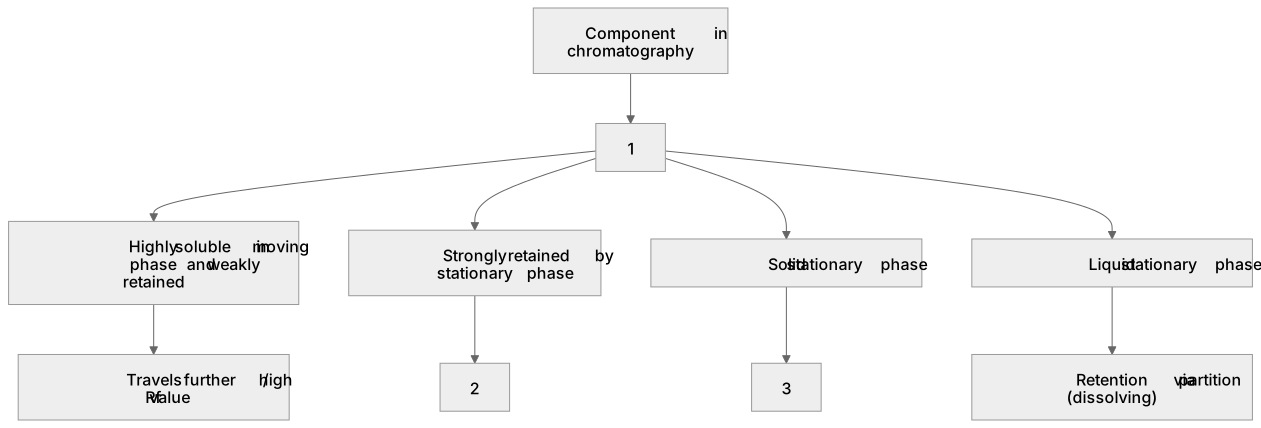
Some boxes have lost their names. Pick the right name for each number.
1Box 1
2Box 2
3Box 3
There is more to this lesson
The full lesson goes on to check your understanding and help you earn the marks. Create a free account to carry on, with your progress saved.
A week of Premium from your first lesson · Then the free plan continues · No card, no charge
Test your understanding of Chromatography (A-level only): Separation depends on the balance between solubility in the moving phase and retention by the stationary phase.
Active recall beats re-reading. Take an instant quiz now to test what you’ve learned and lock it into long-term memory.
A week of Premium from your first lesson · Then the free plan continues · No card, no charge