AQA · A-Level · Chemistry
Course version: 7405 · Version from Sept 2016
Types of chromatography include: thin-layer chromatography (TLC) – a plate…
Full specification wording
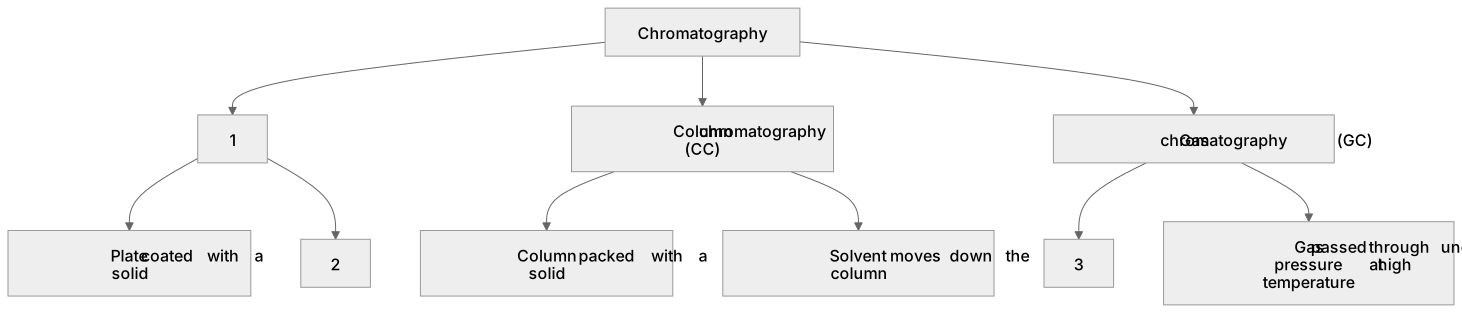
Chromatography (A-level only): Types of chromatography include: thin-layer chromatography (TLC) – a plate is coated with a solid and a solvent moves up the plate column chromatography (CC) – a column is packed with a solid and a solvent moves down the column gas chromatography (GC) – a column is packed with a solid or with a solid coated by a liquid, and a gas is passed through the column under pressure at high temperature.
On a thin-layer plate the stationary phase is a thin coating of silica or alumina and the mobile phase is a solvent that climbs by capillary action.
Checked against the AQA 7405 specification (opens in a new tab) on .
- Point 2 of 5
- 4 key terms
Study notes
From the checked teaching notes for this specification point.
The idea
On a thin-layer plate the stationary phase is a thin coating of silica or alumina and the mobile phase is a solvent that climbs by capillary action. In a column the same kind of solid is packed into a tube and the solvent runs down through it under gravity, so the separated components leave the bottom one after another and can actually be collected: that is why it is the preparative method. In gas chromatography the column holds a solid, or a solid coated with a non-volatile liquid, and the mobile phase is an unreactive carrier gas pushed through under pressure while the column sits in a hot oven. The high temperature keeps the sample as a vapour, and each component leaves at its own retention time.
What earns the marks
- Identifying the stationary phase in a named technique, the coating on the plate, the packing in the column, or the solid or coated solid in a gas chromatography column.
- Identifying the mobile phase, a solvent moving up the plate, a solvent moving down the column, or a carrier gas under pressure.
- Stating that gas chromatography is run hot so that the components are carried as vapour.
- Stating that column chromatography allows the separated components to be collected.
Common mistakes and how to put them right
Calling the plate itself the stationary phase, when it is the thin coating of silica or alumina.
Saying the solvent moves down the plate in thin-layer chromatography.
Describing the carrier gas as reacting with the sample, when it must be unreactive.
Calling the liquid coating in a gas chromatography column the mobile phase, when the gas is mobile and the coating is stationary.
Exam tips
- Match the direction to the method: up the plate, down the column, through the gas chromatography column.
- Say what the stationary phase is made of, not simply where it sits.
- Use each technique's own vocabulary: plate and spot, column and fraction, retention time.
Try the lesson
The start of the Chromatography (A-level only): Types of chromatography include: thin-layer chromatography (TLC) – a plate is coated with a solid and a solvent moves up the plate column chromatography (CC) – a column is packed with a solid and a solvent moves down the column gas chromatography (GC) – a column is packed with a solid or with a solid coated by a liquid, and a gas is passed through the column under pressure at high temperature. lesson, made from checked teaching notes for this specification point.
Have a go first
In thin-layer chromatography, what is the role of the solvent?
Listen
On a thin-layer plate the stationary phase is a thin coating of silica or alumina and the mobile phase is a solvent that climbs by capillary action. In a column the same kind of solid is packed into a tube and the solvent runs down through it under gravity, so the separated components leave the bottom one after another and can actually be collected: that is why it is the preparative method. In gas chromatography the column holds a solid, or a solid coated with a non-volatile liquid, and the mobile phase is an unreactive carrier gas pushed through under pressure while the column sits in a hot oven. The high temperature keeps the sample as a vapour, and each component leaves at its own retention time. A strong answer earns marks for these points. identifying the stationary phase in a named technique, the coating on the plate, the packing in the column, or the solid or coated solid in a gas chromatography column. identifying the mobile phase, a solvent moving up the plate, a solvent moving down the column, or a carrier gas under pressure. stating that gas chromatography is run hot so that the components are carried as vapour. stating that column chromatography allows the separated components to be collected. Exam tip: Match the direction to the method: up the plate, down the column, through the gas chromatography column.
See it

Key words
Say what each word means before you turn the card.
thin-layer chromatography
Try answering aloud or in your head before turning the card.
column chromatography
Try answering aloud or in your head before turning the card.
gas chromatography
Try answering aloud or in your head before turning the card.
carrier gas under pressure
Try answering aloud or in your head before turning the card.
See every definition
- thin-layer chromatography
- A plate is coated with a solid and a solvent moves up the plate.
- column chromatography
- A column is packed with a solid and a solvent moves down the column.
- gas chromatography
- A column is packed with a solid or with a solid coated by a liquid, and a gas is passed through the column under pressure at high temperature.
- carrier gas under pressure
- An unreactive gas pushed through the column under pressure while the column sits in a hot oven.
Label the diagram
Some boxes have lost their names. Pick the right name for each number.
1Box 1
2Box 2
3Box 3
There is more to this lesson
The full lesson goes on to check your understanding and help you earn the marks. Create a free account to carry on, with your progress saved.
A week of Premium from your first lesson · Then the free plan continues · No card, no charge
Test your understanding of Chromatography (A-level only): Types of chromatography include: thin-layer chromatography (TLC) – a plate is coated with a solid and a solvent moves up the plate column chromatography (CC) – a column is packed with a solid and a solvent moves down the column gas chromatography (GC) – a column is packed with a solid or with a solid coated by a liquid, and a gas is passed through the column under pressure at high temperature.
Active recall beats re-reading. Take an instant quiz now to test what you’ve learned and lock it into long-term memory.
A week of Premium from your first lesson · Then the free plan continues · No card, no charge