AQA · A-Level · Chemistry
Course version: 7405 · Version from Sept 2016
Reactions can only occur when collisions take place between particles…
Full specification wording
Collision theory: Reactions can only occur when collisions take place between particles having sufficient energy.
Particles in a gas or solution are in constant random motion and collide constantly, yet only a tiny minority of those collisions produce a reaction.
Checked against the AQA 7405 specification (opens in a new tab) on .
- Point 1 of 3
- 4 key terms
Study notes
From the checked teaching notes for this specification point.
The idea
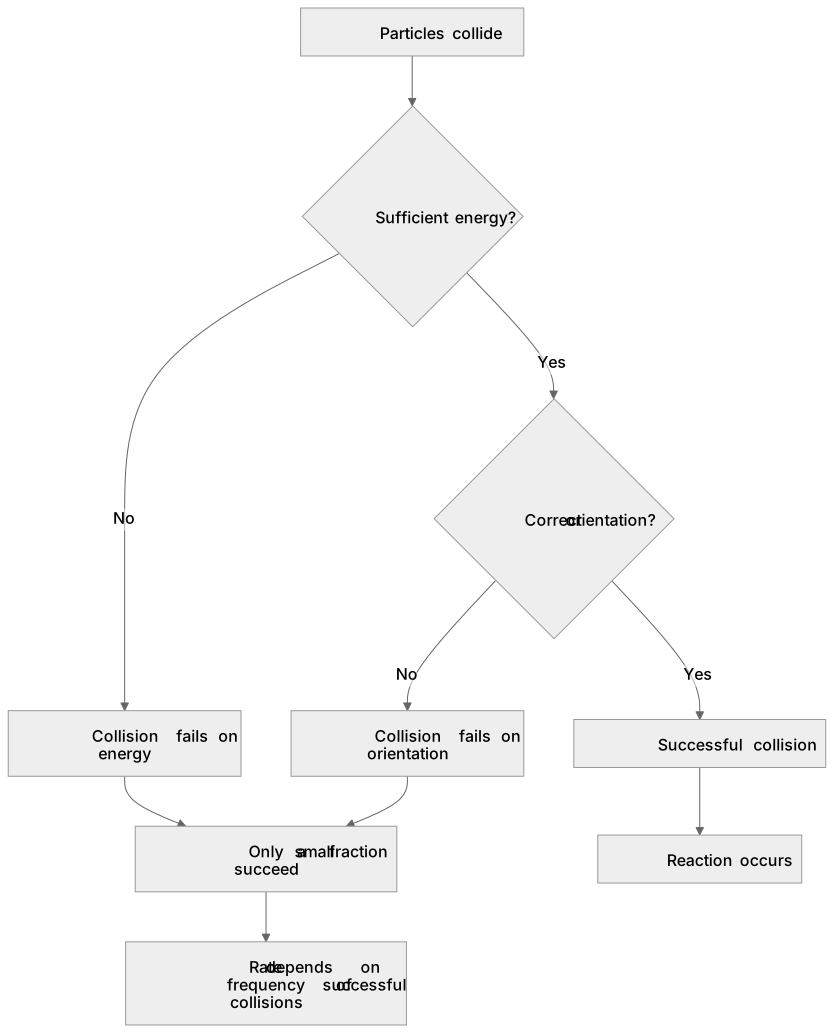
Particles in a gas or solution are in constant random motion and collide constantly, yet only a tiny minority of those collisions produce a reaction. For a collision to work, the particles must arrive with at least a minimum combined kinetic energy, enough to start breaking the existing bonds and reach the transition state. They must also be correctly oriented, so that the right atoms meet. Most collisions fail on energy: at room temperature only a small fraction of particles are moving fast enough. That is why rate depends on the frequency of successful collisions rather than the total collision frequency, and why examiners want the word successful, or the phrase collisions with energy greater than or equal to the activation energy, rather than simply more collisions.
What earns the marks
- Stating that particles must collide for a reaction to occur.
- Adding that the collision must involve energy greater than or equal to the activation energy.
- Referring to the frequency of successful collisions rather than the total number of collisions.
- Mentioning correct orientation of the colliding particles as a second requirement.
Common mistakes and how to put them right
Writing that more collisions occur without saying they are successful collisions, which is not credited.
Using the words chance or probability of collision, which examiners ignore.
Claiming every collision leads to reaction provided the particles touch.
Confusing the energy of a collision with the temperature of a single particle.
Saying particles need activation energy to collide, rather than to react once they have collided.
Exam tips
- Use the phrase more frequent successful collisions; both words carry marks in rate explanations.
- Reserve the word collision for particles and the word energy for the barrier, and connect them in one sentence.
- If a question gives a concentration or pressure change, mention collision frequency; if it gives a temperature or catalyst change, mention the proportion of collisions that succeed.
Try the lesson
The start of the Collision theory: Reactions can only occur when collisions take place between particles having sufficient energy. lesson, made from checked teaching notes for this specification point.
Have a go first
According to collision theory, what two conditions must be met for a reaction to occur between two particles?
Listen
Particles in a gas or solution are in constant random motion and collide constantly, yet only a tiny minority of those collisions produce a reaction. For a collision to work, the particles must arrive with at least a minimum combined kinetic energy, enough to start breaking the existing bonds and reach the transition state. They must also be correctly oriented, so that the right atoms meet. Most collisions fail on energy: at room temperature only a small fraction of particles are moving fast enough. That is why rate depends on the frequency of successful collisions rather than the total collision frequency, and why examiners want the word successful, or the phrase collisions with energy greater than or equal to the activation energy, rather than simply more collisions. A strong answer earns marks for these points. stating that particles must collide for a reaction to occur. adding that the collision must involve energy greater than or equal to the activation energy. referring to the frequency of successful collisions rather than the total number of collisions. mentioning correct orientation of the colliding particles as a second requirement. Exam tip: Use the phrase more frequent successful collisions; both words carry marks in rate explanations.
See it
Key words
Say what each word means before you turn the card.
collision theory
Try answering aloud or in your head before turning the card.
successful collisions
Try answering aloud or in your head before turning the card.
energy requirement
Try answering aloud or in your head before turning the card.
orientation
Try answering aloud or in your head before turning the card.
See every definition
- collision theory
- Reactions can only occur when collisions take place between particles having sufficient energy.
- successful collisions
- Collisions that produce a reaction, which rate depends on the frequency of rather than the total collision frequency.
- energy requirement
- The particles must arrive with at least a minimum combined kinetic energy, enough to start breaking the existing bonds and reach the transition state.
- orientation
- The particles must be correctly oriented, so that the right atoms meet.
There is more to this lesson
The full lesson goes on to check your understanding and help you earn the marks. Create a free account to carry on, with your progress saved.
A week of Premium from your first lesson · Then the free plan continues · No card, no charge
Test your understanding of Collision theory: Reactions can only occur when collisions take place between particles having sufficient energy.
Active recall beats re-reading. Take an instant quiz now to test what you’ve learned and lock it into long-term memory.
A week of Premium from your first lesson · Then the free plan continues · No card, no charge