AQA · A-Level · Chemistry
Course version: 7405 · Version from Sept 2016
Collision theory: This energy is called the activation energy.
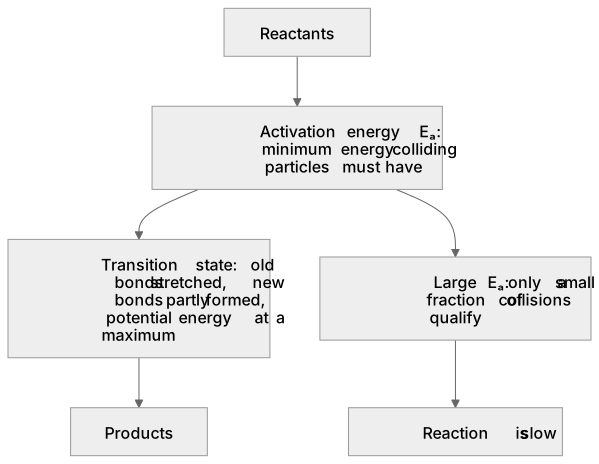
The activation energy, Eₐ, is the minimum energy that colliding particles must have in order to react.
Checked against the AQA 7405 specification (opens in a new tab) on .
- Point 2 of 3
- 2 key terms
Study notes
From the checked teaching notes for this specification point.
The idea
The activation energy, Eₐ, is the minimum energy that colliding particles must have in order to react. Physically it is the cost of reaching the transition state, the arrangement partway through the reaction where old bonds are stretched and new ones are only partly formed and the potential energy is at a maximum. On an enthalpy profile it is the height from the reactants up to that peak, measured from the reactant level, not from the products and not from the baseline. Every reaction has one, exothermic reactions included, which is why a mixture of petrol and air is stable until a spark supplies the first particles with enough energy. A large Eₐ means only a small fraction of collisions qualify, so the reaction is slow.
What earns the marks
- Defining activation energy as the minimum energy needed for a reaction to occur.
- Adding that it is the minimum energy the colliding particles must have.
- Marking Eₐ on a profile from the reactant level up to the peak.
- Linking a larger activation energy to a smaller proportion of successful collisions and a slower rate.
Common mistakes and how to put them right
Measuring Eₐ from the products or from the zero line rather than from the reactants.
Defining it as the energy given out by the reaction, confusing it with ∆H.
Saying exothermic reactions have no activation energy.
Describing Eₐ as the average energy of the particles rather than the minimum needed.
Drawing the peak below the reactant level on a profile diagram.
Exam tips
- Include the word minimum; a definition without it does not score.
- On any profile diagram, use two separate arrows: one from reactants to peak for Eₐ and one from reactants to products for ∆H.
- Link the size of Eₐ to the fraction of particles beyond it whenever a question asks about rate.
Try the lesson
The start of the Collision theory: This energy is called the activation energy. lesson, made from checked teaching notes for this specification point.
Have a go first
In collision theory, what name is given to the minimum energy that colliding particles must possess for a reaction to occur?
Listen
The activation energy, Eₐ, is the minimum energy that colliding particles must have in order to react. Physically it is the cost of reaching the transition state, the arrangement partway through the reaction where old bonds are stretched and new ones are only partly formed and the potential energy is at a maximum. On an enthalpy profile it is the height from the reactants up to that peak, measured from the reactant level, not from the products and not from the baseline. Every reaction has one, exothermic reactions included, which is why a mixture of petrol and air is stable until a spark supplies the first particles with enough energy. A large Eₐ means only a small fraction of collisions qualify, so the reaction is slow. A strong answer earns marks for these points. defining activation energy as the minimum energy needed for a reaction to occur. adding that it is the minimum energy the colliding particles must have. marking Eₐ on a profile from the reactant level up to the peak. linking a larger activation energy to a smaller proportion of successful collisions and a slower rate. Exam tip: Include the word minimum; a definition without it does not score.
See it
Key words
Say what each word means before you turn the card.
activation energy
Try answering aloud or in your head before turning the card.
transition state
Try answering aloud or in your head before turning the card.
See every definition
- activation energy
- The minimum energy that colliding particles must have in order to react.
- transition state
- The arrangement partway through the reaction where old bonds are stretched and new ones are only partly formed and the potential energy is at a maximum.
Label the diagram
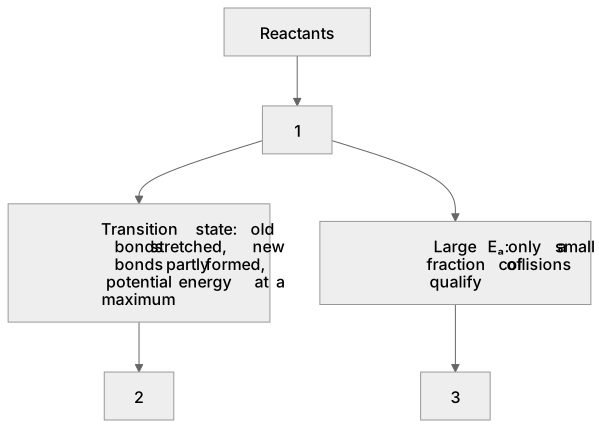
Some boxes have lost their names. Pick the right name for each number.
1Box 1
2Box 2
3Box 3
There is more to this lesson
The full lesson goes on to check your understanding and help you earn the marks. Create a free account to carry on, with your progress saved.
A week of Premium from your first lesson · Then the free plan continues · No card, no charge
Test your understanding of Collision theory: This energy is called the activation energy.
Active recall beats re-reading. Take an instant quiz now to test what you’ve learned and lock it into long-term memory.
A week of Premium from your first lesson · Then the free plan continues · No card, no charge