AQA · A-Level · Chemistry
Course version: 7405 · Version from Sept 2016
Combustion of alkanes: Alkanes are used as fuels.
Burning an alkane is strongly exothermic because the bonds made in the products, C=O in carbon dioxide and O–H in water, are stronger overall than the C–C and C–H bonds broken in the fuel together…
Checked against the AQA 7405 specification (opens in a new tab) on .
- Point 1 of 5
- 3 key terms
Study notes
From the checked teaching notes for this specification point.
The idea
Burning an alkane is strongly exothermic because the bonds made in the products, C=O in carbon dioxide and O–H in water, are stronger overall than the C–C and C–H bonds broken in the fuel together with the O=O bonds broken in oxygen. The energy released per gram is high. Methane is natural gas, propane and butane are bottled as LPG, roughly C₅ to C₁₀ makes petrol, and longer chains give kerosene and diesel. Many are liquid or easily liquefied, making them simple to store and transport. The costs are that crude oil is finite and non-renewable, and complete combustion produces CO₂, a greenhouse gas. Incomplete combustion, when oxygen is limited, produces toxic carbon monoxide (CO) or carbon particulates (soot) instead of CO₂.
What earns the marks
- Combustion being exothermic because the bonds formed are stronger than the bonds broken.
- A balanced combustion equation for a named alkane.
- A named alkane fuel matched to its use, such as methane for heating or octane in petrol.
- A disadvantage, such as carbon dioxide emission or the non-renewable supply.
Common mistakes and how to put them right
Saying bond breaking releases energy, when breaking bonds always requires energy.
Omitting the O=O bonds of oxygen from a bond enthalpy argument about combustion.
Claiming alkane fuels are renewable because more crude oil keeps being found.
Giving pollution as a disadvantage without naming a specific pollutant.
Exam tips
- Set out bonds broken and bonds made as two separate totals if asked why combustion is exothermic.
- Name the specific alkane and the specific use rather than writing that oil is used for fuel.
- Give one named pollutant when asked for an environmental disadvantage.
Try the lesson
The start of the Combustion of alkanes: Alkanes are used as fuels. lesson, made from checked teaching notes for this specification point.
Have a go first
Which thermodynamic property of alkanes makes them highly suitable for use as fuels?
Listen
Burning an alkane is strongly exothermic because the bonds made in the products, C=O in carbon dioxide and O–H in water, are stronger overall than the C–C and C–H bonds broken in the fuel together with the O=O bonds broken in oxygen. The energy released per gram is high. Methane is natural gas, propane and butane are bottled as LPG, roughly C₅ to C₁₀ makes petrol, and longer chains give kerosene and diesel. Many are liquid or easily liquefied, making them simple to store and transport. The costs are that crude oil is finite and non-renewable, and complete combustion produces CO₂, a greenhouse gas. Incomplete combustion, when oxygen is limited, produces toxic carbon monoxide (CO) or carbon particulates (soot) instead of CO₂. A strong answer earns marks for these points. combustion being exothermic because the bonds formed are stronger than the bonds broken. a balanced combustion equation for a named alkane. a named alkane fuel matched to its use, such as methane for heating or octane in petrol. a disadvantage, such as carbon dioxide emission or the non-renewable supply. Exam tip: Set out bonds broken and bonds made as two separate totals if asked why combustion is exothermic.
See it
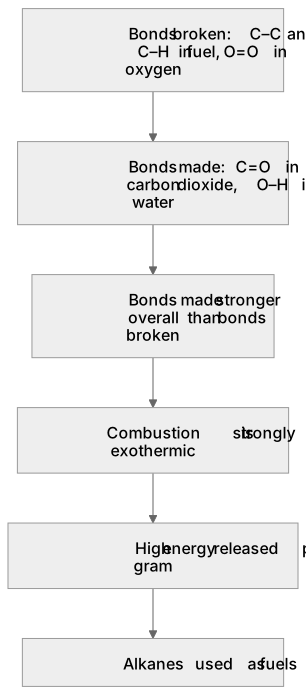
Put it in order
Put these steps in the order they happen.
- 1. Bonds made stronger overall than bonds broken
- 2. Bonds made: C=O in carbon dioxide, O–H in water
- 3. Bonds broken: C–C and C–H in fuel, O=O in oxygen
- 4. Alkanes used as fuels
- 5. High energy released per gram
- 6. Combustion is strongly exothermic
Key words
Say what each word means before you turn the card.
exothermic combustion
Try answering aloud or in your head before turning the card.
bond enthalpy balance
Try answering aloud or in your head before turning the card.
alkane fuels and uses
Try answering aloud or in your head before turning the card.
See every definition
- exothermic combustion
- Burning an alkane is strongly exothermic because the bonds made in the products are stronger overall than the bonds broken in the fuel and in oxygen.
- bond enthalpy balance
- The C=O bonds in carbon dioxide and O–H bonds in water are stronger overall than the C–C and C–H bonds broken in the fuel together with the O=O bonds broken in oxygen.
- alkane fuels and uses
- Methane is natural gas, propane and butane are bottled as LPG, roughly C₅ to C₁₀ makes petrol, and longer chains give kerosene and diesel.
Label the diagram
Some boxes have lost their names. Pick the right name for each number.
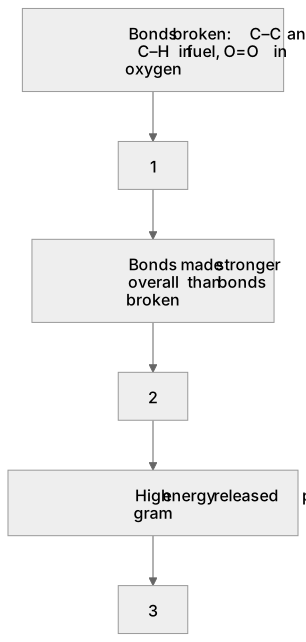
1Box 1
2Box 2
3Box 3
There is more to this lesson
The full lesson goes on to check your understanding and help you earn the marks. Create a free account to carry on, with your progress saved.
A week of Premium from your first lesson · Then the free plan continues · No card, no charge
Test your understanding of Combustion of alkanes: Alkanes are used as fuels.
Active recall beats re-reading. Take an instant quiz now to test what you’ve learned and lock it into long-term memory.
A week of Premium from your first lesson · Then the free plan continues · No card, no charge