AQA · A-Level · Chemistry
Course version: 7405 · Version from Sept 2016
Combustion of alkanes and other organic compounds can be complete or…
Full specification wording
Combustion of alkanes: Combustion of alkanes and other organic compounds can be complete or incomplete.
With plenty of oxygen an alkane burns completely, so every carbon becomes CO₂ and every hydrogen becomes H₂O, as in C₃H₈ + 5O₂ → 3CO₂ + 4H₂O. With a limited oxygen supply the carbon is only partly…
Checked against the AQA 7405 specification (opens in a new tab) on .
- Point 2 of 5
- 4 key terms
Study notes
From the checked teaching notes for this specification point.
The idea
With plenty of oxygen an alkane burns completely, so every carbon becomes CO₂ and every hydrogen becomes H₂O, as in C₃H₈ + 5O₂ → 3CO₂ + 4H₂O. With a limited oxygen supply the carbon is only partly oxidised, giving carbon monoxide, or not oxidised at all, giving carbon as soot, while the hydrogen still becomes water. Two consequences follow. Less energy is released per mole of fuel, which is why an experimental enthalpy of combustion from a calorimeter comes out less exothermic than the data book value; incomplete combustion is a standard mark scheme answer for that discrepancy, alongside heat loss. And the products are hazardous, since carbon monoxide is a toxic ligand for haemoglobin and soot aggravates respiratory disease.
What earns the marks
- A balanced equation for complete combustion giving only CO₂ and H₂O.
- A balanced equation for incomplete combustion giving CO or C together with H₂O.
- Linking incomplete combustion to a less exothermic experimental value.
- A hazard of an incomplete combustion product, such as the toxicity of carbon monoxide.
Common mistakes and how to put them right
Writing an incomplete combustion equation that does not balance because the oxygen coefficient was not adjusted.
Giving less exothermic without a reason when the question asks why an experimental value is low.
Claiming incomplete combustion releases more energy because more products are formed.
Naming carbon dioxide as the toxic product instead of carbon monoxide.
Exam tips
- Balance carbon and hydrogen first, then use a fraction or double the equation to balance oxygen.
- When explaining a low calorimetry result, give incomplete combustion as a reason distinct from heat loss.
- Say limited oxygen supply rather than no oxygen, which would prevent combustion altogether.
Try the lesson
The start of the Combustion of alkanes: Combustion of alkanes and other organic compounds can be complete or incomplete. lesson, made from checked teaching notes for this specification point.
Have a go first
Which two products are formed when an alkane undergoes complete combustion in a plentiful supply of air?
Listen
With plenty of oxygen an alkane burns completely, so every carbon becomes CO₂ and every hydrogen becomes H₂O, as in C₃H₈ + 5O₂ → 3CO₂ + 4H₂O. With a limited oxygen supply the carbon is only partly oxidised, giving carbon monoxide, or not oxidised at all, giving carbon as soot, while the hydrogen still becomes water. Two consequences follow. Less energy is released per mole of fuel, which is why an experimental enthalpy of combustion from a calorimeter comes out less exothermic than the data book value; incomplete combustion is a standard mark scheme answer for that discrepancy, alongside heat loss. And the products are hazardous, since carbon monoxide is a toxic ligand for haemoglobin and soot aggravates respiratory disease. A strong answer earns marks for these points. a balanced equation for complete combustion giving only CO₂ and H₂O. a balanced equation for incomplete combustion giving CO or C together with H₂O. linking incomplete combustion to a less exothermic experimental value. a hazard of an incomplete combustion product, such as the toxicity of carbon monoxide. Exam tip: Balance carbon and hydrogen first, then use a fraction or double the equation to balance oxygen.
See it

Key words
Say what each word means before you turn the card.
complete combustion
Try answering aloud or in your head before turning the card.
incomplete combustion
Try answering aloud or in your head before turning the card.
carbon monoxide and soot
Try answering aloud or in your head before turning the card.
errors in enthalpy of combustion
Try answering aloud or in your head before turning the card.
See every definition
- complete combustion
- With plenty of oxygen an alkane burns so every carbon becomes CO₂ and every hydrogen becomes H₂O.
- incomplete combustion
- With a limited oxygen supply the carbon is only partly oxidised, giving carbon monoxide, or not oxidised at all, giving carbon as soot, while the hydrogen still becomes water.
- carbon monoxide and soot
- Products of incomplete combustion that are hazardous, since carbon monoxide is a toxic ligand for haemoglobin and soot aggravates respiratory disease.
- errors in enthalpy of combustion
- An experimental enthalpy of combustion from a calorimeter comes out less exothermic than the data book value, and incomplete combustion is a standard mark scheme answer for that discrepancy, alongside heat loss.
Label the diagram
Some boxes have lost their names. Pick the right name for each number.
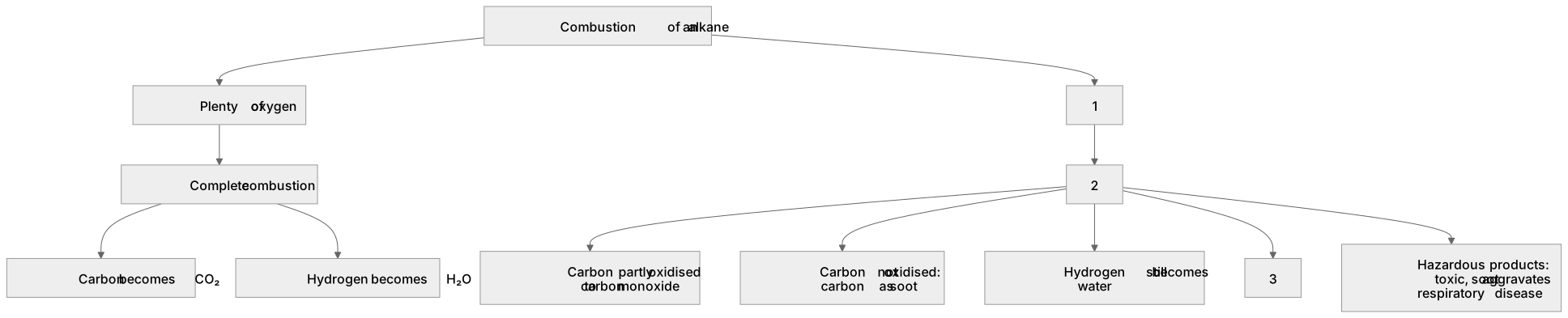
1Box 1
2Box 2
3Box 3
There is more to this lesson
The full lesson goes on to check your understanding and help you earn the marks. Create a free account to carry on, with your progress saved.
A week of Premium from your first lesson · Then the free plan continues · No card, no charge
Test your understanding of Combustion of alkanes: Combustion of alkanes and other organic compounds can be complete or incomplete.
Active recall beats re-reading. Take an instant quiz now to test what you’ve learned and lock it into long-term memory.
A week of Premium from your first lesson · Then the free plan continues · No card, no charge