AQA · A-Level · Chemistry
Course version: 7405 · Version from Sept 2016
Combustion of hydrocarbons containing sulfur leads to sulfur dioxide that…
Full specification wording
Combustion of alkanes: Combustion of hydrocarbons containing sulfur leads to sulfur dioxide that causes air pollution.
Crude oil contains sulfur compounds, and any sulfur left in a fuel is oxidised when that fuel burns: S + O₂ → SO₂.
Checked against the AQA 7405 specification (opens in a new tab) on .
- Point 4 of 5
- 4 key terms
Study notes
From the checked teaching notes for this specification point.
The idea
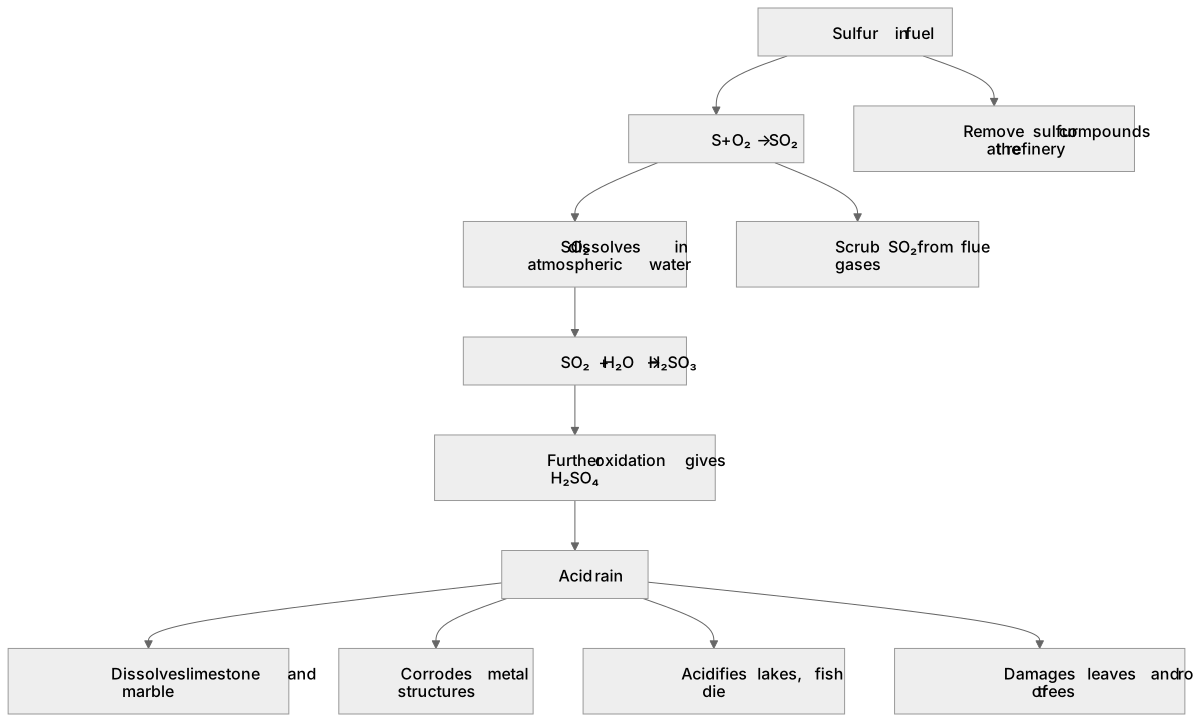
Crude oil contains sulfur compounds, and any sulfur left in a fuel is oxidised when that fuel burns: S + O₂ → SO₂. Sulfur dioxide is an acidic gas. Dissolved in atmospheric water it forms sulfurous acid, SO₂ + H₂O → H₂SO₃, and further oxidation in the air gives sulfuric acid, H₂SO₄. This is acid rain. Aqueous sulfur dioxide is acidic enough to register around pH 2 to 3, which is why it attacks carbonate stonework such as limestone and marble, corrodes metal structures, acidifies lakes so that fish die, and damages the leaves and roots of trees. The practical response is to remove sulfur compounds from fuels at the refinery and to scrub sulfur dioxide from flue gases at power stations.
What earns the marks
- The equation S + O₂ → SO₂ for the oxidation of sulfur during combustion.
- Sulfur dioxide dissolving in water to give an acidic solution, with an equation such as SO₂ + H₂O → H₂SO₃.
- Naming acid rain and a specific effect, such as dissolving limestone or acidifying lakes.
- A measure taken to reduce emissions, such as removing sulfur from the fuel beforehand.
Common mistakes and how to put them right
Writing SO₃ as the direct product of burning sulfur in an engine, when SO₂ forms first.
Saying sulfur dioxide causes the greenhouse effect rather than acid rain.
Giving it is bad for the environment instead of a named effect such as damage to limestone.
Forgetting that the sulfur comes from impurities in the fuel rather than from the hydrocarbon chain itself.
Exam tips
- Write equations for both stages: sulfur to sulfur dioxide, then sulfur dioxide to an acid.
- Name a specific consequence of acid rain, because general environmental harm scores nothing.
- Keep acid rain separate from global warming in your answer, since different gases cause them.
Try the lesson
The start of the Combustion of alkanes: Combustion of hydrocarbons containing sulfur leads to sulfur dioxide that causes air pollution. lesson, made from checked teaching notes for this specification point.
Have a go first
Which gas is produced when a hydrocarbon that contains sulfur is burned in air?
Listen
Crude oil contains sulfur compounds, and any sulfur left in a fuel is oxidised when that fuel burns: S + O₂ → SO₂. Sulfur dioxide is an acidic gas. Dissolved in atmospheric water it forms sulfurous acid, SO₂ + H₂O → H₂SO₃, and further oxidation in the air gives sulfuric acid, H₂SO₄. This is acid rain. Aqueous sulfur dioxide is acidic enough to register around pH 2 to 3, which is why it attacks carbonate stonework such as limestone and marble, corrodes metal structures, acidifies lakes so that fish die, and damages the leaves and roots of trees. The practical response is to remove sulfur compounds from fuels at the refinery and to scrub sulfur dioxide from flue gases at power stations. A strong answer earns marks for these points. the equation S + O₂ → SO₂ for the oxidation of sulfur during combustion. sulfur dioxide dissolving in water to give an acidic solution, with an equation such as SO₂ + H₂O → H₂SO₃. naming acid rain and a specific effect, such as dissolving limestone or acidifying lakes. a measure taken to reduce emissions, such as removing sulfur from the fuel beforehand. Exam tip: Write equations for both stages: sulfur to sulfur dioxide, then sulfur dioxide to an acid.
See it
Key words
Say what each word means before you turn the card.
sulfur impurities in fuel
Try answering aloud or in your head before turning the card.
formation of sulfur dioxide
Try answering aloud or in your head before turning the card.
acid rain
Try answering aloud or in your head before turning the card.
damage to buildings and lakes
Try answering aloud or in your head before turning the card.
See every definition
- sulfur impurities in fuel
- Crude oil contains sulfur compounds, and any sulfur left in a fuel is oxidised when that fuel burns.
- formation of sulfur dioxide
- Sulfur in a fuel is oxidised during combustion, forming sulfur dioxide by the equation S + O₂ → SO₂.
- acid rain
- Sulfur dioxide dissolves in atmospheric water to form sulfurous acid, and further oxidation in the air gives sulfuric acid.
- damage to buildings and lakes
- Aqueous sulfur dioxide is acidic enough to attack carbonate stonework such as limestone and marble, and to acidify lakes so that fish die.
Label the diagram
Some boxes have lost their names. Pick the right name for each number.
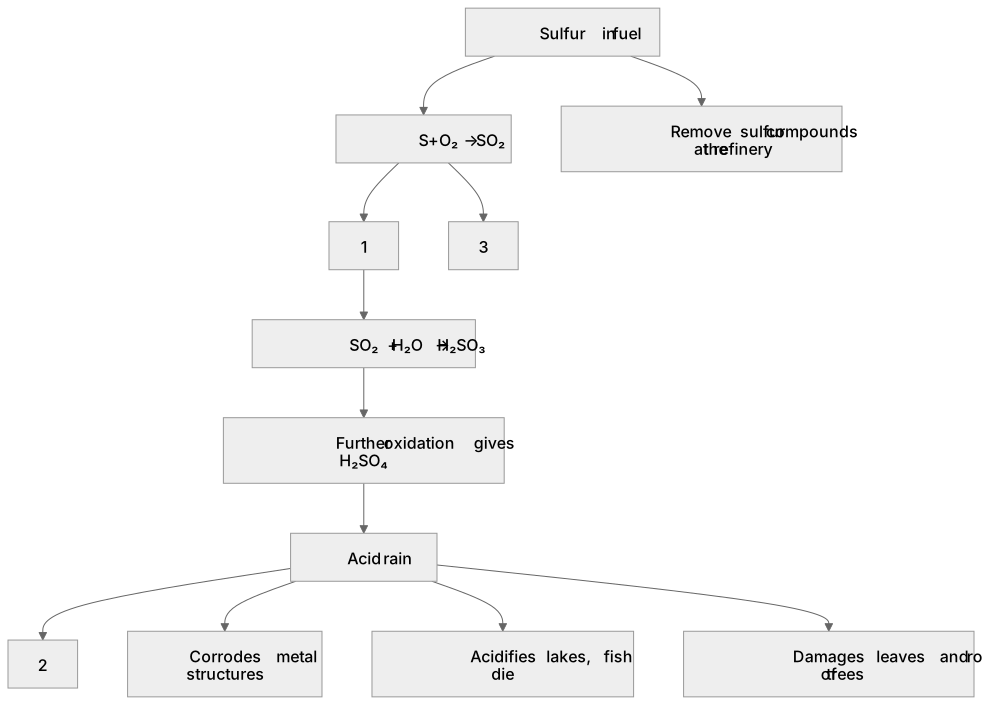
1Box 1
2Box 2
3Box 3
There is more to this lesson
The full lesson goes on to check your understanding and help you earn the marks. Create a free account to carry on, with your progress saved.
A week of Premium from your first lesson · Then the free plan continues · No card, no charge
Test your understanding of Combustion of alkanes: Combustion of hydrocarbons containing sulfur leads to sulfur dioxide that causes air pollution.
Active recall beats re-reading. Take an instant quiz now to test what you’ve learned and lock it into long-term memory.
A week of Premium from your first lesson · Then the free plan continues · No card, no charge