AQA · A-Level · Chemistry
Course version: 7405 · Version from Sept 2016
Students should be able to: explain why sulfur dioxide can be removed from…
Full specification wording
Combustion of alkanes: Students should be able to: explain why sulfur dioxide can be removed from flue gases using calcium oxide or calcium carbonate.
This is an acid-base reaction and the explanation must say so.
Checked against the AQA 7405 specification (opens in a new tab) on .
- Point 5 of 5
- 3 key terms
Study notes
From the checked teaching notes for this specification point.
The idea
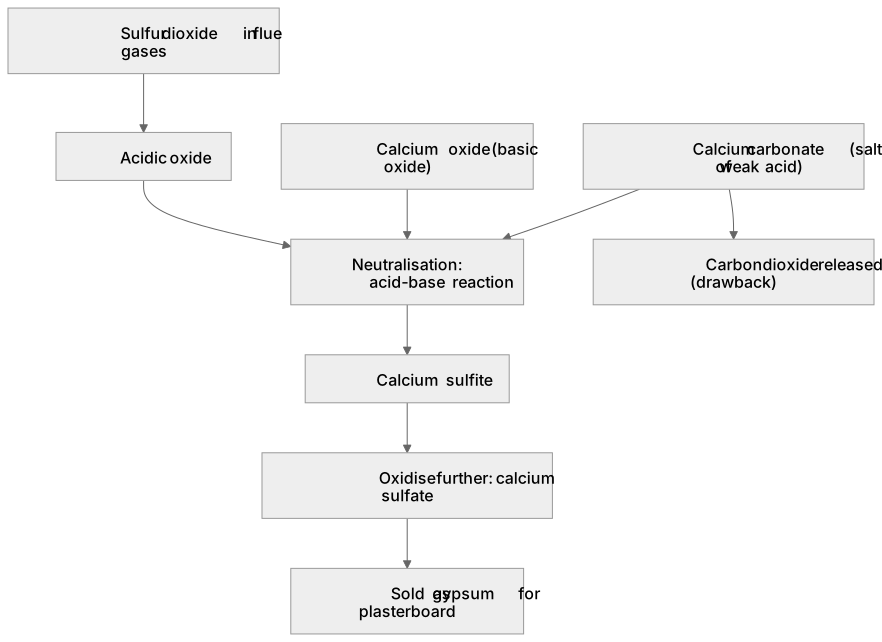
This is an acid-base reaction and the explanation must say so. Sulfur dioxide is an acidic oxide, calcium oxide is a basic oxide and calcium carbonate is the salt of a weak acid, so both neutralise it. In flue gas desulfurisation a slurry of powdered calcium oxide or calcium carbonate in water is sprayed into the rising gases, and the solid produced is calcium sulfite: CaO + SO₂ → CaSO₃, or CaCO₃ + SO₂ → CaSO₃ + CO₂. A fine slurry is used so as to maximise the surface area available. Oxidising the sulfite further gives calcium sulfate, sold as gypsum for plasterboard. The carbonate route has an obvious drawback, releasing a mole of carbon dioxide for every mole of sulfur dioxide removed.
What earns the marks
- Identifying sulfur dioxide as an acidic oxide and calcium oxide or calcium carbonate as basic.
- A balanced equation such as CaO + SO₂ → CaSO₃ or CaCO₃ + SO₂ → CaSO₃ + CO₂.
- Describing the process as neutralisation, or as an acid-base reaction.
- A comment on the products, such as calcium sulfate being sold as gypsum or carbon dioxide being released by the carbonate route.
Common mistakes and how to put them right
Writing calcium sulfate as the direct product with calcium oxide, when the immediate product is the sulfite.
Calling the reaction a redox reaction, when sulfur stays in the +4 oxidation state throughout.
Forgetting the carbon dioxide product when calcium carbonate is the reagent used.
Describing calcium oxide as acidic because it contains oxygen.
Exam tips
- Name the acid-base relationship explicitly, because they react together is not an explanation.
- Check the oxidation state of sulfur on both sides to confirm this is neutralisation rather than redox.
- Include carbon dioxide as a product whenever the reagent is the carbonate.
Try the lesson
The start of the Combustion of alkanes: Students should be able to: explain why sulfur dioxide can be removed from flue gases using calcium oxide or calcium carbonate. lesson, made from checked teaching notes for this specification point.
Have a go first
Calcium oxide is used to remove sulfur dioxide from flue gases. What type of substance is calcium oxide in this reaction?
Listen
This is an acid-base reaction and the explanation must say so. Sulfur dioxide is an acidic oxide, calcium oxide is a basic oxide and calcium carbonate is the salt of a weak acid, so both neutralise it. In flue gas desulfurisation a slurry of powdered calcium oxide or calcium carbonate in water is sprayed into the rising gases, and the solid produced is calcium sulfite: CaO + SO₂ → CaSO₃, or CaCO₃ + SO₂ → CaSO₃ + CO₂. A fine slurry is used so as to maximise the surface area available. Oxidising the sulfite further gives calcium sulfate, sold as gypsum for plasterboard. The carbonate route has an obvious drawback, releasing a mole of carbon dioxide for every mole of sulfur dioxide removed. A strong answer earns marks for these points. identifying sulfur dioxide as an acidic oxide and calcium oxide or calcium carbonate as basic. a balanced equation such as CaO + SO₂ → CaSO₃ or CaCO₃ + SO₂ → CaSO₃ + CO₂. describing the process as neutralisation, or as an acid-base reaction. a comment on the products, such as calcium sulfate being sold as gypsum or carbon dioxide being released by the carbonate route. Exam tip: Name the acid-base relationship explicitly, because they react together is not an explanation.
See it
Key words
Say what each word means before you turn the card.
flue gas desulfurisation
Try answering aloud or in your head before turning the card.
acidic and basic oxides
Try answering aloud or in your head before turning the card.
carbon dioxide trade-off
Try answering aloud or in your head before turning the card.
See every definition
- flue gas desulfurisation
- A slurry of powdered calcium oxide or calcium carbonate in water is sprayed into the rising gases, and the solid produced is calcium sulfite.
- acidic and basic oxides
- Sulfur dioxide is an acidic oxide, calcium oxide is a basic oxide and calcium carbonate is the salt of a weak acid, so both neutralise it.
- carbon dioxide trade-off
- The carbonate route has an obvious drawback, releasing a mole of carbon dioxide for every mole of sulfur dioxide removed.
Label the diagram
Some boxes have lost their names. Pick the right name for each number.
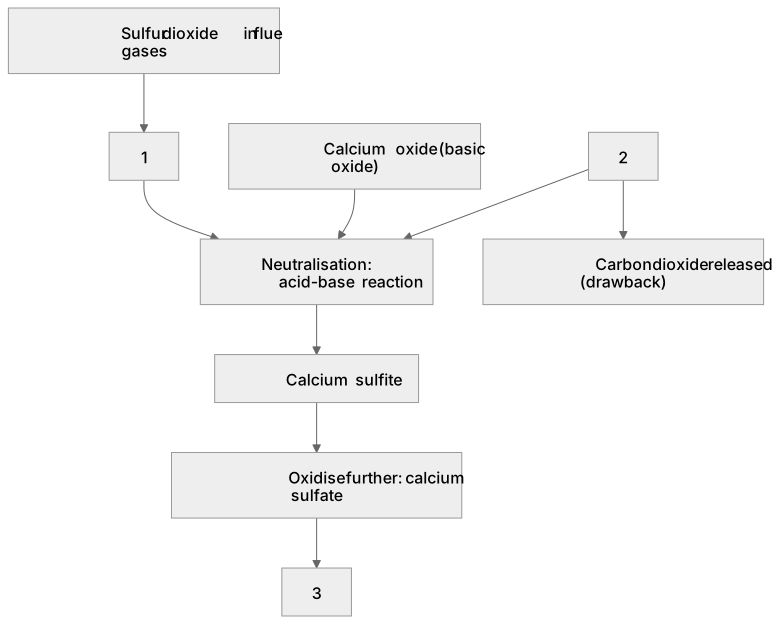
1Box 1
2Box 2
3Box 3
There is more to this lesson
The full lesson goes on to check your understanding and help you earn the marks. Create a free account to carry on, with your progress saved.
A week of Premium from your first lesson · Then the free plan continues · No card, no charge
Test your understanding of Combustion of alkanes: Students should be able to: explain why sulfur dioxide can be removed from flue gases using calcium oxide or calcium carbonate.
Active recall beats re-reading. Take an instant quiz now to test what you’ve learned and lock it into long-term memory.
A week of Premium from your first lesson · Then the free plan continues · No card, no charge