AQA · A-Level · Chemistry
Course version: 7405 · Version from Sept 2016
Required practical 7 Measuring the rate of reaction: by an initial rate…
Full specification wording
Determination of rate equation (A-level only): Required practical 7 Measuring the rate of reaction: by an initial rate method by a continuous monitoring method.
Required practical 7 covers the two standard ways of measuring a rate.
Checked against the AQA 7405 specification (opens in a new tab) on .
- Point 4 of 4
- 3 key terms
Study notes
From the checked teaching notes for this specification point.
The idea
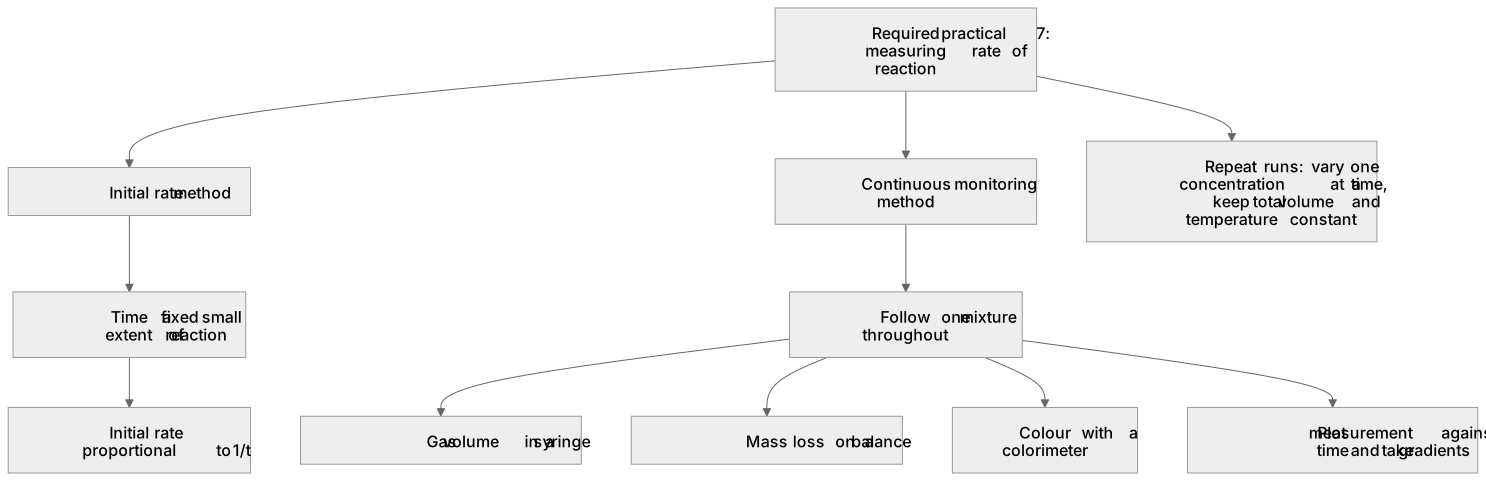
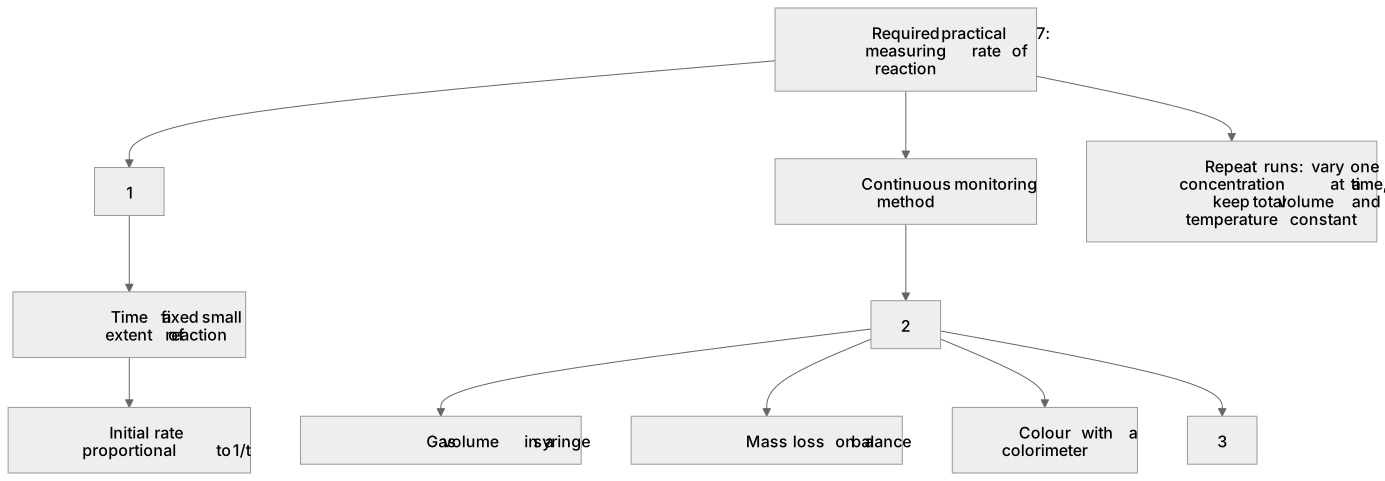
Required practical 7 covers the two standard ways of measuring a rate. The initial rate method times how long a fixed small amount of product takes to appear, as in an iodine clock where a limited amount of thiosulfate consumes the iodine until it runs out and the starch suddenly turns blue black; because the same tiny extent of reaction occurs each time, the initial rate is proportional to 1/t. The continuous monitoring method follows one mixture throughout, by collecting gas in a syringe, recording mass loss on a balance, or tracking colour with a colorimeter, then plotting the measurement against time and taking gradients. Repeat runs vary one concentration at a time, keeping the total volume and the temperature constant.
What earns the marks
- Stating that the initial rate is proportional to 1/t when a fixed small extent of reaction is timed.
- Naming an appropriate continuous measurement, such as gas volume, mass loss or colorimetry, matched to the reaction.
- Keeping the total volume and the temperature constant while one concentration is varied.
- Determining a rate from the gradient of the plotted curve at the required time.
Common mistakes and how to put them right
Varying a concentration by adding more reagent without topping up with water, so the total volume changes.
Taking the gradient of a chord across a curved section and calling it the initial rate.
Choosing mass loss to follow a reaction whose only gaseous product is hydrogen, where the change is too small to measure reliably.
Starting the clock after mixing is complete, so the earliest and fastest part of the reaction is missed.
Leaving the reaction mixture out of a water bath, so the temperature drifts between runs.
Exam tips
- Match the monitoring method to an observable change: colour for a coloured species, gas volume for a gaseous product.
- Say why the total volume is kept constant, since it is what fixes all the other concentrations.
- Draw tangents with a ruler across a wide span and show the triangle you used to find the gradient.
Try the lesson
The start of the Determination of rate equation (A-level only): Required practical 7 Measuring the rate of reaction: by an initial rate method by a continuous monitoring method. lesson, made from checked teaching notes for this specification point.
Have a go first
In a continuous monitoring method, the volume of gas produced is measured every 10 s. The volume is 20 cm³ at 20 s and 40 cm³ at 40 s. What is the average rate between 20 s and 40 s?
Listen
Required practical 7 covers the two standard ways of measuring a rate. The initial rate method times how long a fixed small amount of product takes to appear, as in an iodine clock where a limited amount of thiosulfate consumes the iodine until it runs out and the starch suddenly turns blue black; because the same tiny extent of reaction occurs each time, the initial rate is proportional to 1/t. The continuous monitoring method follows one mixture throughout, by collecting gas in a syringe, recording mass loss on a balance, or tracking colour with a colorimeter, then plotting the measurement against time and taking gradients. Repeat runs vary one concentration at a time, keeping the total volume and the temperature constant. A strong answer earns marks for these points. stating that the initial rate is proportional to 1/t when a fixed small extent of reaction is timed. naming an appropriate continuous measurement, such as gas volume, mass loss or colorimetry, matched to the reaction. keeping the total volume and the temperature constant while one concentration is varied. determining a rate from the gradient of the plotted curve at the required time. Exam tip: Match the monitoring method to an observable change: colour for a coloured species, gas volume for a gaseous product.
See it
Key words
Say what each word means before you turn the card.
continuous monitoring
Try answering aloud or in your head before turning the card.
iodine clock
Try answering aloud or in your head before turning the card.
controlling volume and temperature
Try answering aloud or in your head before turning the card.
See every definition
- continuous monitoring
- Following one mixture throughout, by collecting gas in a syringe, recording mass loss on a balance, or tracking colour with a colorimeter, then plotting the measurement against time and taking gradients.
- iodine clock
- A method where a limited amount of thiosulfate consumes the iodine until it runs out and the starch suddenly turns blue black, so the same tiny extent of reaction occurs each time.
- controlling volume and temperature
- Repeat runs vary one concentration at a time, keeping the total volume and the temperature constant.
Label the diagram
Some boxes have lost their names. Pick the right name for each number.
1Box 1
2Box 2
3Box 3
There is more to this lesson
The full lesson goes on to check your understanding and help you earn the marks. Create a free account to carry on, with your progress saved.
A week of Premium from your first lesson · Then the free plan continues · No card, no charge
Test your understanding of Determination of rate equation (A-level only): Required practical 7 Measuring the rate of reaction: by an initial rate method by a continuous monitoring method.
Active recall beats re-reading. Take an instant quiz now to test what you’ve learned and lock it into long-term memory.
A week of Premium from your first lesson · Then the free plan continues · No card, no charge