AQA · A-Level · Chemistry
Course version: 7405 · Version from Sept 2016
DNA exists as two complementary strands arranged in the form of a double…
Full specification wording
DNA (A-level only): DNA exists as two complementary strands arranged in the form of a double helix.
The pairing is fixed: adenine always hydrogen bonds to thymine, and cytosine always to guanine.
Checked against the AQA 7405 specification (opens in a new tab) on .
- Point 5 of 5
- 4 key terms
Study notes
From the checked teaching notes for this specification point.
The idea
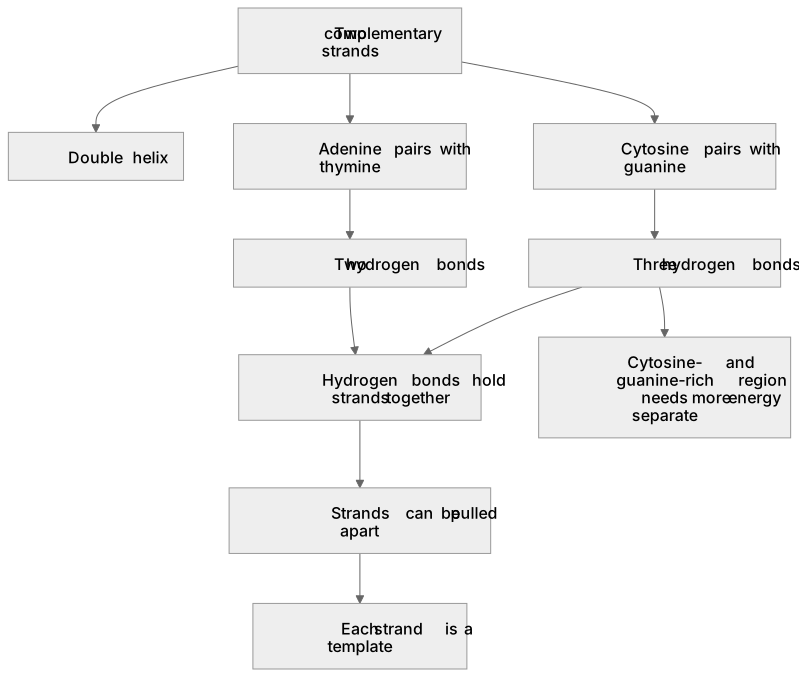
The pairing is fixed: adenine always hydrogen bonds to thymine, and cytosine always to guanine. Each hydrogen bond runs from an N-H on one base to a lone pair on an oxygen or a nitrogen of its partner, and there are two such bonds in an adenine-thymine pair but three in a cytosine-guanine pair. A two-ring purine always pairs with a one-ring pyrimidine, so every rung is the same width and the helix keeps a constant diameter. Complementary means the sequence of one strand fixes the sequence of the other, which is exactly what makes copying possible: pull the strands apart and each one is a template. Because it has three hydrogen bonds per pair rather than two, a region rich in cytosine and guanine takes more energy to separate.
What earns the marks
- Stating that adenine pairs with thymine and cytosine pairs with guanine.
- Naming hydrogen bonding as the interaction holding the two strands together.
- Two hydrogen bonds in an adenine-thymine pair and three in a cytosine-guanine pair.
- Identifying the atoms involved, a polar N-H hydrogen and a lone pair on nitrogen or oxygen.
- Deducing the complementary sequence from the strand given.
Common mistakes and how to put them right
Drawing hydrogen bonds from C-H groups, which are not polar enough to form them.
Pairing adenine with guanine, so purine with purine, which would make that rung too wide.
Saying the two strands are held together by covalent bonds.
Giving three hydrogen bonds to adenine-thymine and two to cytosine-guanine, the wrong way round.
Writing the partner strand by copying the sequence instead of swapping each base for its pair.
Exam tips
- Draw hydrogen bonds as dashed lines running from the hydrogen to a marked lone pair; a solid line reads as a covalent bond and scores nothing.
- Count before you commit: two bonds for adenine-thymine, three for cytosine-guanine.
- If asked which region needs more energy to separate, answer in terms of the number of hydrogen bonds per base pair.
Try the lesson
The start of the DNA (A-level only): DNA exists as two complementary strands arranged in the form of a double helix. lesson, made from checked teaching notes for this specification point.
Have a go first
What is the overall shape formed by the two complementary strands of DNA?
Listen
The pairing is fixed: adenine always hydrogen bonds to thymine, and cytosine always to guanine. Each hydrogen bond runs from an N-H on one base to a lone pair on an oxygen or a nitrogen of its partner, and there are two such bonds in an adenine-thymine pair but three in a cytosine-guanine pair. A two-ring purine always pairs with a one-ring pyrimidine, so every rung is the same width and the helix keeps a constant diameter. Complementary means the sequence of one strand fixes the sequence of the other, which is exactly what makes copying possible: pull the strands apart and each one is a template. Because it has three hydrogen bonds per pair rather than two, a region rich in cytosine and guanine takes more energy to separate. A strong answer earns marks for these points. stating that adenine pairs with thymine and cytosine pairs with guanine. naming hydrogen bonding as the interaction holding the two strands together. two hydrogen bonds in an adenine-thymine pair and three in a cytosine-guanine pair. identifying the atoms involved, a polar N-H hydrogen and a lone pair on nitrogen or oxygen. Exam tip: Draw hydrogen bonds as dashed lines running from the hydrogen to a marked lone pair; a solid line reads as a covalent bond and scores nothing.
See it
Key words
Say what each word means before you turn the card.
complementary base pairing
Try answering aloud or in your head before turning the card.
hydrogen bonding between bases
Try answering aloud or in your head before turning the card.
purine with pyrimidine
Try answering aloud or in your head before turning the card.
template for replication
Try answering aloud or in your head before turning the card.
See every definition
- complementary base pairing
- Adenine always hydrogen bonds to thymine, and cytosine always to guanine, so the sequence of one strand fixes the sequence of the other.
- hydrogen bonding between bases
- Each bond runs from an N-H on one base to a lone pair on an oxygen or a nitrogen of its partner, holding the two strands together.
- purine with pyrimidine
- A two-ring purine always pairs with a one-ring pyrimidine, so every rung is the same width and the helix keeps a constant diameter.
- template for replication
- Pull the strands apart and each one is a template, which is exactly what makes copying possible.
Label the diagram
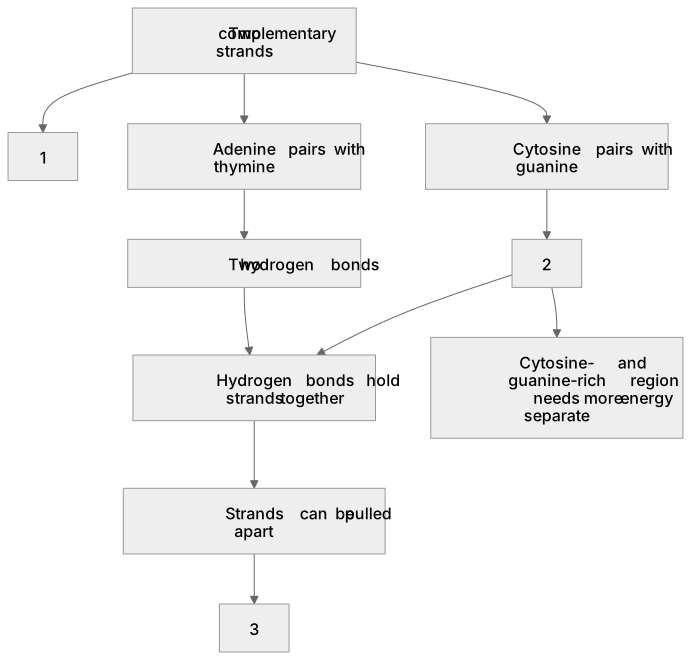
Some boxes have lost their names. Pick the right name for each number.
1Box 1
2Box 2
3Box 3
There is more to this lesson
The full lesson goes on to check your understanding and help you earn the marks. Create a free account to carry on, with your progress saved.
A week of Premium from your first lesson · Then the free plan continues · No card, no charge
Test your understanding of DNA (A-level only): DNA exists as two complementary strands arranged in the form of a double helix.
Active recall beats re-reading. Take an instant quiz now to test what you’ve learned and lock it into long-term memory.
A week of Premium from your first lesson · Then the free plan continues · No card, no charge