AQA · A-Level · Chemistry
Course version: 7405 · Version from Sept 2016
This results in a sugar- phosphate-sugar-phosphate polymer chain with…
Full specification wording
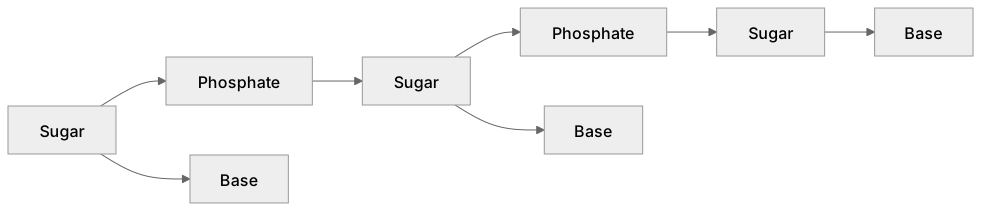
DNA (A-level only): This results in a sugar- phosphate-sugar-phosphate polymer chain with bases attached to the sugars in the chain.
Every second unit along the chain is a sugar and every other one a phosphate, so the backbone repeats and carries no information at all.
Checked against the AQA 7405 specification (opens in a new tab) on .
- Point 4 of 5
- 4 key terms
Study notes
From the checked teaching notes for this specification point.
The idea
Every second unit along the chain is a sugar and every other one a phosphate, so the backbone repeats and carries no information at all. Everything that distinguishes one gene from another is the order of the bases hanging off those sugars. After forming two ester links a phosphate still keeps one ionisable OH, and at the pH inside a cell that group loses its proton, so the backbone is a chain of negative charges. It is therefore strongly attracted to water, which is why the backbone faces outwards while the flat, far less polar bases point inwards. That is a neat piece of structure-and-property reasoning, and it also puts the bases exactly where they can hydrogen bond to a partner strand.
What earns the marks
- Describing the backbone as alternating sugar and phosphate units.
- The bases being attached to the sugars rather than to the phosphates.
- Stating that the base sequence, not the backbone, carries the information.
- Linking the negative charge on the phosphates to the backbone facing the aqueous surroundings.
Common mistakes and how to put them right
Drawing the bases hanging off the phosphate groups.
Drawing an alternating base and sugar chain with the phosphates as side groups.
Claiming the backbone differs between organisms.
Describing the phosphate group as neutral at the pH inside a cell.
Exam tips
- Sketch three repeat units rather than one; the alternation only becomes visible once the chain repeats.
- Label the backbone and the bases separately on a diagram so the examiner can see which part you mean.
- When a question asks what the chain results in, it wants the pattern, so name sugar and phosphate in the order they alternate.
Try the lesson
The start of the DNA (A-level only): This results in a sugar- phosphate-sugar-phosphate polymer chain with bases attached to the sugars in the chain. lesson, made from checked teaching notes for this specification point.
Have a go first
In a single strand of DNA, to which part of the polymer chain are the nitrogenous bases attached?
Listen
Every second unit along the chain is a sugar and every other one a phosphate, so the backbone repeats and carries no information at all. Everything that distinguishes one gene from another is the order of the bases hanging off those sugars. After forming two ester links a phosphate still keeps one ionisable OH, and at the pH inside a cell that group loses its proton, so the backbone is a chain of negative charges. It is therefore strongly attracted to water, which is why the backbone faces outwards while the flat, far less polar bases point inwards. That is a neat piece of structure-and-property reasoning, and it also puts the bases exactly where they can hydrogen bond to a partner strand. A strong answer earns marks for these points. describing the backbone as alternating sugar and phosphate units. the bases being attached to the sugars rather than to the phosphates. stating that the base sequence, not the backbone, carries the information. linking the negative charge on the phosphates to the backbone facing the aqueous surroundings. Exam tip: Sketch three repeat units rather than one; the alternation only becomes visible once the chain repeats.
See it
Key words
Say what each word means before you turn the card.
alternating backbone
Try answering aloud or in your head before turning the card.
base sequence stores information
Try answering aloud or in your head before turning the card.
charged phosphate groups
Try answering aloud or in your head before turning the card.
polar backbone faces water
Try answering aloud or in your head before turning the card.
See every definition
- alternating backbone
- A sugar-phosphate-sugar-phosphate polymer chain in which every second unit is a sugar and every other one a phosphate.
- base sequence stores information
- Everything that distinguishes one gene from another is the order of the bases hanging off the sugars, not the backbone.
- charged phosphate groups
- After forming two ester links a phosphate keeps one ionisable OH, which at the pH inside a cell loses its proton, so the backbone is a chain of negative charges.
- polar backbone faces water
- Being a chain of negative charges, the backbone is strongly attracted to water, which is why it faces outwards while the flat, far less polar bases point inwards.
There is more to this lesson
The full lesson goes on to check your understanding and help you earn the marks. Create a free account to carry on, with your progress saved.
A week of Premium from your first lesson · Then the free plan continues · No card, no charge
Test your understanding of DNA (A-level only): This results in a sugar- phosphate-sugar-phosphate polymer chain with bases attached to the sugars in the chain.
Active recall beats re-reading. Take an instant quiz now to test what you’ve learned and lock it into long-term memory.
A week of Premium from your first lesson · Then the free plan continues · No card, no charge