AQA · A-Level · Chemistry
Course version: 7405 · Version from Sept 2016
Friedel–Crafts acylation reactions are also important steps in synthesis.
Full specification wording
Electrophilic substitution (A-level only): Friedel–Crafts acylation reactions are also important steps in synthesis.
Friedel-Crafts acylation attaches an acyl group to the ring, forming a new carbon-carbon bond, which is exactly what a synthesis usually needs and what nitration cannot do.
Checked against the AQA 7405 specification (opens in a new tab) on .
- Point 3 of 4
- 4 key terms
Study notes
From the checked teaching notes for this specification point.
The idea
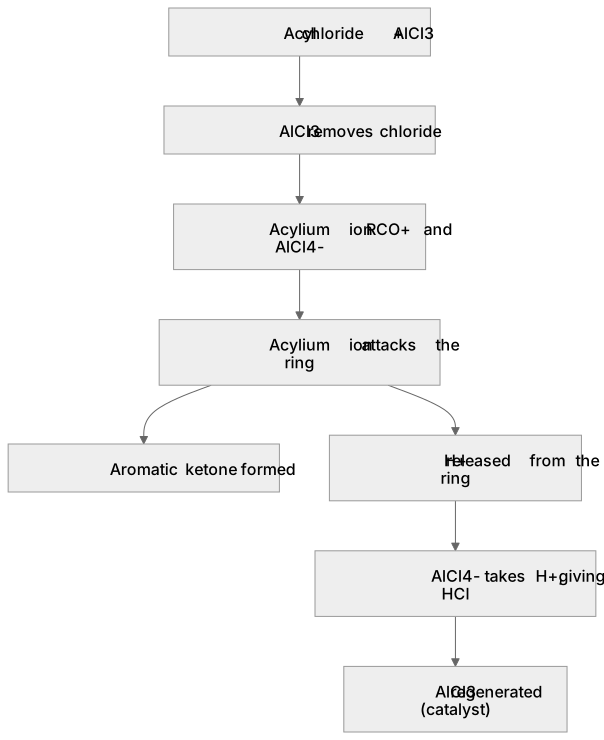
Friedel-Crafts acylation attaches an acyl group to the ring, forming a new carbon-carbon bond, which is exactly what a synthesis usually needs and what nitration cannot do. The reagents are an acyl chloride and anhydrous aluminium chloride, AlCl₃, acting as a halogen carrier. AlCl₃ pulls the chloride off the acyl chloride to give the acylium ion RCO⁺ and AlCl₄⁻; the acylium ion is the electrophile that attacks the ring. At the end AlCl₄⁻ takes the H⁺ released from the ring, giving HCl and regenerating AlCl₃, so it is a catalyst and not a reactant. The product is an aromatic ketone, which can then be reduced or built on further. Conditions must be dry, since water destroys the AlCl₃.
What earns the marks
- Aluminium chloride generating the acylium ion from the acyl chloride.
- An equation showing AlCl₄⁻ formed alongside the acylium ion.
- The aromatic ketone as the organic product.
- AlCl₃ being regenerated, so it is a catalyst rather than a reagent.
Common mistakes and how to put them right
Treating aluminium chloride as a reactant that appears in the overall equation.
Drawing the product as an ester or an aldehyde rather than a ketone.
Forgetting that the conditions must be anhydrous.
Giving HCl as the only inorganic product and omitting the regeneration of the catalyst.
Exam tips
- Write both halogen-carrier equations, the one that makes the electrophile and the one that regenerates the catalyst; they are usually a mark each.
- The acylium ion carries its positive charge on the carbon of the C=O; put it there when you draw it.
Try the lesson
The start of the Electrophilic substitution (A-level only): Friedel–Crafts acylation reactions are also important steps in synthesis. lesson, made from checked teaching notes for this specification point.
Have a go first
Which reagent reacts with benzene in the presence of AlCl₃ during a Friedel–Crafts acylation?
Listen
Friedel-Crafts acylation attaches an acyl group to the ring, forming a new carbon-carbon bond, which is exactly what a synthesis usually needs and what nitration cannot do. The reagents are an acyl chloride and anhydrous aluminium chloride, AlCl₃, acting as a halogen carrier. AlCl₃ pulls the chloride off the acyl chloride to give the acylium ion RCO⁺ and AlCl₄⁻; the acylium ion is the electrophile that attacks the ring. At the end AlCl₄⁻ takes the H⁺ released from the ring, giving HCl and regenerating AlCl₃, so it is a catalyst and not a reactant. The product is an aromatic ketone, which can then be reduced or built on further. Conditions must be dry, since water destroys the AlCl₃. A strong answer earns marks for these points. aluminium chloride generating the acylium ion from the acyl chloride. an equation showing AlCl₄⁻ formed alongside the acylium ion. the aromatic ketone as the organic product. AlCl₃ being regenerated, so it is a catalyst rather than a reagent. Exam tip: Write both halogen-carrier equations, the one that makes the electrophile and the one that regenerates the catalyst; they are usually a mark each.
See it
Key words
Say what each word means before you turn the card.
acylium ion
Try answering aloud or in your head before turning the card.
halogen carrier
Try answering aloud or in your head before turning the card.
carbon-carbon bond formation
Try answering aloud or in your head before turning the card.
anhydrous conditions
Try answering aloud or in your head before turning the card.
See every definition
- acylium ion
- The electrophile RCO⁺ that attacks the ring, produced when AlCl₃ pulls the chloride off the acyl chloride.
- halogen carrier
- The role of anhydrous aluminium chloride, AlCl₃, in the reaction.
- carbon-carbon bond formation
- What Friedel-Crafts acylation does by attaching an acyl group to the ring, which is what a synthesis usually needs.
- anhydrous conditions
- Conditions that must be dry, since water destroys the AlCl₃.
Label the diagram
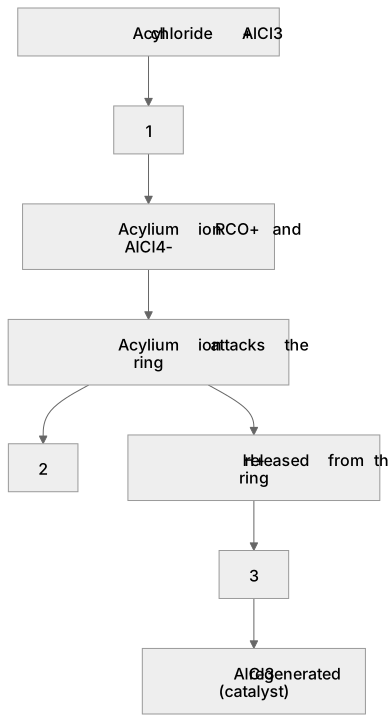
Some boxes have lost their names. Pick the right name for each number.
1Box 1
2Box 2
3Box 3
There is more to this lesson
The full lesson goes on to check your understanding and help you earn the marks. Create a free account to carry on, with your progress saved.
A week of Premium from your first lesson · Then the free plan continues · No card, no charge
Test your understanding of Electrophilic substitution (A-level only): Friedel–Crafts acylation reactions are also important steps in synthesis.
Active recall beats re-reading. Take an instant quiz now to test what you’ve learned and lock it into long-term memory.
A week of Premium from your first lesson · Then the free plan continues · No card, no charge