AQA · A-Level · Chemistry
Course version: 7405 · Version from Sept 2016
Students should be able to outline the electrophilic substitution…
Full specification wording
Electrophilic substitution (A-level only): Students should be able to outline the electrophilic substitution mechanisms of: nitration, including the generation of the nitronium ion acylation using AlCl as a catalyst.
Both mechanisms begin by making the electrophile.
Checked against the AQA 7405 specification (opens in a new tab) on .
- Point 4 of 4
- 4 key terms
Study notes
From the checked teaching notes for this specification point.
The idea
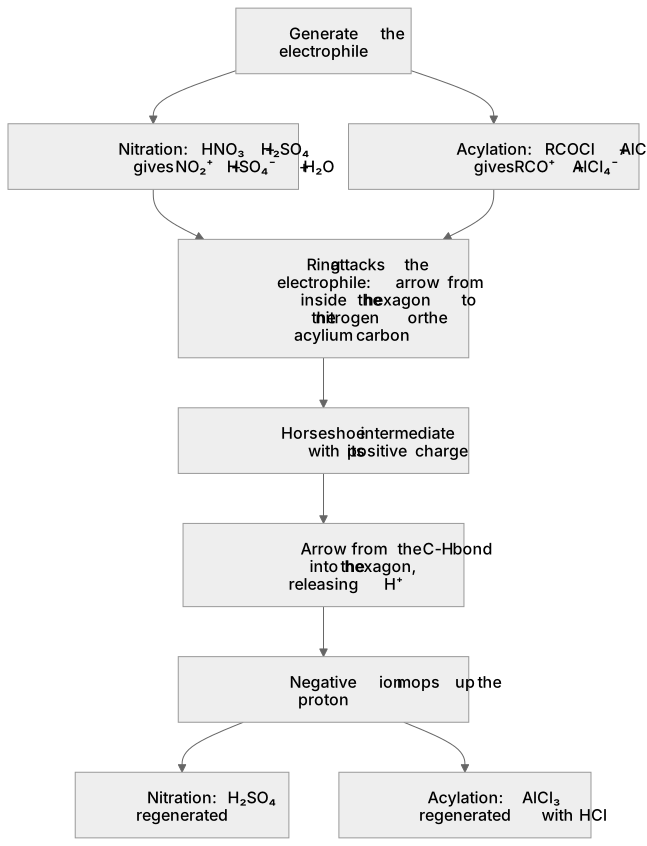
Both mechanisms begin by making the electrophile. For nitration the two concentrated acids react, HNO₃ + H₂SO₄ giving NO₂⁺ + HSO₄⁻ + H₂O, and the positive charge in the nitronium ion sits on the nitrogen atom. For acylation, RCOCl + AlCl₃ gives RCO⁺ + AlCl₄⁻. Then the ring attacks: a curly arrow runs from inside the hexagon to the nitrogen or to the acylium carbon, giving the horseshoe intermediate with its positive charge. A second arrow runs from the C-H bond at that carbon back into the hexagon, releasing H⁺. The negative ion mops up that proton, regenerating H₂SO₄ in the nitration and AlCl₃ with HCl in the acylation.
What earns the marks
- The equation generating the nitronium ion from the two concentrated acids.
- The electrophile drawn with the positive charge on the nitrogen atom of NO₂⁺.
- The curly arrow from inside the hexagon to the nitrogen or to the positive charge.
- The curly arrow from the C-H bond into the hexagon.
- The equation that regenerates the catalyst using the H⁺ released.
Common mistakes and how to put them right
Putting the positive charge of the nitronium ion on an oxygen atom.
Drawing the attacking arrow from a Kekulé double bond instead of from inside the ring.
Omitting the hydrogen from the attacked carbon of the intermediate, leaving no C-H bond for the second arrow.
Regenerating the catalyst without accounting for the H⁺ that was released.
Exam tips
- Every curly arrow starts from a lone pair or a bond; an arrow drawn from a charge symbol is penalised each time.
- If you use skeletal formulae in a mechanism and a C-H bond breaks, you must draw in both that bond and the H to earn the mark.
Try the lesson
The start of the Electrophilic substitution (A-level only): Students should be able to outline the electrophilic substitution mechanisms of: nitration, including the generation of the nitronium ion acylation using AlCl as a catalyst. lesson, made from checked teaching notes for this specification point.
Have a go first
Which reagent mixture is used to generate the nitronium ion for the nitration of benzene?
Listen
Both mechanisms begin by making the electrophile. For nitration the two concentrated acids react, HNO₃ + H₂SO₄ giving NO₂⁺ + HSO₄⁻ + H₂O, and the positive charge in the nitronium ion sits on the nitrogen atom. For acylation, RCOCl + AlCl₃ gives RCO⁺ + AlCl₄⁻. Then the ring attacks: a curly arrow runs from inside the hexagon to the nitrogen or to the acylium carbon, giving the horseshoe intermediate with its positive charge. A second arrow runs from the C-H bond at that carbon back into the hexagon, releasing H⁺. The negative ion mops up that proton, regenerating H₂SO₄ in the nitration and AlCl₃ with HCl in the acylation. A strong answer earns marks for these points. the equation generating the nitronium ion from the two concentrated acids. the electrophile drawn with the positive charge on the nitrogen atom of NO₂⁺. the curly arrow from inside the hexagon to the nitrogen or to the positive charge. the curly arrow from the C-H bond into the hexagon. Exam tip: Every curly arrow starts from a lone pair or a bond; an arrow drawn from a charge symbol is penalised each time.
See it
Key words
Say what each word means before you turn the card.
nitronium ion generation
Try answering aloud or in your head before turning the card.
acylium ion
Try answering aloud or in your head before turning the card.
curly arrow mechanism
Try answering aloud or in your head before turning the card.
horseshoe intermediate
Try answering aloud or in your head before turning the card.
See every definition
- nitronium ion generation
- The two concentrated acids react, HNO₃ + H₂SO₄ giving NO₂⁺ + HSO₄⁻ + H₂O, with the positive charge sitting on the nitrogen atom.
- acylium ion
- Formed when RCOCl + AlCl₃ gives RCO⁺ + AlCl₄⁻, with AlCl₃ acting as a catalyst.
- curly arrow mechanism
- An arrow runs from inside the hexagon to the nitrogen or to the acylium carbon, then a second arrow runs from the C-H bond at that carbon back into the hexagon, releasing H⁺.
- horseshoe intermediate
- The species formed when the ring attacks the electrophile, carrying its positive charge.
Label the diagram
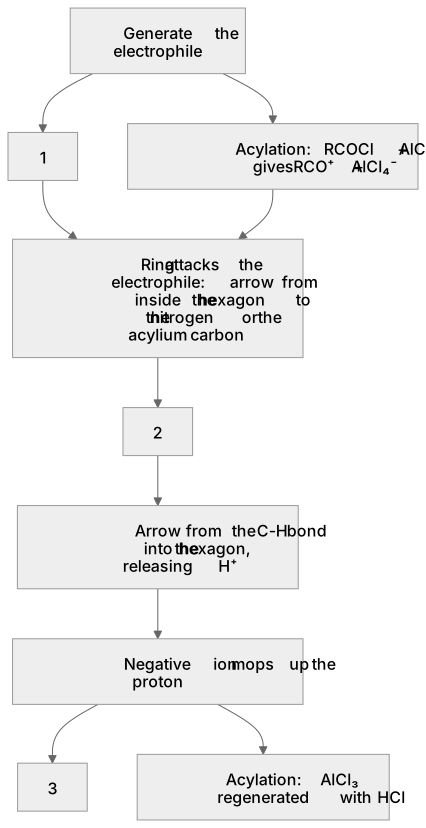
Some boxes have lost their names. Pick the right name for each number.
1Box 1
2Box 2
3Box 3
There is more to this lesson
The full lesson goes on to check your understanding and help you earn the marks. Create a free account to carry on, with your progress saved.
A week of Premium from your first lesson · Then the free plan continues · No card, no charge
Test your understanding of Electrophilic substitution (A-level only): Students should be able to outline the electrophilic substitution mechanisms of: nitration, including the generation of the nitronium ion acylation using AlCl as a catalyst.
Active recall beats re-reading. Take an instant quiz now to test what you’ve learned and lock it into long-term memory.
A week of Premium from your first lesson · Then the free plan continues · No card, no charge