AQA · A-Level · Chemistry
Course version: 7405 · Version from Sept 2016
Alkenes can be formed from alcohols by acid-catalysed elimination reactions.
Full specification wording
Elimination: Alkenes can be formed from alcohols by acid-catalysed elimination reactions.
Heating an alcohol with an acid catalyst removes water across two adjacent carbons and leaves a double bond: ethanol gives ethene, CH₃CH₂OH → CH₂=CH₂ + H₂O. Concentrated sulfuric or phosphoric…
Checked against the AQA 7405 specification (opens in a new tab) on .
- Point 2 of 5
- 3 key terms
Study notes
From the checked teaching notes for this specification point.
The idea
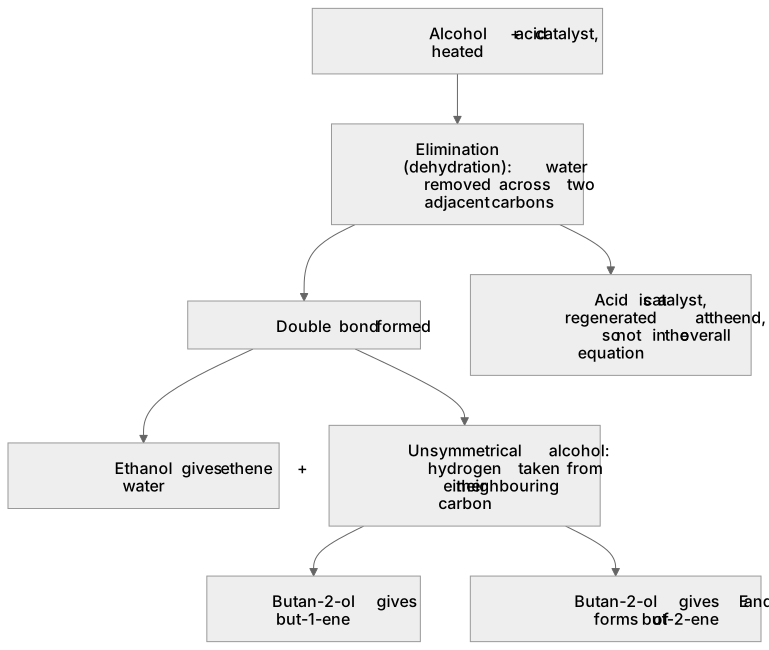
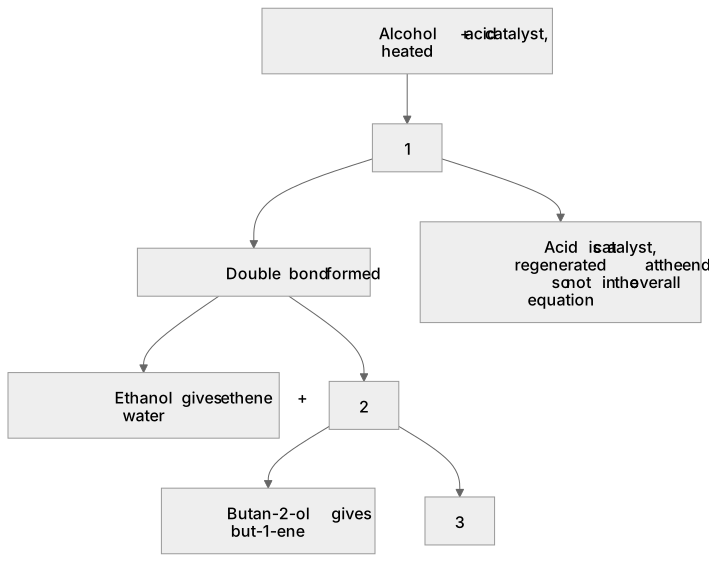
Heating an alcohol with an acid catalyst removes water across two adjacent carbons and leaves a double bond: ethanol gives ethene, CH₃CH₂OH → CH₂=CH₂ + H₂O. Concentrated sulfuric or phosphoric acid is used, or the vapour is passed over hot aluminium oxide. The acid is a catalyst, regenerated at the end, so it does not belong on either side of the overall equation. Because the hydrogen can be taken from either neighbouring carbon, an unsymmetrical alcohol gives more than one alkene: butan-2-ol gives but-1-ene and both E and Z forms of but-2-ene. The reaction is classed as elimination, and specifically as dehydration, because the fragment lost is a whole water molecule.
What earns the marks
- Naming concentrated sulfuric or phosphoric acid as catalyst, with heating.
- The balanced equation showing the alkene and water.
- Naming the reaction type as elimination, or dehydration.
- Identifying all the possible alkenes from an unsymmetrical alcohol, including E and Z isomers.
Common mistakes and how to put them right
Writing the acid as a reactant that is consumed in the overall equation.
Leaving water out of the products.
Giving only one alkene from butan-2-ol, missing but-1-ene or one of the E-Z pair.
Calling the reaction substitution because the hydroxyl group has gone.
Exam tips
- Before answering, mark every carbon next to the hydroxyl carbon that carries a hydrogen; each gives a product.
- Check for E-Z isomerism in each alkene you produce, since it is often worth a separate mark.
- Say the acid is a catalyst if asked why it does not appear in the equation.
Try the lesson
The start of the Elimination: Alkenes can be formed from alcohols by acid-catalysed elimination reactions. lesson, made from checked teaching notes for this specification point.
Have a go first
Which reagent is used to convert ethanol into ethene by acid-catalysed elimination?
Listen
Heating an alcohol with an acid catalyst removes water across two adjacent carbons and leaves a double bond: ethanol gives ethene, CH₃CH₂OH → CH₂=CH₂ + H₂O. Concentrated sulfuric or phosphoric acid is used, or the vapour is passed over hot aluminium oxide. The acid is a catalyst, regenerated at the end, so it does not belong on either side of the overall equation. Because the hydrogen can be taken from either neighbouring carbon, an unsymmetrical alcohol gives more than one alkene: butan-2-ol gives but-1-ene and both E and Z forms of but-2-ene. The reaction is classed as elimination, and specifically as dehydration, because the fragment lost is a whole water molecule. A strong answer earns marks for these points. naming concentrated sulfuric or phosphoric acid as catalyst, with heating. the balanced equation showing the alkene and water. naming the reaction type as elimination, or dehydration. identifying all the possible alkenes from an unsymmetrical alcohol, including E and Z isomers. Exam tip: Before answering, mark every carbon next to the hydroxyl carbon that carries a hydrogen; each gives a product.
See it
Key words
Say what each word means before you turn the card.
dehydration of alcohols
Try answering aloud or in your head before turning the card.
elimination of water
Try answering aloud or in your head before turning the card.
more than one alkene
Try answering aloud or in your head before turning the card.
See every definition
- dehydration of alcohols
- A reaction in which an alcohol is heated with an acid catalyst so that a whole water molecule is lost and a double bond is left.
- elimination of water
- The reaction type in which water is removed across two adjacent carbons, leaving a double bond, and which is classed as elimination.
- more than one alkene
- The result when an unsymmetrical alcohol reacts, because the hydrogen can be taken from either neighbouring carbon, giving products such as but-1-ene and both E and Z forms of but-2-ene.
Label the diagram
Some boxes have lost their names. Pick the right name for each number.
1Box 1
2Box 2
3Box 3
There is more to this lesson
The full lesson goes on to check your understanding and help you earn the marks. Create a free account to carry on, with your progress saved.
A week of Premium from your first lesson · Then the free plan continues · No card, no charge
Test your understanding of Elimination: Alkenes can be formed from alcohols by acid-catalysed elimination reactions.
Active recall beats re-reading. Take an instant quiz now to test what you’ve learned and lock it into long-term memory.
A week of Premium from your first lesson · Then the free plan continues · No card, no charge