AQA · A-Level · Chemistry
Course version: 7405 · Version from Sept 2016
The concurrent substitution and elimination reactions of a halogenoalkane…
Full specification wording
Elimination: The concurrent substitution and elimination reactions of a halogenoalkane (eg 2-bromopropane with potassium hydroxide).
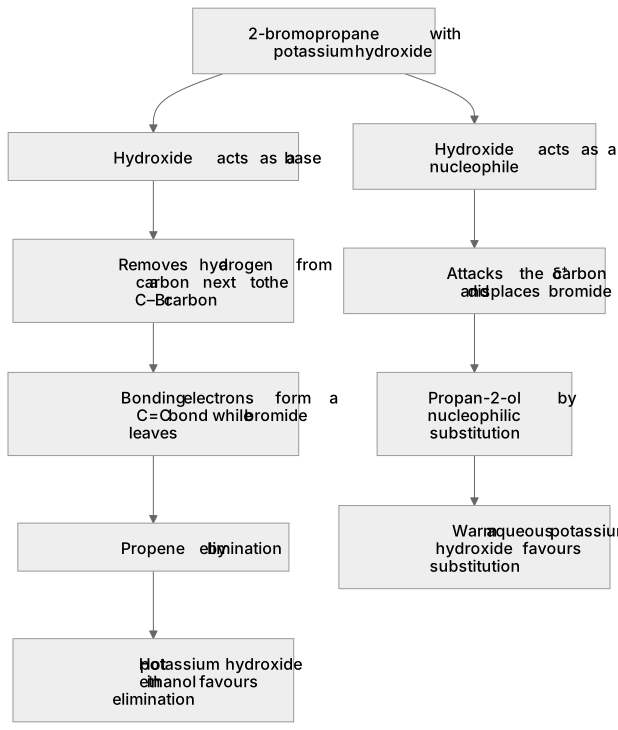
Hydroxide ion can behave in two ways towards 2-bromopropane, and both happen at the same time.
Checked against the AQA 7405 specification (opens in a new tab) on .
- Point 1 of 5
- 3 key terms
Study notes
From the checked teaching notes for this specification point.
The idea
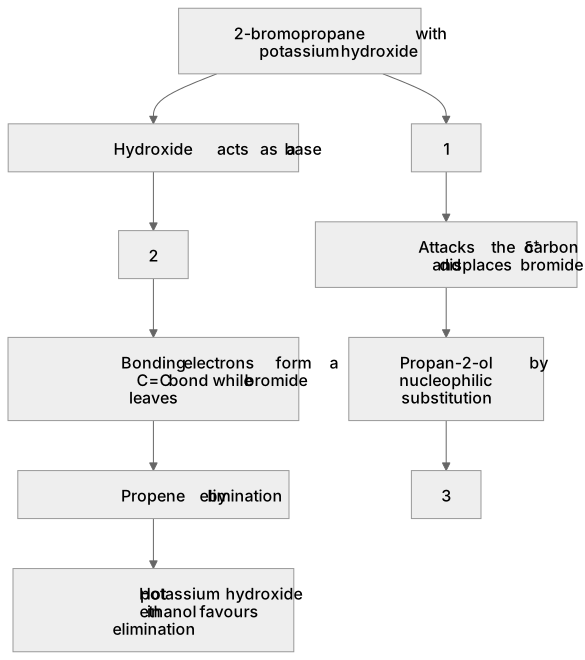
Hydroxide ion can behave in two ways towards 2-bromopropane, and both happen at the same time. As a nucleophile it attacks the δ⁺ carbon and displaces bromide, giving propan-2-ol by nucleophilic substitution. As a base it removes a hydrogen from a carbon next to the C–Br carbon; those bonding electrons swing in to form a C=C bond while bromide leaves, giving propene by elimination. Conditions shift the balance rather than switching one route off: warm aqueous potassium hydroxide favours substitution, while hot potassium hydroxide dissolved in ethanol favours elimination. Exam answers must name both mechanisms correctly and say which role the hydroxide is playing in each, since the same reagent is doing two different jobs.
What earns the marks
- Naming elimination as the route to the alkene and nucleophilic substitution as the route to the alcohol.
- Stating that hydroxide acts as a base in one reaction and as a nucleophile in the other.
- The conditions that favour each route, aqueous and warm against ethanolic and hot.
- The three curly arrows in the elimination, including the arrow from the C–H bond into the C–C bond.
Common mistakes and how to put them right
Assuming two different reagents are used, when the same potassium hydroxide does both jobs.
Naming the alkene route "nucleophilic elimination", which contradicts the base role of the hydroxide.
Drawing the hydroxide arrow to the carbon instead of to the hydrogen in the elimination.
Writing that changing the solvent stops one reaction entirely rather than changing the proportions.
Exam tips
- Name the solvent, not just the reagent: "KOH in ethanol" and "KOH(aq)" are what distinguish the two answers.
- Label which hydrogen you are removing; from 2-bromopropane it must come from a CH₃ group.
- If a question says "concurrent", it expects both products, so give both and say which conditions favour which.
Try the lesson
The start of the Elimination: The concurrent substitution and elimination reactions of a halogenoalkane (eg 2-bromopropane with potassium hydroxide). lesson, made from checked teaching notes for this specification point.
Have a go first
When 2-bromopropane reacts with potassium hydroxide dissolved in ethanol, two organic products are formed. Which pair of products is formed?
Listen
Hydroxide ion can behave in two ways towards 2-bromopropane, and both happen at the same time. As a nucleophile it attacks the δ⁺ carbon and displaces bromide, giving propan-2-ol by nucleophilic substitution. As a base it removes a hydrogen from a carbon next to the C–Br carbon; those bonding electrons swing in to form a C=C bond while bromide leaves, giving propene by elimination. Conditions shift the balance rather than switching one route off: warm aqueous potassium hydroxide favours substitution, while hot potassium hydroxide dissolved in ethanol favours elimination. Exam answers must name both mechanisms correctly and say which role the hydroxide is playing in each, since the same reagent is doing two different jobs. A strong answer earns marks for these points. naming elimination as the route to the alkene and nucleophilic substitution as the route to the alcohol. stating that hydroxide acts as a base in one reaction and as a nucleophile in the other. the conditions that favour each route, aqueous and warm against ethanolic and hot. the three curly arrows in the elimination, including the arrow from the C–H bond into the C–C bond. Exam tip: Name the solvent, not just the reagent: "KOH in ethanol" and "KOH(aq)" are what distinguish the two answers.
See it
Key words
Say what each word means before you turn the card.
competing reactions
Try answering aloud or in your head before turning the card.
role of solvent
Try answering aloud or in your head before turning the card.
elimination to an alkene
Try answering aloud or in your head before turning the card.
See every definition
- competing reactions
- The concurrent substitution and elimination reactions of a halogenoalkane, such as 2-bromopropane with potassium hydroxide, both happening at the same time.
- role of solvent
- Conditions shift the balance rather than switching one route off: warm aqueous potassium hydroxide favours substitution, while hot potassium hydroxide dissolved in ethanol favours elimination.
- elimination to an alkene
- As a base the hydroxide removes a hydrogen from a carbon next to the C–Br carbon, and those bonding electrons swing in to form a C=C bond while bromide leaves, giving propene.
Label the diagram
Some boxes have lost their names. Pick the right name for each number.
1Box 1
2Box 2
3Box 3
There is more to this lesson
The full lesson goes on to check your understanding and help you earn the marks. Create a free account to carry on, with your progress saved.
A week of Premium from your first lesson · Then the free plan continues · No card, no charge
Test your understanding of Elimination: The concurrent substitution and elimination reactions of a halogenoalkane (eg 2-bromopropane with potassium hydroxide).
Active recall beats re-reading. Take an instant quiz now to test what you’ve learned and lock it into long-term memory.
A week of Premium from your first lesson · Then the free plan continues · No card, no charge