AQA · A-Level · Chemistry
Course version: 7405 · Version from Sept 2016
Enthalpy change (∆H) is the heat energy change measured under conditions…
Full specification wording
Enthalpy change: Enthalpy change (∆H) is the heat energy change measured under conditions of constant pressure.
Enthalpy, H, is the heat content of a system at constant pressure, and ∆H is the difference H(products) − H(reactants).
Checked against the AQA 7405 specification (opens in a new tab) on .
- Point 2 of 3
- 4 key terms
Study notes
From the checked teaching notes for this specification point.
The idea
Enthalpy, H, is the heat content of a system at constant pressure, and ∆H is the difference H(products) − H(reactants). The constant pressure condition matters because a reaction that produces gas does work pushing back the atmosphere; measure the heat in a sealed rigid vessel and you get a slightly different quantity. Reactions done in an open beaker or a polystyrene cup happen at constant atmospheric pressure, so the heat measured there is the enthalpy change directly. Enthalpy itself cannot be measured, only the change, which is why every value is quoted relative to a defined starting point and per mole of a specified substance, in kJ mol⁻¹. Examiners accept heat change at constant pressure but refuse heat change or energy change on its own.
What earns the marks
- Defining ∆H as the heat energy change measured at constant pressure.
- Stating that ∆H is the enthalpy of the products minus the enthalpy of the reactants.
- Quoting the change per mole with units kJ mol⁻¹ and a sign.
- Recognising that a reaction carried out in an open vessel is at constant pressure, so the heat measured is ∆H.
Common mistakes and how to put them right
Defining ∆H as simply the heat change or the energy change, which is refused because the constant pressure condition is missing.
Writing reactants minus products, which flips the sign of every answer.
Treating enthalpy as something a substance possesses a measurable absolute amount of, rather than something only measurable as a change.
Omitting per mole, so a heat output in joules is offered as an enthalpy change.
Assuming ∆H changes if the amounts are doubled, rather than the total heat released doubling while ∆H per mole stays fixed.
Exam tips
- Learn the phrase at constant pressure; it is the marking point that separates a full definition from a half one.
- Check units before you write a value: joules for a heat change q, kilojoules per mole for an enthalpy change ∆H.
- State what the mole refers to, for example per mole of methane burned, when the equation contains several substances.
Try the lesson
The start of the Enthalpy change: Enthalpy change (∆H) is the heat energy change measured under conditions of constant pressure. lesson, made from checked teaching notes for this specification point.
Have a go first
Which statement correctly describes the standard definition of an enthalpy change, ∆H?
Listen
Enthalpy, H, is the heat content of a system at constant pressure, and ∆H is the difference H(products) − H(reactants). The constant pressure condition matters because a reaction that produces gas does work pushing back the atmosphere; measure the heat in a sealed rigid vessel and you get a slightly different quantity. Reactions done in an open beaker or a polystyrene cup happen at constant atmospheric pressure, so the heat measured there is the enthalpy change directly. Enthalpy itself cannot be measured, only the change, which is why every value is quoted relative to a defined starting point and per mole of a specified substance, in kJ mol⁻¹. Examiners accept heat change at constant pressure but refuse heat change or energy change on its own. A strong answer earns marks for these points. defining ∆H as the heat energy change measured at constant pressure. stating that ∆H is the enthalpy of the products minus the enthalpy of the reactants. quoting the change per mole with units kJ mol⁻¹ and a sign. recognising that a reaction carried out in an open vessel is at constant pressure, so the heat measured is ∆H. Exam tip: Learn the phrase at constant pressure; it is the marking point that separates a full definition from a half one.
See it
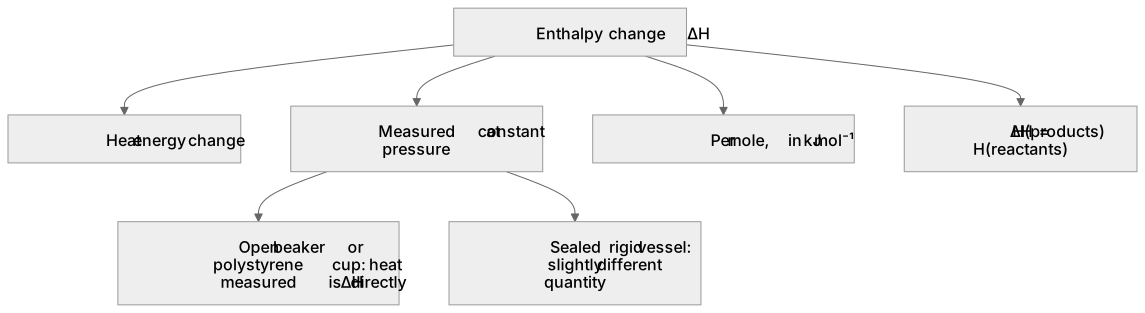
Key words
Say what each word means before you turn the card.
enthalpy change
Try answering aloud or in your head before turning the card.
constant pressure
Try answering aloud or in your head before turning the card.
products minus reactants
Try answering aloud or in your head before turning the card.
per mole quantities
Try answering aloud or in your head before turning the card.
See every definition
- enthalpy change
- The heat energy change measured under conditions of constant pressure.
- constant pressure
- The condition under which enthalpy change is measured, as in an open beaker or a polystyrene cup at constant atmospheric pressure.
- products minus reactants
- The difference H(products) − H(reactants) that gives ∆H.
- per mole quantities
- The basis on which every enthalpy value is quoted, relative to a defined starting point and per mole of a specified substance, in kJ mol⁻¹.
Label the diagram
Some boxes have lost their names. Pick the right name for each number.
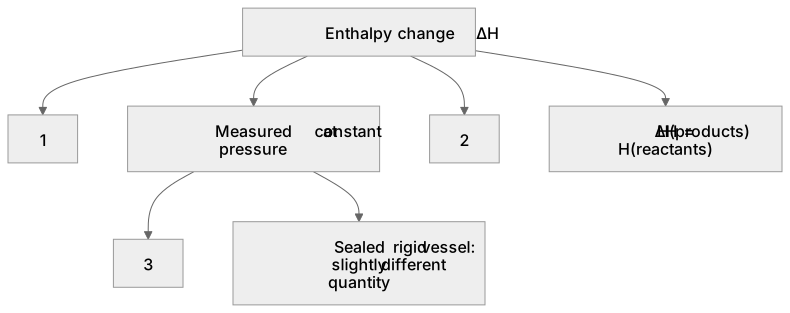
1Box 1
2Box 2
3Box 3
There is more to this lesson
The full lesson goes on to check your understanding and help you earn the marks. Create a free account to carry on, with your progress saved.
A week of Premium from your first lesson · Then the free plan continues · No card, no charge
Test your understanding of Enthalpy change: Enthalpy change (∆H) is the heat energy change measured under conditions of constant pressure.
Active recall beats re-reading. Take an instant quiz now to test what you’ve learned and lock it into long-term memory.
A week of Premium from your first lesson · Then the free plan continues · No card, no charge