AQA · A-Level · Chemistry
Course version: 7405 · Version from Sept 2016
Enthalpy change: Reactions can be endothermic or exothermic.
Every reaction breaks bonds and makes bonds.
Checked against the AQA 7405 specification (opens in a new tab) on .
- Point 1 of 3
- 4 key terms
Study notes
From the checked teaching notes for this specification point.
The idea
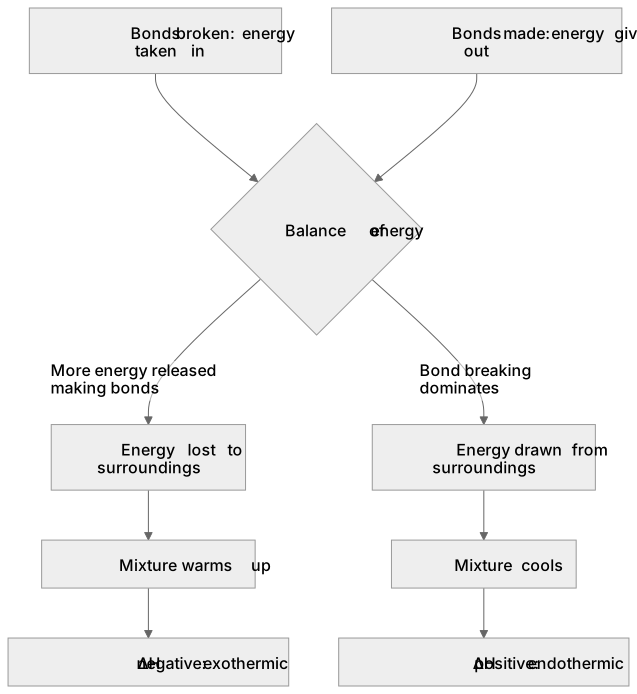
Every reaction breaks bonds and makes bonds. Breaking bonds takes energy in, making bonds gives energy out, and the sign of ∆H records the balance. If more energy is released forming the new bonds than was needed to break the old ones, the system loses energy to the surroundings, the mixture warms up and ∆H is negative: combustion and neutralisation behave this way. If bond breaking dominates, energy is drawn from the surroundings, the mixture cools and ∆H is positive, as when ammonium nitrate dissolves in water. On an enthalpy profile the products sit below the reactants for an exothermic change and above them for an endothermic one, and both profiles still show an activation energy hump, because energy is always needed to start breaking bonds.
What earns the marks
- Stating that a reaction is exothermic because more energy is released making bonds than is taken in breaking them.
- Linking a temperature rise in the surroundings to a negative ∆H, or a temperature fall to a positive ∆H.
- An enthalpy profile with products drawn below the reactants for an exothermic change, with ∆H labelled between the two levels.
- Describing an experimental combustion value as less exothermic or less negative, rather than just smaller, when comparing with a data book value.
Common mistakes and how to put them right
Writing that bond breaking releases energy and bond making absorbs it, which reverses the sign of every answer that follows.
Calling a reaction exothermic because the flask felt cold, confusing the system with the surroundings.
Quoting an exothermic enthalpy change without the minus sign, so −890 kJ mol⁻¹ is written as 890 kJ mol⁻¹.
Saying an endothermic reaction is impossible because it takes energy in, rather than checking the entropy term.
Assuming an exothermic reaction needs no activation energy, so no hump is drawn on the profile.
Exam tips
- Fix the sign by asking which way heat travels: out of the system means negative, into the system means positive.
- If a question asks how a measured value differs from a data book value, answer less exothermic and give a reason such as incomplete combustion or heat loss to the surroundings.
- Always give an enthalpy change a sign and the units kJ mol⁻¹; an unsigned number can be read either way and loses the mark.
Try the lesson
The start of the Enthalpy change: Reactions can be endothermic or exothermic. lesson, made from checked teaching notes for this specification point.
Have a go first
In an exothermic reaction, what happens to the temperature of the surroundings?
Listen
Every reaction breaks bonds and makes bonds. Breaking bonds takes energy in, making bonds gives energy out, and the sign of ∆H records the balance. If more energy is released forming the new bonds than was needed to break the old ones, the system loses energy to the surroundings, the mixture warms up and ∆H is negative: combustion and neutralisation behave this way. If bond breaking dominates, energy is drawn from the surroundings, the mixture cools and ∆H is positive, as when ammonium nitrate dissolves in water. On an enthalpy profile the products sit below the reactants for an exothermic change and above them for an endothermic one, and both profiles still show an activation energy hump, because energy is always needed to start breaking bonds. A strong answer earns marks for these points. stating that a reaction is exothermic because more energy is released making bonds than is taken in breaking them. linking a temperature rise in the surroundings to a negative ∆H, or a temperature fall to a positive ∆H. an enthalpy profile with products drawn below the reactants for an exothermic change, with ∆H labelled between the two levels. describing an experimental combustion value as less exothermic or less negative, rather than just smaller, when comparing with a data book value. Exam tip: Fix the sign by asking which way heat travels: out of the system means negative, into the system means positive.
See it
Key words
Say what each word means before you turn the card.
bond breaking is endothermic
Try answering aloud or in your head before turning the card.
bond making is exothermic
Try answering aloud or in your head before turning the card.
sign of ∆H
Try answering aloud or in your head before turning the card.
enthalpy profiles
Try answering aloud or in your head before turning the card.
See every definition
- bond breaking is endothermic
- Breaking bonds takes energy in, and if bond breaking dominates, energy is drawn from the surroundings and the mixture cools.
- bond making is exothermic
- Making bonds gives energy out, and if more energy is released forming the new bonds than was needed to break the old ones, the system loses energy to the surroundings.
- sign of ∆H
- The sign records the balance: negative when the system loses energy to the surroundings, positive when energy is drawn from the surroundings.
- enthalpy profiles
- On these the products sit below the reactants for an exothermic change and above them for an endothermic one, and both still show an activation energy hump.
There is more to this lesson
The full lesson goes on to check your understanding and help you earn the marks. Create a free account to carry on, with your progress saved.
A week of Premium from your first lesson · Then the free plan continues · No card, no charge
Test your understanding of Enthalpy change: Reactions can be endothermic or exothermic.
Active recall beats re-reading. Take an instant quiz now to test what you’ve learned and lock it into long-term memory.
A week of Premium from your first lesson · Then the free plan continues · No card, no charge