AQA · A-Level · Chemistry
Course version: 7405 · Version from Sept 2016
Colour arises when some of the wavelengths of visible light are absorbed…
Full specification wording
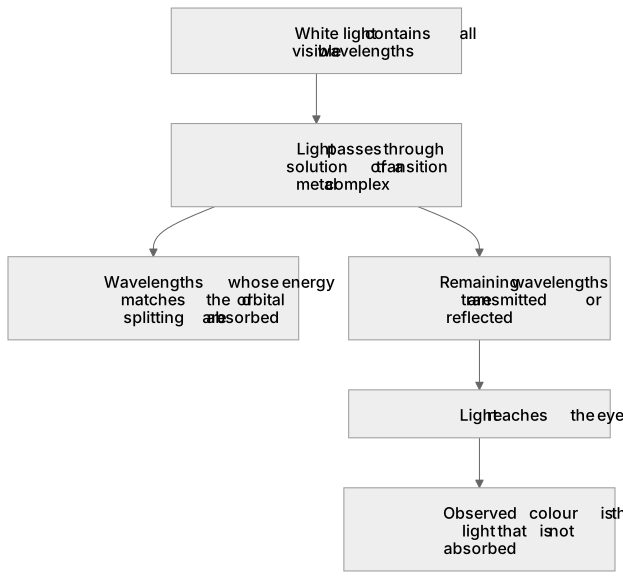
Formation of coloured ions (A-level only): Colour arises when some of the wavelengths of visible light are absorbed and the remaining wavelengths of light are transmitted or reflected.
White light contains all the visible wavelengths.
Checked against the AQA 7405 specification (opens in a new tab) on .
- Point 2 of 6
- 4 key terms
Study notes
From the checked teaching notes for this specification point.
The idea
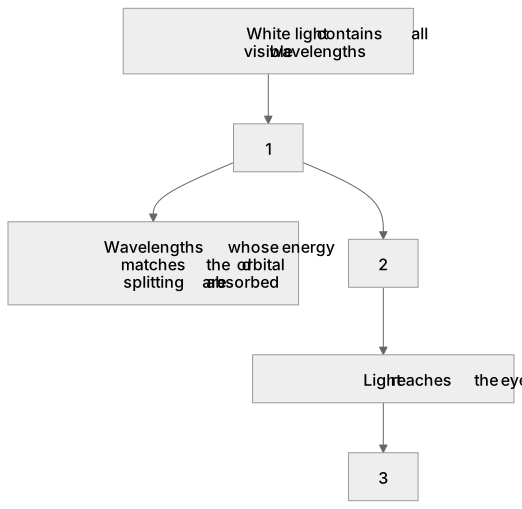
White light contains all the visible wavelengths. When it passes through a solution of a transition metal complex, the frequencies whose energy matches the d orbital splitting are absorbed, and the light that reaches your eye is what is left over, transmitted through the solution or reflected from a solid. The colour you see is therefore the complement of the colour absorbed. A solution of [CuCl₄]²⁻ looks yellow because everything except yellow light has been removed, and the mark scheme for exactly that question awards one mark for saying visible light is absorbed and another for saying only yellow light is transmitted or reflected. Note the two traps: the complex does not absorb yellow light, and it does not emit light.
What earns the marks
- Stating that visible or white light is absorbed as d electrons are excited.
- Stating that the remaining wavelengths are transmitted or reflected to the eye.
- Naming the observed colour as the light that is not absorbed.
- Referring to light explicitly in at least one of those statements.
Common mistakes and how to put them right
Writing that a yellow solution absorbs yellow light, which the mark scheme specifically rejects.
Saying the complex emits the colour you see rather than transmitting or reflecting it.
Describing the absorption without ever using the word light, which fails the mark scheme requirement.
Claiming all wavelengths are absorbed, which would make the solution black rather than coloured.
Exam tips
- Write two clauses: what is absorbed, then what is transmitted or reflected.
- Never use the word emitted about the colour of a complex.
- Name the observed colour as the transmitted light, matching the colour given in the question.
Try the lesson
The start of the Formation of coloured ions (A-level only): Colour arises when some of the wavelengths of visible light are absorbed and the remaining wavelengths of light are transmitted or reflected. lesson, made from checked teaching notes for this specification point.
Have a go first
A solution appears green when viewed in white light. Which statement describes why the solution looks green?
Listen
White light contains all the visible wavelengths. When it passes through a solution of a transition metal complex, the frequencies whose energy matches the d orbital splitting are absorbed, and the light that reaches your eye is what is left over, transmitted through the solution or reflected from a solid. The colour you see is therefore the complement of the colour absorbed. A solution of [CuCl₄]²⁻ looks yellow because everything except yellow light has been removed, and the mark scheme for exactly that question awards one mark for saying visible light is absorbed and another for saying only yellow light is transmitted or reflected. Note the two traps: the complex does not absorb yellow light, and it does not emit light. A strong answer earns marks for these points. stating that visible or white light is absorbed as d electrons are excited. stating that the remaining wavelengths are transmitted or reflected to the eye. naming the observed colour as the light that is not absorbed. referring to light explicitly in at least one of those statements. Exam tip: Write two clauses: what is absorbed, then what is transmitted or reflected.
See it
Key words
Say what each word means before you turn the card.
absorption of visible light
Try answering aloud or in your head before turning the card.
transmitted and reflected light
Try answering aloud or in your head before turning the card.
complementary colour
Try answering aloud or in your head before turning the card.
composition of white light
Try answering aloud or in your head before turning the card.
See every definition
- absorption of visible light
- Some of the wavelengths of visible light are absorbed when light passes through a solution of a transition metal complex.
- transmitted and reflected light
- The remaining wavelengths of light that are not absorbed are transmitted through the solution or reflected from a solid.
- complementary colour
- The colour you see is the complement of the colour absorbed, because the absorbed wavelengths have been removed from white light.
- composition of white light
- White light contains all the visible wavelengths.
Label the diagram
Some boxes have lost their names. Pick the right name for each number.
1Box 1
2Box 2
3Box 3
There is more to this lesson
The full lesson goes on to check your understanding and help you earn the marks. Create a free account to carry on, with your progress saved.
A week of Premium from your first lesson · Then the free plan continues · No card, no charge
Test your understanding of Formation of coloured ions (A-level only): Colour arises when some of the wavelengths of visible light are absorbed and the remaining wavelengths of light are transmitted or reflected.
Active recall beats re-reading. Take an instant quiz now to test what you’ve learned and lock it into long-term memory.
A week of Premium from your first lesson · Then the free plan continues · No card, no charge