AQA · A-Level · Chemistry
Course version: 7405 · Version from Sept 2016
Transition metal ions can be identified by their colour.
Full specification wording
Formation of coloured ions (A-level only): Transition metal ions can be identified by their colour.
Each combination of metal, oxidation state, ligand and co-ordination number gives a different d orbital splitting and therefore a different colour, making colour a genuine identification tool.
Checked against the AQA 7405 specification (opens in a new tab) on .
- Point 1 of 6
- 4 key terms
Study notes
From the checked teaching notes for this specification point.
The idea
Each combination of metal, oxidation state, ligand and co-ordination number gives a different d orbital splitting and therefore a different colour, making colour a genuine identification tool. Learn the aqueous ions first: [Cu(H₂O)₆]²⁺ is blue, [Fe(H₂O)₆]²⁺ pale green, [Co(H₂O)₆]²⁺ pink, [Cr(H₂O)₆]³⁺ ruby/green and [Mn(H₂O)₆]²⁺ very pale pink. For [Fe(H₂O)₆]³⁺, the pure ion is purple, but it often appears yellow or orange-brown in solution due to hydrolysis; AQA accepts these colours. Then learn the changes: excess ammonia turns copper(II) deep blue as [Cu(NH₃)₄(H₂O)₂]²⁺ forms, concentrated hydrochloric acid turns it yellow as [CuCl₄]²⁻ forms, and cobalt(II) goes from pink to blue. Oxidation state matters too, since MnO₄⁻ is purple while Mn²⁺ is almost colourless.
What earns the marks
- The correct colour of a named aqueous transition metal ion.
- The colour of the product complex after a named reagent has been added.
- Identifying the ion present from a described colour and a stated colour change.
- Naming the change responsible, such as a change of ligand or of oxidation state.
Common mistakes and how to put them right
Describing a solution colour as a precipitate colour, or the other way round.
Writing clear instead of colourless, which examiners will not accept as a colour.
Assuming every transition metal ion is intensely coloured, when Mn²⁺ is very pale and Zn²⁺ is not a transition metal ion at all.
Confusing the colours of iron(II) and iron(III) aqueous ions, or thinking orange-brown is incorrect for iron(III).
Exam tips
- State the full formula of the complex alongside the colour, because a colour on its own often scores only half.
- Use colourless for a solution with no colour and reserve white for a solid.
- Learn colours in pairs, starting solution and finishing solution, because questions almost always ask for a change.
Try the lesson
The start of the Formation of coloured ions (A-level only): Transition metal ions can be identified by their colour. lesson, made from checked teaching notes for this specification point.
Have a go first
A student has three unlabelled aqueous solutions, each containing a different transition metal ion. One solution is blue, one is pale green and one is pale pink. Which statement best explains why the student can use these colours to help identify the ions present?
Listen
Each combination of metal, oxidation state, ligand and co-ordination number gives a different d orbital splitting and therefore a different colour, making colour a genuine identification tool. Learn the aqueous ions first: [Cu(H₂O)₆]²⁺ is blue, [Fe(H₂O)₆]²⁺ pale green, [Co(H₂O)₆]²⁺ pink, [Cr(H₂O)₆]³⁺ ruby/green and [Mn(H₂O)₆]²⁺ very pale pink. For [Fe(H₂O)₆]³⁺, the pure ion is purple, but it often appears yellow or orange-brown in solution due to hydrolysis; AQA accepts these colours. Then learn the changes: excess ammonia turns copper(II) deep blue as [Cu(NH₃)₄(H₂O)₂]²⁺ forms, concentrated hydrochloric acid turns it yellow as [CuCl₄]²⁻ forms, and cobalt(II) goes from pink to blue. Oxidation state matters too, since MnO₄⁻ is purple while Mn²⁺ is almost colourless. A strong answer earns marks for these points. the correct colour of a named aqueous transition metal ion. the colour of the product complex after a named reagent has been added. identifying the ion present from a described colour and a stated colour change. naming the change responsible, such as a change of ligand or of oxidation state. Exam tip: State the full formula of the complex alongside the colour, because a colour on its own often scores only half.
See it

Key words
Say what each word means before you turn the card.
identification by colour
Try answering aloud or in your head before turning the card.
aqueous complexes
Try answering aloud or in your head before turning the card.
colour changes on adding reagents
Try answering aloud or in your head before turning the card.
oxidation state and colour
Try answering aloud or in your head before turning the card.
See every definition
- identification by colour
- Transition metal ions can be identified by their colour.
- aqueous complexes
- The aqueous ions include [Cu(H₂O)₆]²⁺, which is blue, and [Fe(H₂O)₆]²⁺, which is pale green.
- colour changes on adding reagents
- Excess ammonia turns copper(II) deep blue, concentrated hydrochloric acid turns it yellow, and cobalt(II) goes from pink to blue.
- oxidation state and colour
- Oxidation state matters too, since MnO₄⁻ is purple while Mn²⁺ is almost colourless.
Label the diagram
Some boxes have lost their names. Pick the right name for each number.
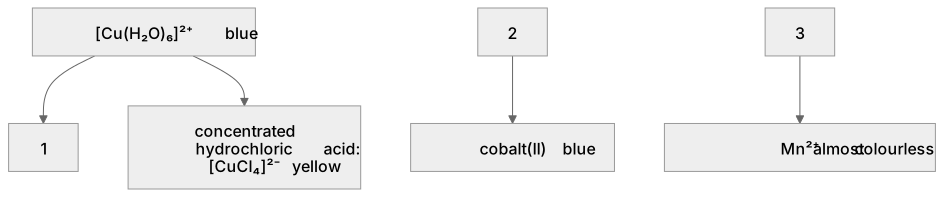
1Box 1
2Box 2
3Box 3
There is more to this lesson
The full lesson goes on to check your understanding and help you earn the marks. Create a free account to carry on, with your progress saved.
A week of Premium from your first lesson · Then the free plan continues · No card, no charge
Test your understanding of Formation of coloured ions (A-level only): Transition metal ions can be identified by their colour.
Active recall beats re-reading. Take an instant quiz now to test what you’ve learned and lock it into long-term memory.
A week of Premium from your first lesson · Then the free plan continues · No card, no charge