AQA · A-Level · Chemistry
Course version: 7405 · Version from Sept 2016
A complex is a central metal atom or ion surrounded by ligands.
Full specification wording
General properties of transition metals (A-level only): A complex is a central metal atom or ion surrounded by ligands.
A complex is a central metal atom or ion bonded to a set of ligands by co-ordinate bonds.
Checked against the AQA 7405 specification (opens in a new tab) on .
- Point 4 of 5
Study notes
From the checked teaching notes for this specification point.
The idea
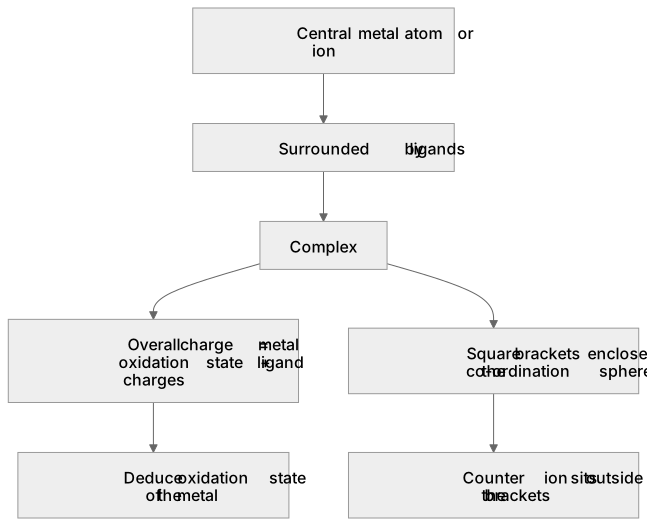
A complex is a central metal atom or ion bonded to a set of ligands by co-ordinate bonds. Note atom or ion: Cr(PF₃)₆ is a complex even though the chromium is in oxidation state zero, because PF₃ is a neutral ligand and the whole species is neutral. The overall charge on a complex is the sum of the metal's oxidation state and the charges on the ligands, so [Cu(H₂O)₆]²⁺ carries 2⁺ from copper(II) with six neutral water ligands, while [CuCl₄]²⁻ is 2⁺ from copper(II) plus 4⁻ from four chloride ions. Square brackets enclose everything inside the co-ordination sphere, and any counter ion, such as the third chloride in [Cr(NH₃)₄Cl₂]Cl, sits outside them.
What earns the marks
- Central metal atom or ion surrounded by ligands as the definition.
- Deducing the oxidation state of the metal from the overall charge and the ligand charges.
- A correctly written formula with square brackets and the overall charge outside them.
- Explaining a zero oxidation state, as in Cr(PF₃)₆, by both the ligands and the complex being neutral.
Common mistakes and how to put them right
Defining a complex as a metal ion only, which loses the mark on neutral complexes such as Cr(PF₃)₆.
Omitting the overall charge when writing the formula of a complex ion.
Including a counter ion inside the square brackets, for example writing [Cr(NH₃)₄Cl₃].
Forgetting that anionic ligands such as Cl⁻ lower the overall charge when deducing an oxidation state.
Exam tips
- Write atom or ion in the definition, because atom is what earns credit on zero oxidation state examples.
- Set the arithmetic out: metal oxidation state plus total ligand charge equals the charge shown outside the bracket.
- Decide which species are bonded to the metal before writing the brackets, since anything ionically bound sits outside.
Try the lesson
The start of the General properties of transition metals (A-level only): A complex is a central metal atom or ion surrounded by ligands. lesson, made from checked teaching notes for this specification point.
Have a go first
In the complex ion [Cu(H₂O)₆]²⁺, which species acts as the central metal ion?
Listen
A complex is a central metal atom or ion bonded to a set of ligands by co-ordinate bonds. Note atom or ion: Cr(PF₃)₆ is a complex even though the chromium is in oxidation state zero, because PF₃ is a neutral ligand and the whole species is neutral. The overall charge on a complex is the sum of the metal's oxidation state and the charges on the ligands, so [Cu(H₂O)₆]²⁺ carries 2⁺ from copper(II) with six neutral water ligands, while [CuCl₄]²⁻ is 2⁺ from copper(II) plus 4⁻ from four chloride ions. Square brackets enclose everything inside the co-ordination sphere, and any counter ion, such as the third chloride in [Cr(NH₃)₄Cl₂]Cl, sits outside them. A strong answer earns marks for these points. central metal atom or ion surrounded by ligands as the definition. deducing the oxidation state of the metal from the overall charge and the ligand charges. a correctly written formula with square brackets and the overall charge outside them. explaining a zero oxidation state, as in Cr(PF₃)₆, by both the ligands and the complex being neutral. Exam tip: Write atom or ion in the definition, because atom is what earns credit on zero oxidation state examples.
See it
Label the diagram
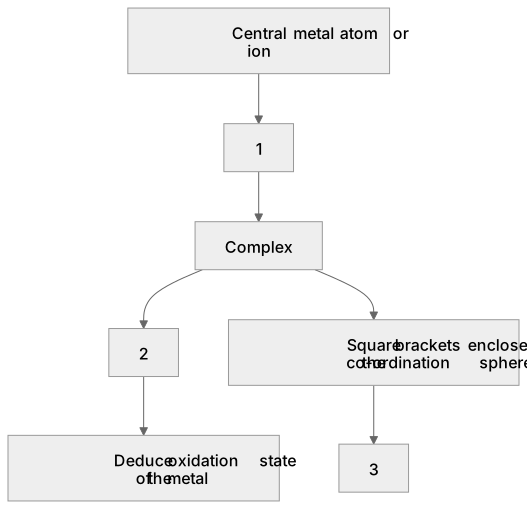
Some boxes have lost their names. Pick the right name for each number.
1Box 1
2Box 2
3Box 3
There is more to this lesson
The full lesson goes on to check your understanding and help you earn the marks. Create a free account to carry on, with your progress saved.
A week of Premium from your first lesson · Then the free plan continues · No card, no charge
Test your understanding of General properties of transition metals (A-level only): A complex is a central metal atom or ion surrounded by ligands.
Active recall beats re-reading. Take an instant quiz now to test what you’ve learned and lock it into long-term memory.
A week of Premium from your first lesson · Then the free plan continues · No card, no charge