AQA · A-Level · Chemistry
Course version: 7405 · Version from Sept 2016
A ligand is a molecule or ion that forms a co-ordinate bond with a…
Full specification wording
General properties of transition metals (A-level only): A ligand is a molecule or ion that forms a co-ordinate bond with a transition metal by donating a pair of electrons.
A ligand is a lone pair donor: it has at least one lone pair and gives that pair to a metal ion to form a co-ordinate, or dative covalent, bond.
Checked against the AQA 7405 specification (opens in a new tab) on .
- Point 3 of 5
- 4 key terms
Study notes
From the checked teaching notes for this specification point.
The idea
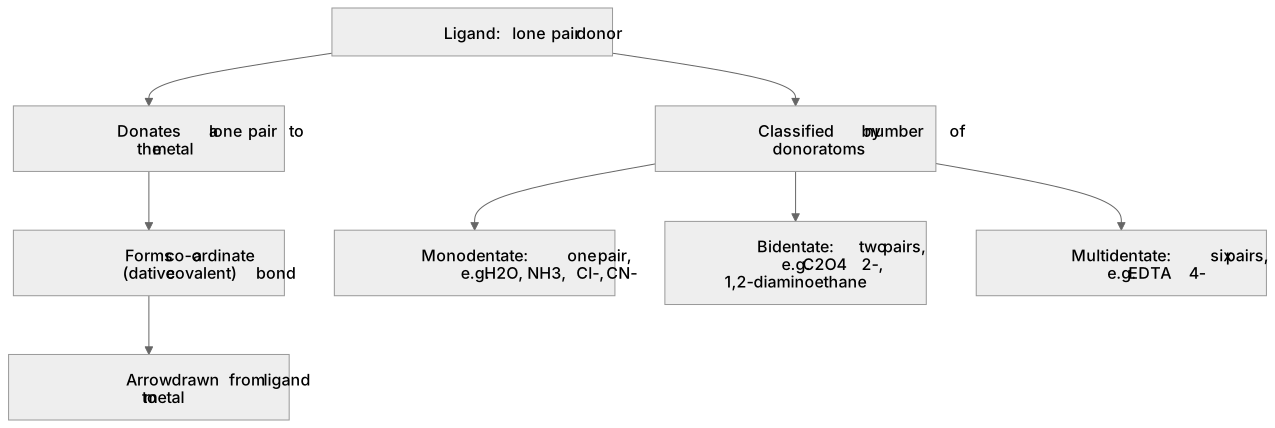
A ligand is a lone pair donor: it has at least one lone pair and gives that pair to a metal ion to form a co-ordinate, or dative covalent, bond. Both electrons in the bond come from the ligand, which is why the bond is drawn as an arrow pointing from the donor atom to the metal. Ligands are classified by how many donor atoms each one uses. Monodentate ligands such as H₂O, NH₃, Cl⁻ and CN⁻ donate one pair each. Bidentate ligands such as ethanedioate, C₂O₄²⁻, and 1,2-diaminoethane, H₂NCH₂CH₂NH₂, donate two pairs and grip the metal at two points. Multidentate ligands such as EDTA⁴⁻ donate six pairs, from two nitrogen atoms and four oxygen atoms, wrapping right round the ion.
What earns the marks
- Stating that a ligand donates a lone pair of electrons to the metal.
- Naming the bond formed as a co-ordinate or dative covalent bond.
- Identifying the donor atom in a named ligand, such as the nitrogen in NH₃ or an oxygen in H₂O.
- Classifying a ligand as monodentate, bidentate or multidentate by counting its donor atoms.
Common mistakes and how to put them right
Saying a ligand shares a pair of electrons, which describes an ordinary covalent bond rather than a co-ordinate one.
Drawing the arrow of the co-ordinate bond from the metal to the ligand.
Calling 1,2-diaminoethane monodentate because it is a single molecule, instead of counting its two nitrogen donor atoms.
Giving EDTA⁴⁻ four donor atoms because of its four negative charges, rather than six.
Exam tips
- Say lone pair and co-ordinate bond explicitly; paraphrases such as joins to the metal do not score.
- Count donor atoms rather than the size of the molecule when deciding how many bonds a ligand forms.
- Remember that the charge on every ligand contributes to the overall charge when you write a formula.
Try the lesson
The start of the General properties of transition metals (A-level only): A ligand is a molecule or ion that forms a co-ordinate bond with a transition metal by donating a pair of electrons. lesson, made from checked teaching notes for this specification point.
Have a go first
Which species acts as a ligand by donating a pair of electrons to a transition metal ion?
Listen
A ligand is a lone pair donor: it has at least one lone pair and gives that pair to a metal ion to form a co-ordinate, or dative covalent, bond. Both electrons in the bond come from the ligand, which is why the bond is drawn as an arrow pointing from the donor atom to the metal. Ligands are classified by how many donor atoms each one uses. Monodentate ligands such as H₂O, NH₃, Cl⁻ and CN⁻ donate one pair each. Bidentate ligands such as ethanedioate, C₂O₄²⁻, and 1,2-diaminoethane, H₂NCH₂CH₂NH₂, donate two pairs and grip the metal at two points. Multidentate ligands such as EDTA⁴⁻ donate six pairs, from two nitrogen atoms and four oxygen atoms, wrapping right round the ion. A strong answer earns marks for these points. stating that a ligand donates a lone pair of electrons to the metal. naming the bond formed as a co-ordinate or dative covalent bond. identifying the donor atom in a named ligand, such as the nitrogen in NH₃ or an oxygen in H₂O. classifying a ligand as monodentate, bidentate or multidentate by counting its donor atoms. Exam tip: Say lone pair and co-ordinate bond explicitly; paraphrases such as joins to the metal do not score.
See it
Key words
Say what each word means before you turn the card.
ligand
Try answering aloud or in your head before turning the card.
co-ordinate bonding
Try answering aloud or in your head before turning the card.
monodentate ligands
Try answering aloud or in your head before turning the card.
bidentate ligands
Try answering aloud or in your head before turning the card.
See every definition
- ligand
- A molecule or ion that forms a co-ordinate bond with a transition metal by donating a pair of electrons.
- co-ordinate bonding
- A bond in which both electrons come from the ligand, drawn as an arrow pointing from the donor atom to the metal.
- monodentate ligands
- Ligands such as H₂O, NH₃, Cl⁻ and CN⁻ that donate one pair each.
- bidentate ligands
- Ligands such as ethanedioate and 1,2-diaminoethane that donate two pairs and grip the metal at two points.
Label the diagram
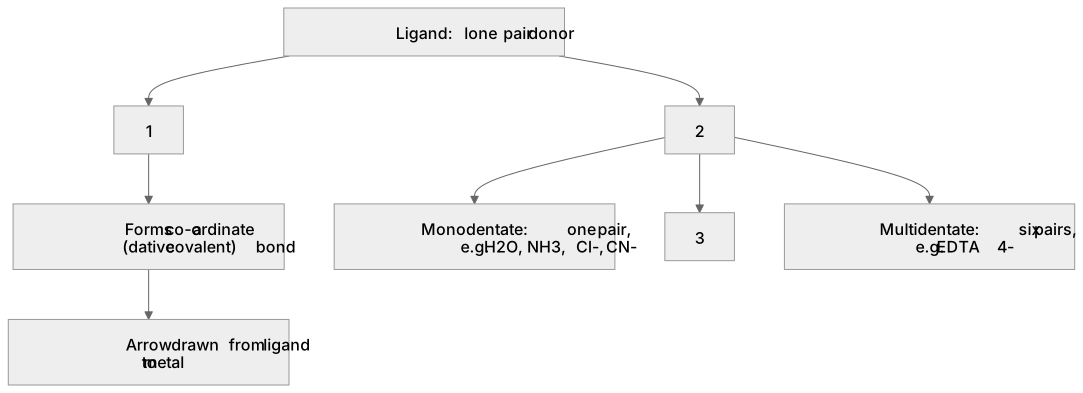
Some boxes have lost their names. Pick the right name for each number.
1Box 1
2Box 2
3Box 3
There is more to this lesson
The full lesson goes on to check your understanding and help you earn the marks. Create a free account to carry on, with your progress saved.
A week of Premium from your first lesson · Then the free plan continues · No card, no charge
Test your understanding of General properties of transition metals (A-level only): A ligand is a molecule or ion that forms a co-ordinate bond with a transition metal by donating a pair of electrons.
Active recall beats re-reading. Take an instant quiz now to test what you’ve learned and lock it into long-term memory.
A week of Premium from your first lesson · Then the free plan continues · No card, no charge