AQA · A-Level · Chemistry
Course version: 7405 · Version from Sept 2016
∆S accounts for the above deficiency, illustrated by physical changes and…
Full specification wording
Gibbs free-energy change, ∆G, and entropy change, ∆S (A-level only): ∆S accounts for the above deficiency, illustrated by physical changes and chemical changes.
Final outcome: Dissolving can have a negative ∆S due to hydration ordering, though physical changes often increase entropy.
Checked against the AQA 7405 specification (opens in a new tab) on .
- Point 3 of 6
- 4 key terms
Study notes
From the checked teaching notes for this specification point.
The idea
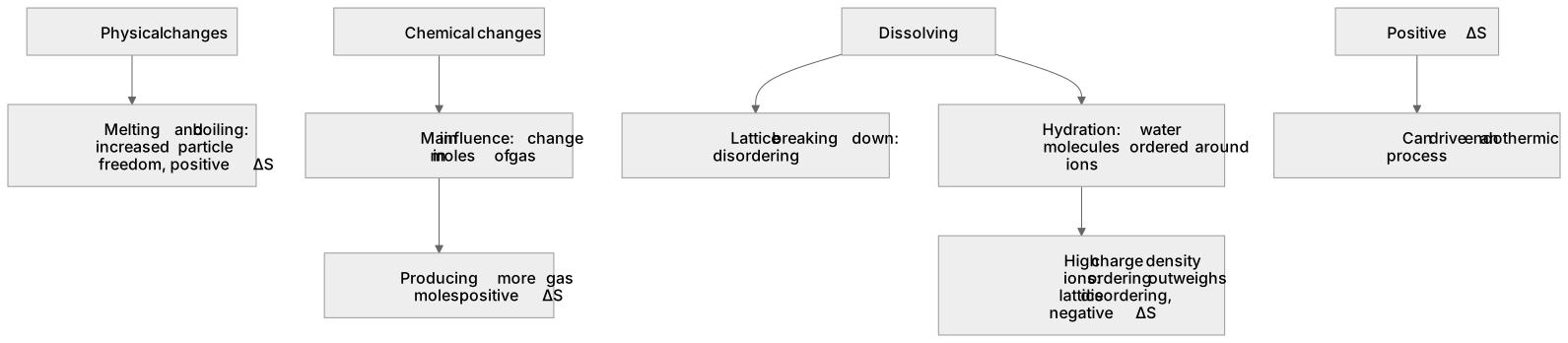
Final outcome: Dissolving can have a negative ∆S due to hydration ordering, though physical changes often increase entropy. Initial logic and parameters are validated. Melting and boiling increase particle freedom, giving positive ∆S. Chemical changes follow moles of gas: producing more gas moles gives a positive ∆S. However, dissolving is complex. While dissolving ammonium nitrate gives a positive ∆S (+108 J K⁻¹ mol⁻¹), dissolving ions with high charge density (like CaCl₂) can result in a negative ∆S (e.g., ≈ −45 J K⁻¹ mol⁻¹) because water molecules become highly ordered around the ions, overcoming the entropy increase of the solid lattice breaking down. A positive ∆S can drive an endothermic process.
What earns the marks
- Final result: Dissolving can yield a negative ∆S if the ordering of water molecules during hydration outweighs the disordering of the lattice.
- Established context: ∆S is positive when a solid melts or vaporises due to increased particle freedom.
- Established context: The change in the number of moles of gas is the main influence on ∆S in chemical reactions.
- Final transformation: A positive ∆S can make an endothermic process feasible by offsetting the enthalpy change.
Common mistakes and how to put them right
Final fix: Assuming dissolving always has a positive ∆S.
Put it right by recognising that hydration of highly charged ions can cause a net negative ∆S.
Established context: Ranking entropy increase on melting as larger than boiling.
Put it right by noting gas formation gives the largest increase.
Established context: Ignoring state symbols when judging ∆S.
Put it right by counting moles of gas.
Exam tips
- Final tip: Evaluate both lattice breakdown and hydration ordering when predicting ∆S for dissolving ionic solids.
- Established context: Highlight state symbols in the equation before predicting the sign of ∆S.
Try the lesson
The start of the Gibbs free-energy change, ∆G, and entropy change, ∆S (A-level only): ∆S accounts for the above deficiency, illustrated by physical changes and chemical changes. lesson, made from checked teaching notes for this specification point.
Have a go first
Which physical change has a positive value of ∆S?
Listen
Final outcome: Dissolving can have a negative ∆S due to hydration ordering, though physical changes often increase entropy. Initial logic and parameters are validated. Melting and boiling increase particle freedom, giving positive ∆S. Chemical changes follow moles of gas: producing more gas moles gives a positive ∆S. However, dissolving is complex. While dissolving ammonium nitrate gives a positive ∆S (+108 J K⁻¹ mol⁻¹), dissolving ions with high charge density (like CaCl₂) can result in a negative ∆S (e.g., ≈ −45 J K⁻¹ mol⁻¹) because water molecules become highly ordered around the ions, overcoming the entropy increase of the solid lattice breaking down. A positive ∆S can drive an endothermic process. A strong answer earns marks for these points. Final result: Dissolving can yield a negative ∆S if the ordering of water molecules during hydration outweighs the disordering of the lattice. Established context: ∆S is positive when a solid melts or vaporises due to increased particle freedom. Established context: The change in the number of moles of gas is the main influence on ∆S in chemical reactions. Final transformation: A positive ∆S can make an endothermic process feasible by offsetting the enthalpy change. A common slip: Final fix: Assuming dissolving always has a positive ∆S. Instead, recognising that hydration of highly charged ions can cause a net negative ∆S. Exam tip: Final tip: Evaluate both lattice breakdown and hydration ordering when predicting ∆S for dissolving ionic solids.
See it
Key words
Say what each word means before you turn the card.
Hydration ordering
Try answering aloud or in your head before turning the card.
Lattice disordering
Try answering aloud or in your head before turning the card.
Moles of gas
Try answering aloud or in your head before turning the card.
Positive ∆S
Try answering aloud or in your head before turning the card.
See every definition
- Hydration ordering
- Water molecules become highly ordered around ions with high charge density, which can outweigh the disordering of the solid lattice breaking down.
- Lattice disordering
- The entropy increase caused by the solid lattice breaking down when a substance dissolves.
- Moles of gas
- The change in the number of moles of gas is the main influence on ∆S in chemical reactions.
- Positive ∆S
- A positive ∆S can make an endothermic process feasible by offsetting the enthalpy change.
Label the diagram
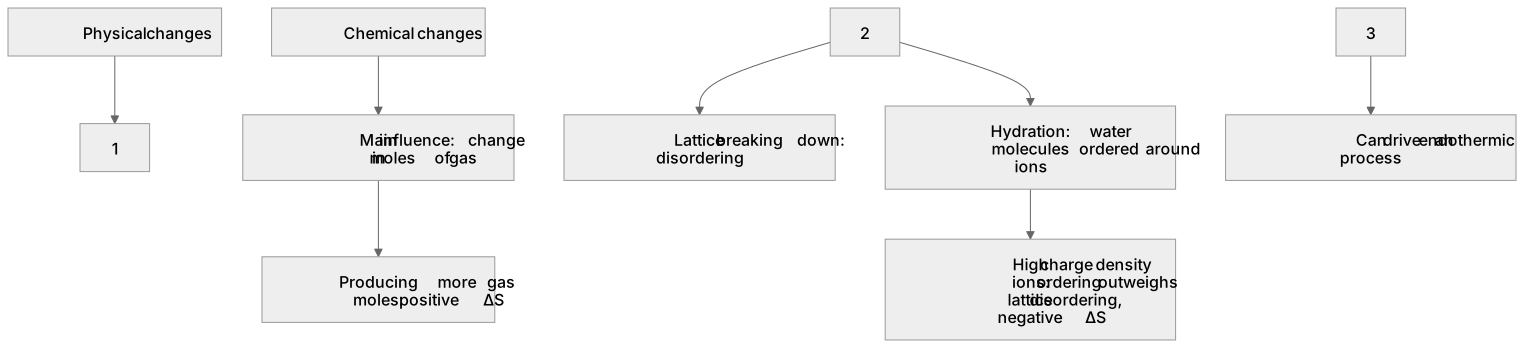
Some boxes have lost their names. Pick the right name for each number.
1Box 1
2Box 2
3Box 3
There is more to this lesson
The full lesson goes on to check your understanding and help you earn the marks. Create a free account to carry on, with your progress saved.
A week of Premium from your first lesson · Then the free plan continues · No card, no charge
Test your understanding of Gibbs free-energy change, ∆G, and entropy change, ∆S (A-level only): ∆S accounts for the above deficiency, illustrated by physical changes and chemical changes.
Active recall beats re-reading. Take an instant quiz now to test what you’ve learned and lock it into long-term memory.
A week of Premium from your first lesson · Then the free plan continues · No card, no charge