AQA · A-Level · Chemistry
Course version: 7405 · Version from Sept 2016
The balance between entropy and enthalpy determines the feasibility of a…
Full specification wording
Gibbs free-energy change, ∆G, and entropy change, ∆S (A-level only): The balance between entropy and enthalpy determines the feasibility of a reaction given by the relationship: ∆G = ∆H – T∆S (derivation not required).
Gibbs free energy combines the two competing factors in one number: ∆G = ∆H − T∆S. The enthalpy term favours change that releases energy, while the entropy term, weighted by the absolute…
Checked against the AQA 7405 specification (opens in a new tab) on .
- Point 4 of 6
- 3 key terms
Study notes
From the checked teaching notes for this specification point.
The idea
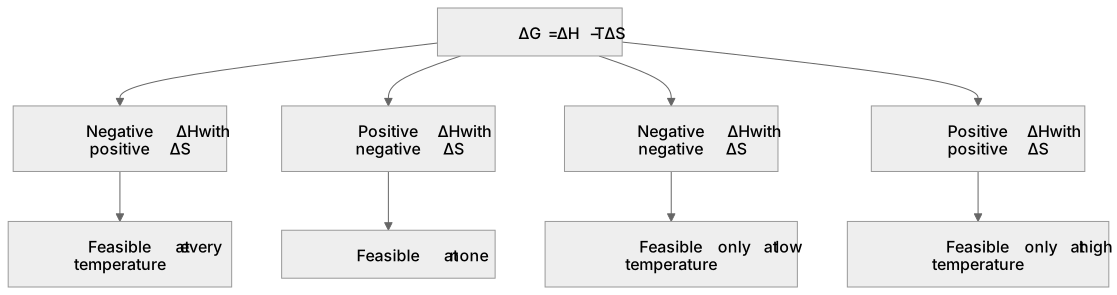
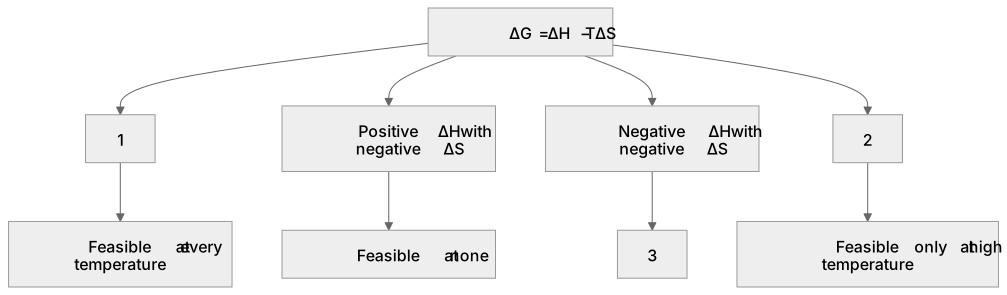
Gibbs free energy combines the two competing factors in one number: ∆G = ∆H − T∆S. The enthalpy term favours change that releases energy, while the entropy term, weighted by the absolute temperature, favours change that increases dispersal. Because the temperature multiplies ∆S, the entropy contribution grows as the system is heated, which is why heating can make an endothermic reaction go. Four combinations follow. Negative ∆H with positive ∆S is feasible at every temperature; positive ∆H with negative ∆S at none; negative ∆H with negative ∆S only at low temperature; positive ∆H with positive ∆S only at high temperature. The unit trap is built in, since ∆H is tabulated in kJ mol⁻¹ and ∆S in J K⁻¹ mol⁻¹.
What earns the marks
- Quoting ∆G = ∆H − T∆S with T as the absolute temperature in kelvin.
- Converting ∆S from J K⁻¹ mol⁻¹ to kJ K⁻¹ mol⁻¹, or ∆H into joules, before substituting.
- Correct substitution with signs preserved.
- Interpreting the size and sign of the T∆S term against ∆H to decide the outcome.
Common mistakes and how to put them right
Substituting ∆H in kilojoules and ∆S in joules without converting, which makes T∆S a thousand times too large.
Using a temperature in degrees Celsius instead of kelvin.
Adding T∆S rather than subtracting it.
Assuming that a negative ∆H alone guarantees a negative ∆G.
Treating ∆G as fixed for a reaction, when it depends on the temperature.
Exam tips
- Write the units next to every substituted value; the conversion is worth a mark by itself.
- State the temperature in kelvin explicitly, even when the question gives 25 °C.
- Before calculating, predict the sign from the signs of ∆H and ∆S so an arithmetic slip is obvious.
Try the lesson
The start of the Gibbs free-energy change, ∆G, and entropy change, ∆S (A-level only): The balance between entropy and enthalpy determines the feasibility of a reaction given by the relationship: ∆G = ∆H – T∆S (derivation not required). lesson, made from checked teaching notes for this specification point.
Have a go first
Which expression gives the Gibbs free-energy change of a reaction?
Listen
Gibbs free energy combines the two competing factors in one number: ∆G = ∆H − T∆S. The enthalpy term favours change that releases energy, while the entropy term, weighted by the absolute temperature, favours change that increases dispersal. Because the temperature multiplies ∆S, the entropy contribution grows as the system is heated, which is why heating can make an endothermic reaction go. Four combinations follow. Negative ∆H with positive ∆S is feasible at every temperature; positive ∆H with negative ∆S at none; negative ∆H with negative ∆S only at low temperature; positive ∆H with positive ∆S only at high temperature. The unit trap is built in, since ∆H is tabulated in kJ mol⁻¹ and ∆S in J K⁻¹ mol⁻¹. A strong answer earns marks for these points. quoting ∆G = ∆H − T∆S with T as the absolute temperature in kelvin. converting ∆S from J K⁻¹ mol⁻¹ to kJ K⁻¹ mol⁻¹, or ∆H into joules, before substituting. correct substitution with signs preserved. interpreting the size and sign of the T∆S term against ∆H to decide the outcome. Exam tip: Write the units next to every substituted value; the conversion is worth a mark by itself.
See it
Key words
Say what each word means before you turn the card.
Gibbs free energy
Try answering aloud or in your head before turning the card.
enthalpy against entropy
Try answering aloud or in your head before turning the card.
temperature weighting
Try answering aloud or in your head before turning the card.
See every definition
- Gibbs free energy
- Combines the two competing factors in one number, given by the relationship ∆G = ∆H – T∆S.
- enthalpy against entropy
- The balance between the two determines the feasibility of a reaction, with the enthalpy term favouring change that releases energy and the entropy term favouring change that increases dispersal.
- temperature weighting
- Because the temperature multiplies ∆S, the entropy contribution grows as the system is heated, which is why heating can make an endothermic reaction go.
Label the diagram
Some boxes have lost their names. Pick the right name for each number.
1Box 1
2Box 2
3Box 3
There is more to this lesson
The full lesson goes on to check your understanding and help you earn the marks. Create a free account to carry on, with your progress saved.
A week of Premium from your first lesson · Then the free plan continues · No card, no charge
Test your understanding of Gibbs free-energy change, ∆G, and entropy change, ∆S (A-level only): The balance between entropy and enthalpy determines the feasibility of a reaction given by the relationship: ∆G = ∆H – T∆S (derivation not required).
Active recall beats re-reading. Take an instant quiz now to test what you’ve learned and lock it into long-term memory.
A week of Premium from your first lesson · Then the free plan continues · No card, no charge