AQA · A-Level · Chemistry
Course version: 7405 · Version from Sept 2016
‘Fingerprinting’ allows identification of a molecule by comparison of…
Full specification wording
Infrared spectroscopy: ‘Fingerprinting’ allows identification of a molecule by comparison of spectra.
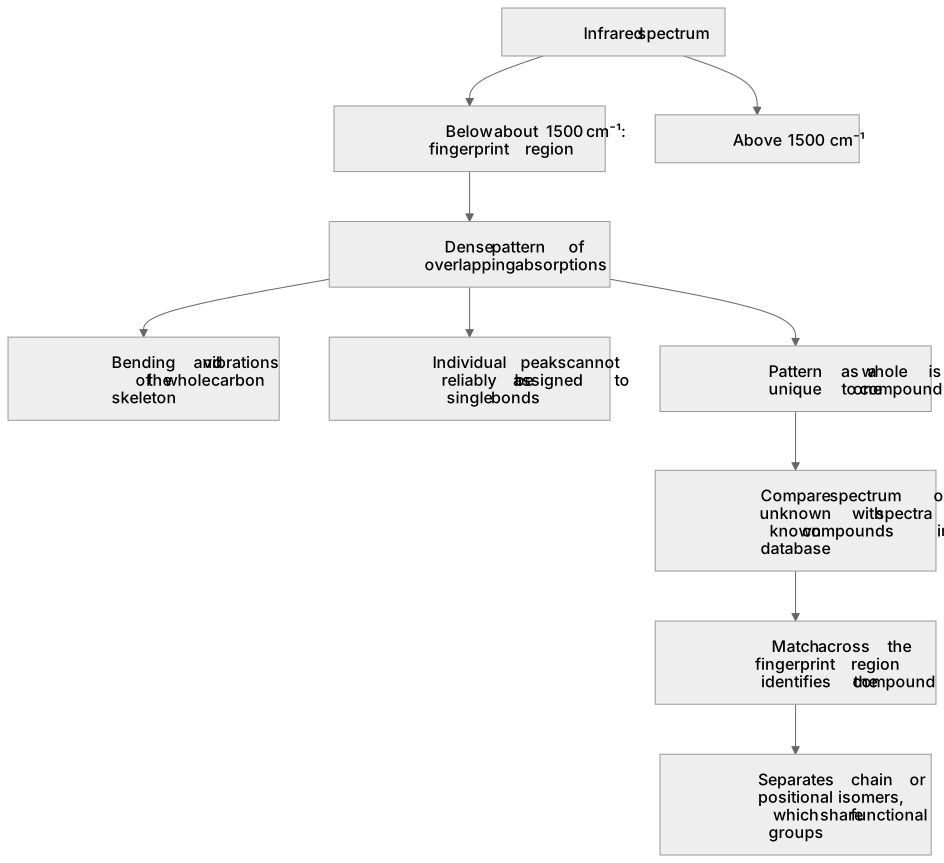
Below about 1500 cm⁻¹ an infrared spectrum becomes a dense pattern of overlapping absorptions produced by bending and by vibrations of the whole carbon skeleton.
Checked against the AQA 7405 specification (opens in a new tab) on .
- Point 2 of 3
- 4 key terms
Study notes
From the checked teaching notes for this specification point.
The idea
Below about 1500 cm⁻¹ an infrared spectrum becomes a dense pattern of overlapping absorptions produced by bending and by vibrations of the whole carbon skeleton. Individual peaks there cannot reliably be assigned to single bonds, but the pattern as a whole is unique to one compound, which is why it is called the fingerprint region. Identification therefore works by matching: the spectrum of the unknown is compared with spectra of known compounds held in a database, and a match across the fingerprint region identifies the compound. This technique is highly effective for separating chain or positional isomers, which contain the same functional groups and so look alike above 1500 cm⁻¹ but differ in skeletal vibrations below it. NMR spectroscopy can also distinguish isomers.
What earns the marks
- Identifying the fingerprint region as below about 1500 cm⁻¹.
- Saying the pattern there is unique to a particular compound.
- Saying identification requires comparison with the spectrum of a known compound or a database.
- Explaining that chain or positional isomers share functional groups, so the fingerprint region is used to separate them.
Common mistakes and how to put them right
Trying to assign individual bonds within the fingerprint region, which is the job of the region above 1500 cm⁻¹.
Claiming a compound can be named from its fingerprint region with no reference spectrum.
Choosing high resolution mass spectrometry to distinguish isomers, which AQA sets as a wrong option.
Assuming all isomers have identical IR spectra above 1500 cm⁻¹ (functional group isomers will differ).
Exam tips
- Say "compared with a database or known spectrum"; identification by matching is the point of the region.
- If two compounds are chain or positional isomers, the fingerprint region is a standard intended answer for distinguishing them.
- Quote the boundary as about 1500 cm⁻¹ rather than an exact figure.
Try the lesson
The start of the Infrared spectroscopy: ‘Fingerprinting’ allows identification of a molecule by comparison of spectra. lesson, made from checked teaching notes for this specification point.
Have a go first
In infrared spectroscopy, what is meant by the fingerprint region of a spectrum?
Listen
Below about 1500 cm⁻¹ an infrared spectrum becomes a dense pattern of overlapping absorptions produced by bending and by vibrations of the whole carbon skeleton. Individual peaks there cannot reliably be assigned to single bonds, but the pattern as a whole is unique to one compound, which is why it is called the fingerprint region. Identification therefore works by matching: the spectrum of the unknown is compared with spectra of known compounds held in a database, and a match across the fingerprint region identifies the compound. This technique is highly effective for separating chain or positional isomers, which contain the same functional groups and so look alike above 1500 cm⁻¹ but differ in skeletal vibrations below it. NMR spectroscopy can also distinguish isomers. A strong answer earns marks for these points. identifying the fingerprint region as below about 1500 cm⁻¹. saying the pattern there is unique to a particular compound. saying identification requires comparison with the spectrum of a known compound or a database. explaining that chain or positional isomers share functional groups, so the fingerprint region is used to separate them. Exam tip: Say "compared with a database or known spectrum"; identification by matching is the point of the region.
See it
Key words
Say what each word means before you turn the card.
fingerprint region
Try answering aloud or in your head before turning the card.
below 1500 cm⁻¹
Try answering aloud or in your head before turning the card.
unique pattern
Try answering aloud or in your head before turning the card.
comparison with a database
Try answering aloud or in your head before turning the card.
See every definition
- fingerprint region
- Below about 1500 cm⁻¹ an infrared spectrum becomes a dense pattern of overlapping absorptions produced by bending and by vibrations of the whole carbon skeleton.
- below 1500 cm⁻¹
- Individual peaks there cannot reliably be assigned to single bonds, but the pattern as a whole is unique to one compound.
- unique pattern
- The pattern as a whole is unique to one compound, which is why it is called the fingerprint region.
- comparison with a database
- The spectrum of the unknown is compared with spectra of known compounds held in a database, and a match across the fingerprint region identifies the compound.
Label the diagram
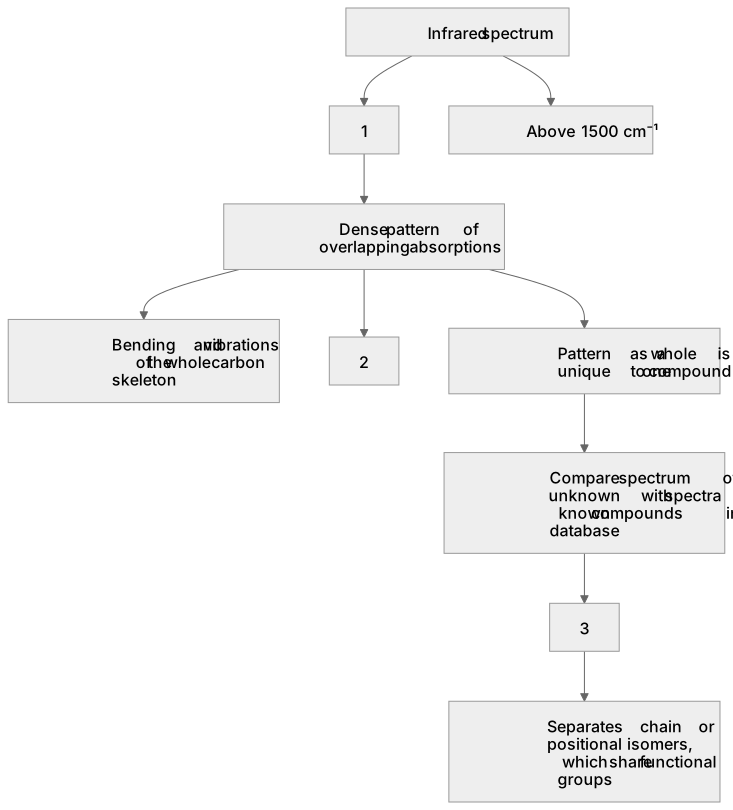
Some boxes have lost their names. Pick the right name for each number.
1Box 1
2Box 2
3Box 3
There is more to this lesson
The full lesson goes on to check your understanding and help you earn the marks. Create a free account to carry on, with your progress saved.
A week of Premium from your first lesson · Then the free plan continues · No card, no charge
Test your understanding of Infrared spectroscopy: ‘Fingerprinting’ allows identification of a molecule by comparison of spectra.
Active recall beats re-reading. Take an instant quiz now to test what you’ve learned and lock it into long-term memory.
A week of Premium from your first lesson · Then the free plan continues · No card, no charge