AQA · A-Level · Chemistry
Course version: 7405 · Version from Sept 2016
Students should be able to: use infrared spectra and the Chemistry Data…
Full specification wording
Infrared spectroscopy: Students should be able to: use infrared spectra and the Chemistry Data Sheet or Booklet to identify particular bonds, and therefore functional groups, and also to identify impurities.
Read a spectrum in a fixed order.
Checked against the AQA 7405 specification (opens in a new tab) on .
- Point 3 of 3
- 4 key terms
Study notes
From the checked teaching notes for this specification point.
The idea
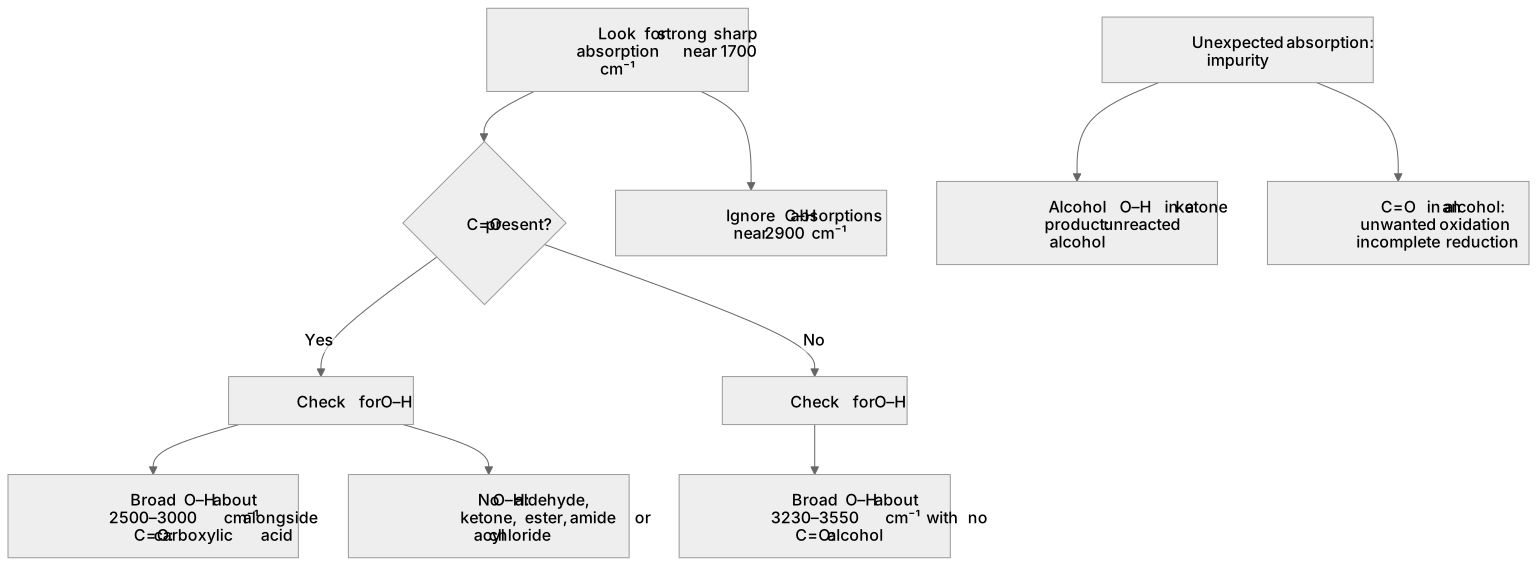
Read a spectrum in a fixed order. Look first for a strong sharp absorption near 1700 cm⁻¹: if C=O is present the compound could be an aldehyde, ketone, carboxylic acid, ester, amide, or acyl chloride. Then look for O–H. A broad absorption between about 2500 and 3000 cm⁻¹ alongside the C=O means a carboxylic acid; a broad absorption between about 3230 and 3550 cm⁻¹ with no C=O means an alcohol. Ignore the C–H absorptions near 2900 cm⁻¹, which nearly every organic compound shows. Impurities appear as absorptions that should not be there: an alcohol O–H still visible in a spectrum of a ketone product shows unreacted alcohol, and a C=O in a spectrum of an alcohol shows unwanted oxidation or incomplete reduction.
What earns the marks
- Quoting the wavenumber of the peak used and the range for it on the data sheet.
- Assigning that peak to the correct bond.
- Deducing the functional group from the combination of peaks present and absent.
- Identifying an impurity from a peak that should not be present and naming the substance.
Common mistakes and how to put them right
Naming a functional group from one peak when the absence of a second peak is what settles it.
Treating the C–H absorption near 2900 cm⁻¹ as diagnostic, when almost every organic compound shows it.
Reading any broad O–H as an alcohol without checking whether it stretches down towards 2500 cm⁻¹.
Quoting a peak position without the unit cm⁻¹.
Exam tips
- Say which peaks are absent as well as which are present; absence is often the deciding evidence.
- Quote your value and then the data sheet range beside it, so the examiner can see the match.
- For a purity question, ask what the starting material would show and check whether that peak is still there.
Try the lesson
The start of the Infrared spectroscopy: Students should be able to: use infrared spectra and the Chemistry Data Sheet or Booklet to identify particular bonds, and therefore functional groups, and also to identify impurities. lesson, made from checked teaching notes for this specification point.
Have a go first
An infrared spectrum of an unknown organic liquid shows a strong, broad absorption centred at about 3300 cm⁻¹ and no absorption in the region 1650–1750 cm⁻¹. Which functional group is present in the liquid?
Listen
Read a spectrum in a fixed order. Look first for a strong sharp absorption near 1700 cm⁻¹: if C=O is present the compound could be an aldehyde, ketone, carboxylic acid, ester, amide, or acyl chloride. Then look for O–H. A broad absorption between about 2500 and 3000 cm⁻¹ alongside the C=O means a carboxylic acid; a broad absorption between about 3230 and 3550 cm⁻¹ with no C=O means an alcohol. Ignore the C–H absorptions near 2900 cm⁻¹, which nearly every organic compound shows. Impurities appear as absorptions that should not be there: an alcohol O–H still visible in a spectrum of a ketone product shows unreacted alcohol, and a C=O in a spectrum of an alcohol shows unwanted oxidation or incomplete reduction. A strong answer earns marks for these points. quoting the wavenumber of the peak used and the range for it on the data sheet. assigning that peak to the correct bond. deducing the functional group from the combination of peaks present and absent. identifying an impurity from a peak that should not be present and naming the substance. Exam tip: Say which peaks are absent as well as which are present; absence is often the deciding evidence.
See it
Key words
Say what each word means before you turn the card.
systematic reading of a spectrum
Try answering aloud or in your head before turning the card.
C=O near 1700 cm⁻¹
Try answering aloud or in your head before turning the card.
broad O–H shapes
Try answering aloud or in your head before turning the card.
absence as evidence
Try answering aloud or in your head before turning the card.
See every definition
- systematic reading of a spectrum
- Reading a spectrum in a fixed order, looking first for a strong sharp absorption near 1700 cm⁻¹ and then for O–H.
- C=O near 1700 cm⁻¹
- A strong sharp absorption near 1700 cm⁻¹, whose presence means the compound could be an aldehyde, ketone, carboxylic acid, ester, amide, or acyl chloride.
- broad O–H shapes
- A broad absorption between about 2500 and 3000 cm⁻¹ alongside the C=O means a carboxylic acid, while between about 3230 and 3550 cm⁻¹ with no C=O means an alcohol.
- absence as evidence
- Deducing the functional group from the combination of peaks present and absent, since the absence of a second peak is what settles it.
There is more to this lesson
The full lesson goes on to check your understanding and help you earn the marks. Create a free account to carry on, with your progress saved.
A week of Premium from your first lesson · Then the free plan continues · No card, no charge
Test your understanding of Infrared spectroscopy: Students should be able to: use infrared spectra and the Chemistry Data Sheet or Booklet to identify particular bonds, and therefore functional groups, and also to identify impurities.
Active recall beats re-reading. Take an instant quiz now to test what you’ve learned and lock it into long-term memory.
A week of Premium from your first lesson · Then the free plan continues · No card, no charge