AQA · A-Level · Chemistry
Course version: 7405 · Version from Sept 2016
Students should be able to: determine the number of fundamental particles…
Full specification wording
Mass number and isotopes: Students should be able to: determine the number of fundamental particles in atoms and ions using mass number, atomic number and charge explain the existence of isotopes.
Counting particles is a three-step routine.
Checked against the AQA 7405 specification (opens in a new tab) on .
- Point 2 of 7
- 4 key terms
Study notes
From the checked teaching notes for this specification point.
The idea
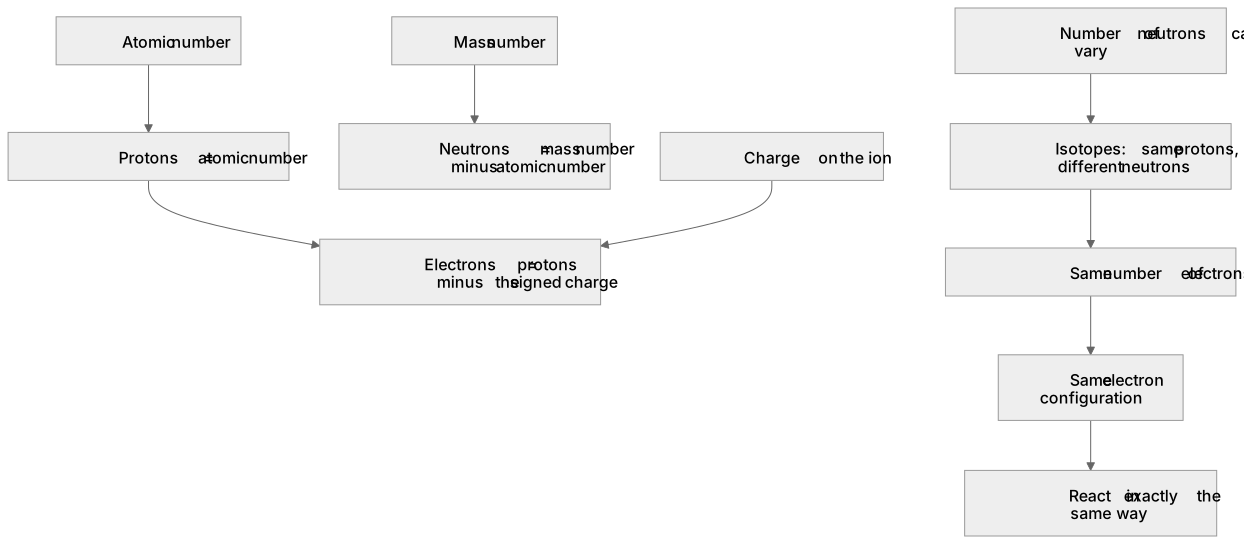
Counting particles is a three-step routine. Protons equal the atomic number. Neutrons equal mass number minus atomic number. Electrons equal protons minus the charge, so a 2⁺ ion has lost two electrons and a 1⁻ ion has gained one; subtracting the signed charge handles both cases in one step. Isotopes exist because the number of neutrons in a nucleus can vary while the proton count stays fixed, so the element is unchanged but the mass number differs. Because isotopes have the same number of electrons and therefore the same electron configuration, they react in exactly the same way; the mark scheme credits same electron configuration and ignores answers based only on the proton count.
What earns the marks
- Number of protons taken directly from the atomic number.
- Number of neutrons calculated as mass number minus atomic number.
- The electron count adjusted correctly for the charge on the ion.
- Isotopes defined as atoms with the same number of protons but different numbers of neutrons.
- The same electron configuration explaining identical chemical properties.
Common mistakes and how to put them right
Adding electrons for a positive ion instead of removing them.
Explaining identical chemistry by saying isotopes have the same number of protons, which examiners ignore.
Saying isotopes have different chemical properties because their masses differ.
Forgetting the charge entirely and giving an ion the same electron count as the atom.
Exam tips
- Write protons, neutrons and electrons as three labelled lines; a table earns the process marks even if one value slips.
- Answer the isotope chemistry question with the words same electron configuration, then add same number of electrons as support.
- Never write same number of neutrons in an isotope answer; that statement is explicitly refused.
Try the lesson
The start of the Mass number and isotopes: Students should be able to: determine the number of fundamental particles in atoms and ions using mass number, atomic number and charge explain the existence of isotopes. lesson, made from checked teaching notes for this specification point.
Have a go first
An atom of ³⁷Cl has atomic number 17. How many neutrons are in one atom of ³⁷Cl?
Listen
Counting particles is a three-step routine. Protons equal the atomic number. Neutrons equal mass number minus atomic number. Electrons equal protons minus the charge, so a 2⁺ ion has lost two electrons and a 1⁻ ion has gained one; subtracting the signed charge handles both cases in one step. Isotopes exist because the number of neutrons in a nucleus can vary while the proton count stays fixed, so the element is unchanged but the mass number differs. Because isotopes have the same number of electrons and therefore the same electron configuration, they react in exactly the same way; the mark scheme credits same electron configuration and ignores answers based only on the proton count. A strong answer earns marks for these points. number of protons taken directly from the atomic number. number of neutrons calculated as mass number minus atomic number. the electron count adjusted correctly for the charge on the ion. isotopes defined as atoms with the same number of protons but different numbers of neutrons. Exam tip: Write protons, neutrons and electrons as three labelled lines; a table earns the process marks even if one value slips.
See it
Key words
Say what each word means before you turn the card.
particle counting
Try answering aloud or in your head before turning the card.
charge and electron number
Try answering aloud or in your head before turning the card.
isotopes
Try answering aloud or in your head before turning the card.
identical chemical properties
Try answering aloud or in your head before turning the card.
See every definition
- particle counting
- A three-step routine in which protons equal the atomic number, neutrons equal mass number minus atomic number, and electrons equal protons minus the charge.
- charge and electron number
- Electrons equal protons minus the charge, so subtracting the signed charge handles both a 2⁺ ion that has lost two electrons and a 1⁻ ion that has gained one.
- isotopes
- Atoms with the same number of protons but different numbers of neutrons, because the number of neutrons in a nucleus can vary while the proton count stays fixed.
- identical chemical properties
- Explained by the same number of electrons and therefore the same electron configuration, so isotopes react in exactly the same way.
Label the diagram
Some boxes have lost their names. Pick the right name for each number.
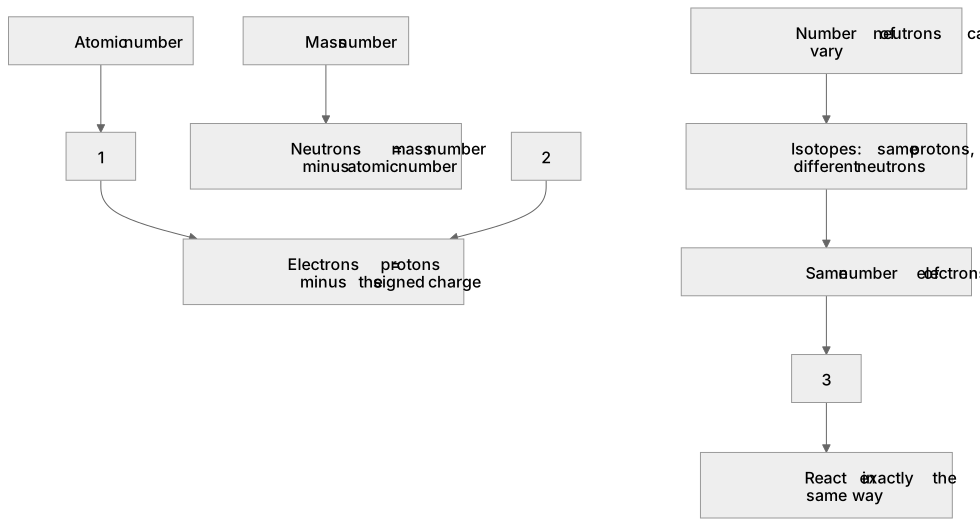
1Box 1
2Box 2
3Box 3
There is more to this lesson
The full lesson goes on to check your understanding and help you earn the marks. Create a free account to carry on, with your progress saved.
A week of Premium from your first lesson · Then the free plan continues · No card, no charge
Test your understanding of Mass number and isotopes: Students should be able to: determine the number of fundamental particles in atoms and ions using mass number, atomic number and charge explain the existence of isotopes.
Active recall beats re-reading. Take an instant quiz now to test what you’ve learned and lock it into long-term memory.
A week of Premium from your first lesson · Then the free plan continues · No card, no charge