AQA · A-Level · Chemistry
Course version: 7405 · Version from Sept 2016
The principles of a simple time of flight (TOF) mass spectrometer, limited…
Full specification wording
Mass number and isotopes: The principles of a simple time of flight (TOF) mass spectrometer, limited to ionisation, acceleration to give all ions constant kinetic energy, ion drift, ion detection, data analysis.
A time of flight spectrometer separates ions by mass in five stages.
Checked against the AQA 7405 specification (opens in a new tab) on .
- Point 3 of 7
- 4 key terms
Study notes
From the checked teaching notes for this specification point.
The idea
A time of flight spectrometer separates ions by mass in five stages. The sample is vaporised and ionised, usually by electron impact for an element. An electric field then accelerates every ion through the same potential difference, so each ion leaves with the same kinetic energy. Since kinetic energy is ½mv², equal energy means a heavier ion must be slower. The ions then drift through a field-free flight tube of known length, so the flight time t = d/v separates them by mass. At the detector each ion gains an electron from the negatively charged plate, producing a current whose size is proportional to the abundance of that ion. Data analysis converts flight times into mass-to-charge ratios and plots abundance against them.
What earns the marks
- The accelerating electric field giving all the ions the same kinetic energy.
- Using kinetic energy = ½mv² to obtain the speed of the ion.
- The flight time related to tube length by speed = distance ÷ time.
- The ion gaining an electron at the detector.
- The size of the current being proportional to the abundance of that isotope.
Common mistakes and how to put them right
Saying heavier ions are given less kinetic energy rather than the same kinetic energy and a lower speed.
Leaving the flight tube length in centimetres when the kinetic energy equation needs metres.
Using the mass in grams rather than kilograms in the kinetic energy equation.
Dividing by the Avogadro constant when converting the mass of one ion to a molar mass, instead of multiplying.
Saying the detector counts the ions directly without describing the transfer of an electron.
Exam tips
- Set out the five stages as five labelled lines; description questions are marked stage by stage.
- Convert units before substituting: centimetres to metres, grams to kilograms.
- Finish a mass calculation by multiplying the mass of one ion in grams by the Avogadro constant to reach a molar mass.
Try the lesson
The start of the Mass number and isotopes: The principles of a simple time of flight (TOF) mass spectrometer, limited to ionisation, acceleration to give all ions constant kinetic energy, ion drift, ion detection, data analysis. lesson, made from checked teaching notes for this specification point.
Have a go first
In a time of flight mass spectrometer, what is the purpose of the ionisation stage?
Listen
A time of flight spectrometer separates ions by mass in five stages. The sample is vaporised and ionised, usually by electron impact for an element. An electric field then accelerates every ion through the same potential difference, so each ion leaves with the same kinetic energy. Since kinetic energy is ½mv², equal energy means a heavier ion must be slower. The ions then drift through a field-free flight tube of known length, so the flight time t = d/v separates them by mass. At the detector each ion gains an electron from the negatively charged plate, producing a current whose size is proportional to the abundance of that ion. Data analysis converts flight times into mass-to-charge ratios and plots abundance against them. A strong answer earns marks for these points. the accelerating electric field giving all the ions the same kinetic energy. using kinetic energy = ½mv² to obtain the speed of the ion. the flight time related to tube length by speed = distance ÷ time. the ion gaining an electron at the detector. Exam tip: Set out the five stages as five labelled lines; description questions are marked stage by stage.
See it
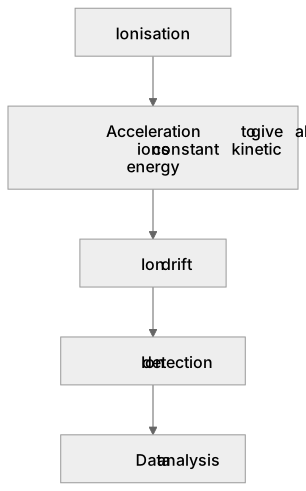
Put it in order
Put these steps in the order they happen.
- 1. Acceleration to give all ions constant kinetic energy
- 2. Ion drift
- 3. Ionisation
- 4. Data analysis
- 5. Ion detection
Key words
Say what each word means before you turn the card.
acceleration to constant kinetic energy
Try answering aloud or in your head before turning the card.
ion drift
Try answering aloud or in your head before turning the card.
detection and current
Try answering aloud or in your head before turning the card.
flight time and mass
Try answering aloud or in your head before turning the card.
See every definition
- acceleration to constant kinetic energy
- An electric field accelerates every ion through the same potential difference, so each ion leaves with the same kinetic energy.
- ion drift
- The ions drift through a field-free flight tube of known length, so the flight time separates them by mass.
- detection and current
- At the detector each ion gains an electron from the negatively charged plate, producing a current whose size is proportional to the abundance of that ion.
- flight time and mass
- Since kinetic energy is ½mv², equal energy means a heavier ion must be slower, so the flight time t = d/v separates ions by mass.
Label the diagram
Some boxes have lost their names. Pick the right name for each number.
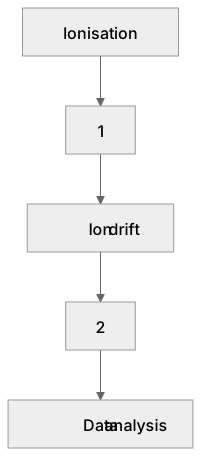
1Box 1
2Box 2
There is more to this lesson
The full lesson goes on to check your understanding and help you earn the marks. Create a free account to carry on, with your progress saved.
A week of Premium from your first lesson · Then the free plan continues · No card, no charge
Test your understanding of Mass number and isotopes: The principles of a simple time of flight (TOF) mass spectrometer, limited to ionisation, acceleration to give all ions constant kinetic energy, ion drift, ion detection, data analysis.
Active recall beats re-reading. Take an instant quiz now to test what you’ve learned and lock it into long-term memory.
A week of Premium from your first lesson · Then the free plan continues · No card, no charge