AQA · A-Level · Chemistry
Course version: 7405 · Version from Sept 2016
Catalytic cracking takes place at a slight pressure, high temperature and…
Full specification wording
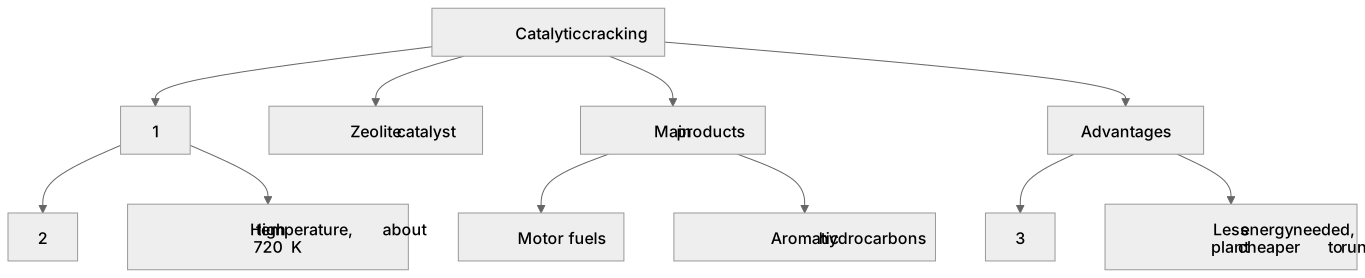
Modification of alkanes by cracking: Catalytic cracking takes place at a slight pressure, high temperature and in the presence of a zeolite catalyst and is used mainly to produce motor fuels and aromatic hydrocarbons (mechanism not required).
Catalytic cracking runs at about 720 K and only a slight pressure over a zeolite catalyst, an aluminosilicate honeycomb with a huge surface area and acidic sites.
Checked against the AQA 7405 specification (opens in a new tab) on .
- Point 3 of 3
- 4 key terms
Study notes
From the checked teaching notes for this specification point.
The idea
Catalytic cracking runs at about 720 K and only a slight pressure over a zeolite catalyst, an aluminosilicate honeycomb with a huge surface area and acidic sites. The mechanism goes through carbocations rather than radicals, though you are not required to write it. The products differ in character from those of thermal cracking: branched alkanes, cycloalkanes and aromatic hydrocarbons, all of which burn smoothly in an engine, so this route is aimed at motor fuels. A mark scheme accepts C₁₄H₃₀ → C₈H₁₈ + C₆H₁₂ for cracking tetradecane into octane and a cycloalkane. Because the catalyst permits a lower temperature and a far lower pressure, less energy is needed and the plant is cheaper to run.
What earns the marks
- A zeolite catalyst together with a slight or moderate pressure.
- A high temperature of about 720 K.
- Motor fuels and aromatic hydrocarbons as the main products.
- A balanced equation such as C₁₄H₃₀ → C₈H₁₈ + C₆H₁₂.
Common mistakes and how to put them right
Giving high pressure for catalytic cracking, which is the thermal cracking condition.
Naming the catalyst as platinum or nickel rather than a zeolite.
Stating alkenes as the main product, which is the thermal cracking answer.
Writing an unbalanced equation by forgetting that a cycloalkane has the formula CₙH₂ₙ.
Exam tips
- Attach zeolite and slight pressure to catalytic cracking every time, because those two words identify the process.
- Check a cycloalkane product against CₙH₂ₙ before declaring the equation balanced.
- Mention lower energy costs if the question asks for an advantage of the catalytic route.
Try the lesson
The start of the Modification of alkanes by cracking: Catalytic cracking takes place at a slight pressure, high temperature and in the presence of a zeolite catalyst and is used mainly to produce motor fuels and aromatic hydrocarbons (mechanism not required). lesson, made from checked teaching notes for this specification point.
Have a go first
Catalytic cracking is used mainly to produce which two types of product?
Listen
Catalytic cracking runs at about 720 K and only a slight pressure over a zeolite catalyst, an aluminosilicate honeycomb with a huge surface area and acidic sites. The mechanism goes through carbocations rather than radicals, though you are not required to write it. The products differ in character from those of thermal cracking: branched alkanes, cycloalkanes and aromatic hydrocarbons, all of which burn smoothly in an engine, so this route is aimed at motor fuels. A mark scheme accepts C₁₄H₃₀ → C₈H₁₈ + C₆H₁₂ for cracking tetradecane into octane and a cycloalkane. Because the catalyst permits a lower temperature and a far lower pressure, less energy is needed and the plant is cheaper to run. A strong answer earns marks for these points. a zeolite catalyst together with a slight or moderate pressure. a high temperature of about 720 K. motor fuels and aromatic hydrocarbons as the main products. a balanced equation such as C₁₄H₃₀ → C₈H₁₈ + C₆H₁₂. Exam tip: Attach zeolite and slight pressure to catalytic cracking every time, because those two words identify the process.
See it

Key words
Say what each word means before you turn the card.
zeolite catalyst
Try answering aloud or in your head before turning the card.
slight pressure and high temperature
Try answering aloud or in your head before turning the card.
motor fuels
Try answering aloud or in your head before turning the card.
aromatic hydrocarbons
Try answering aloud or in your head before turning the card.
See every definition
- zeolite catalyst
- An aluminosilicate honeycomb with a huge surface area and acidic sites, used in catalytic cracking.
- slight pressure and high temperature
- The conditions of catalytic cracking, at a slight pressure and a high temperature of about 720 K.
- motor fuels
- The main product of catalytic cracking, which burns smoothly in an engine.
- aromatic hydrocarbons
- One of the main products of catalytic cracking, alongside motor fuels.
Label the diagram
Some boxes have lost their names. Pick the right name for each number.
1Box 1
2Box 2
3Box 3
There is more to this lesson
The full lesson goes on to check your understanding and help you earn the marks. Create a free account to carry on, with your progress saved.
A week of Premium from your first lesson · Then the free plan continues · No card, no charge
Test your understanding of Modification of alkanes by cracking: Catalytic cracking takes place at a slight pressure, high temperature and in the presence of a zeolite catalyst and is used mainly to produce motor fuels and aromatic hydrocarbons (mechanism not required).
Active recall beats re-reading. Take an instant quiz now to test what you’ve learned and lock it into long-term memory.
A week of Premium from your first lesson · Then the free plan continues · No card, no charge