AQA · A-Level · Chemistry
Course version: 7405 · Version from Sept 2016
Thermal cracking takes place at high pressure and high temperature and…
Full specification wording
Modification of alkanes by cracking: Thermal cracking takes place at high pressure and high temperature and produces a high percentage of alkenes (mechanism not required).
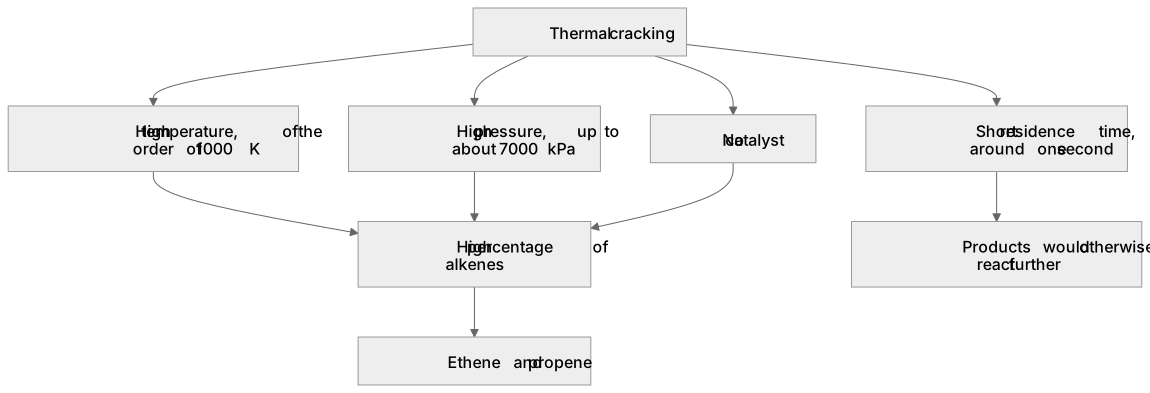
Thermal cracking uses heat and pressure alone: temperatures around 1000 K and pressures up to about 7000 kPa.
Checked against the AQA 7405 specification (opens in a new tab) on .
- Point 2 of 3
- 4 key terms
Study notes
From the checked teaching notes for this specification point.
The idea
Thermal cracking uses heat and pressure alone: temperatures around 1000 K and pressures up to about 7000 kPa. The severe conditions break C–C bonds homolytically, so the mechanism is free-radical, although the specification does not require you to write it out. What matters is the product mix, because thermal cracking gives a high percentage of alkenes, especially ethene and propene, which feed the polymer industry. The residence time is deliberately short, around one second, because the products are more reactive than the feedstock and would otherwise react further. Contrast this with catalytic cracking, which uses a much lower pressure and a zeolite catalyst and is aimed at motor fuels rather than at alkenes.
What earns the marks
- A high temperature of the order of 1000 K.
- A high pressure, up to about 7000 kPa.
- A high percentage of alkenes among the products.
- A balanced equation that shows an alkene as a product.
Common mistakes and how to put them right
Quoting the low pressure of catalytic cracking for thermal cracking.
Adding a zeolite catalyst to thermal cracking, which by definition uses none.
Giving the main products as aromatic hydrocarbons or motor fuels rather than alkenes.
Converting carelessly between °C and K when quoting the temperature.
Exam tips
- Learn the two sets of conditions as a contrasting pair so you attach the right one to the right process.
- Quote units with every condition, because a number alone is not a condition.
- Name ethene or propene as the alkene when asked what thermal cracking is used to produce.
Try the lesson
The start of the Modification of alkanes by cracking: Thermal cracking takes place at high pressure and high temperature and produces a high percentage of alkenes (mechanism not required). lesson, made from checked teaching notes for this specification point.
Have a go first
Which conditions are used in thermal cracking?
Listen
Thermal cracking uses heat and pressure alone: temperatures around 1000 K and pressures up to about 7000 kPa. The severe conditions break C–C bonds homolytically, so the mechanism is free-radical, although the specification does not require you to write it out. What matters is the product mix, because thermal cracking gives a high percentage of alkenes, especially ethene and propene, which feed the polymer industry. The residence time is deliberately short, around one second, because the products are more reactive than the feedstock and would otherwise react further. Contrast this with catalytic cracking, which uses a much lower pressure and a zeolite catalyst and is aimed at motor fuels rather than at alkenes. A strong answer earns marks for these points. a high temperature of the order of 1000 K. a high pressure, up to about 7000 kPa. a high percentage of alkenes among the products. a balanced equation that shows an alkene as a product. Exam tip: Learn the two sets of conditions as a contrasting pair so you attach the right one to the right process.
See it
Key words
Say what each word means before you turn the card.
thermal cracking conditions
Try answering aloud or in your head before turning the card.
high temperature and pressure
Try answering aloud or in your head before turning the card.
alkene rich products
Try answering aloud or in your head before turning the card.
short residence time
Try answering aloud or in your head before turning the card.
See every definition
- thermal cracking conditions
- High pressure and high temperature, with temperatures around 1000 K and pressures up to about 7000 kPa.
- high temperature and pressure
- The severe conditions that break C–C bonds homolytically, giving a free-radical mechanism.
- alkene rich products
- A high percentage of alkenes, especially ethene and propene, which feed the polymer industry.
- short residence time
- Deliberately around one second, because the products are more reactive than the feedstock and would otherwise react further.
Label the diagram
Some boxes have lost their names. Pick the right name for each number.
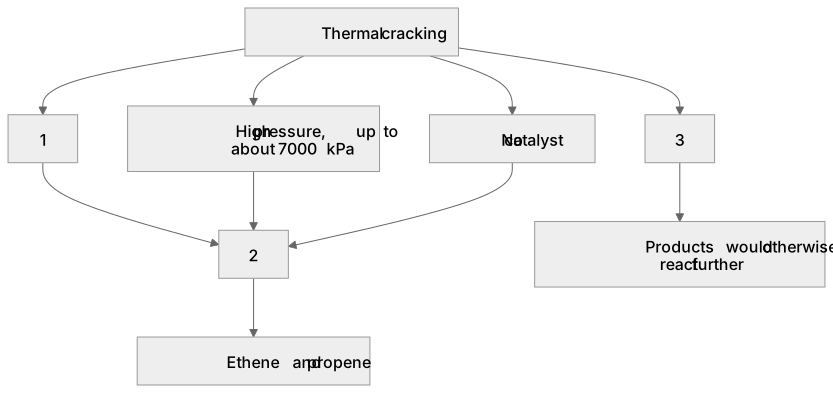
1Box 1
2Box 2
3Box 3
There is more to this lesson
The full lesson goes on to check your understanding and help you earn the marks. Create a free account to carry on, with your progress saved.
A week of Premium from your first lesson · Then the free plan continues · No card, no charge
Test your understanding of Modification of alkanes by cracking: Thermal cracking takes place at high pressure and high temperature and produces a high percentage of alkenes (mechanism not required).
Active recall beats re-reading. Take an instant quiz now to test what you’ve learned and lock it into long-term memory.
A week of Premium from your first lesson · Then the free plan continues · No card, no charge