AQA · A-Level · Chemistry
Course version: 7405 · Version from Sept 2016
Cracking involves breaking C–C bonds in alkanes.
Full specification wording
Modification of alkanes by cracking: Cracking involves breaking C–C bonds in alkanes.
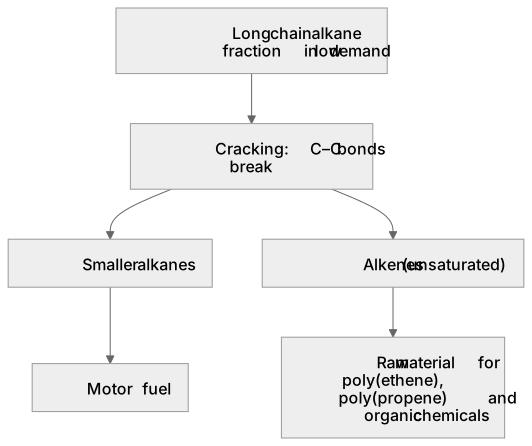
Fractional distillation delivers more long chain alkane than anyone wants and less petrol than everyone wants, so the long chains are broken up.
Checked against the AQA 7405 specification (opens in a new tab) on .
- Point 1 of 3
- 4 key terms
Study notes
From the checked teaching notes for this specification point.
The idea
Fractional distillation delivers more long chain alkane than anyone wants and less petrol than everyone wants, so the long chains are broken up. Cracking snaps C–C bonds in a large alkane to give smaller molecules, and because the fragments have to share out the hydrogen that was there, at least one product is normally unsaturated. Equations must balance exactly: C₁₄H₃₀ → C₈H₁₈ + C₆H₁₂ is one route, and C₁₄H₃₀ → C₈H₁₈ + 2C₃H₆ is another that a mark scheme accepts for the same starting material. The short alkanes go into motor fuel, while the alkenes are the raw material for poly(ethene), poly(propene) and much of the rest of the organic chemical industry.
What earns the marks
- A balanced equation in which carbon and hydrogen atoms tally on both sides.
- At least one unsaturated product where the hydrogen count requires it.
- Identifying C–C bonds as the bonds that break.
- An economic reason, such as converting a fraction in low demand into fuels and alkenes in high demand.
Common mistakes and how to put them right
Writing an equation that does not balance, most often by dropping hydrogen atoms.
Producing only alkanes from an alkane, which cannot balance unless hydrogen is also a product.
Saying C–H bonds are broken in cracking rather than C–C bonds.
Confusing cracking with combustion because both involve high temperatures.
Exam tips
- Balance carbon first, then hydrogen, and let the leftover hydrogen tell you whether an alkene is needed.
- More than one correct equation usually exists, so any balanced answer with sensible products will score.
- Say which product goes to fuel and which to polymers if the question asks about usefulness.
Try the lesson
The start of the Modification of alkanes by cracking: Cracking involves breaking C–C bonds in alkanes. lesson, made from checked teaching notes for this specification point.
Have a go first
Which of the following is a key feature of the cracking process for alkanes?
Listen
Fractional distillation delivers more long chain alkane than anyone wants and less petrol than everyone wants, so the long chains are broken up. Cracking snaps C–C bonds in a large alkane to give smaller molecules, and because the fragments have to share out the hydrogen that was there, at least one product is normally unsaturated. Equations must balance exactly: C₁₄H₃₀ → C₈H₁₈ + C₆H₁₂ is one route, and C₁₄H₃₀ → C₈H₁₈ + 2C₃H₆ is another that a mark scheme accepts for the same starting material. The short alkanes go into motor fuel, while the alkenes are the raw material for poly(ethene), poly(propene) and much of the rest of the organic chemical industry. A strong answer earns marks for these points. a balanced equation in which carbon and hydrogen atoms tally on both sides. at least one unsaturated product where the hydrogen count requires it. identifying C–C bonds as the bonds that break. an economic reason, such as converting a fraction in low demand into fuels and alkenes in high demand. Exam tip: Balance carbon first, then hydrogen, and let the leftover hydrogen tell you whether an alkene is needed.
See it
Key words
Say what each word means before you turn the card.
breaking C–C bonds
Try answering aloud or in your head before turning the card.
supply and demand
Try answering aloud or in your head before turning the card.
balanced cracking equations
Try answering aloud or in your head before turning the card.
alkene products
Try answering aloud or in your head before turning the card.
See every definition
- breaking C–C bonds
- Cracking involves breaking these bonds in alkanes, rather than C–H bonds.
- supply and demand
- The economic reason for cracking is converting a fraction in low demand into fuels and alkenes in high demand.
- balanced cracking equations
- Equations must balance exactly, with carbon and hydrogen atoms tallying on both sides.
- alkene products
- Because the fragments have to share out the hydrogen that was there, at least one product is normally unsaturated.
Label the diagram
Some boxes have lost their names. Pick the right name for each number.
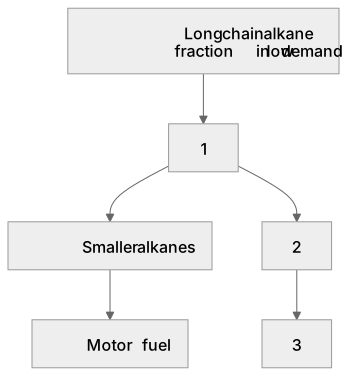
1Box 1
2Box 2
3Box 3
There is more to this lesson
The full lesson goes on to check your understanding and help you earn the marks. Create a free account to carry on, with your progress saved.
A week of Premium from your first lesson · Then the free plan continues · No card, no charge
Test your understanding of Modification of alkanes by cracking: Cracking involves breaking C–C bonds in alkanes.
Active recall beats re-reading. Take an instant quiz now to test what you’ve learned and lock it into long-term memory.
A week of Premium from your first lesson · Then the free plan continues · No card, no charge