AQA · A-Level · Chemistry
Course version: 7405 · Version from Sept 2016
Appreciation that scientists have developed a range of analytical…
Full specification wording
Nuclear magnetic resonance spectroscopy (A-level only): Appreciation that scientists have developed a range of analytical techniques which together enable the structures of new compounds to be confirmed.
No single instrument hands you a structure, which is why examiners set questions that give three at once.
Checked against the AQA 7405 specification (opens in a new tab) on .
- Point 1 of 4
- 4 key terms
Study notes
From the checked teaching notes for this specification point.
The idea
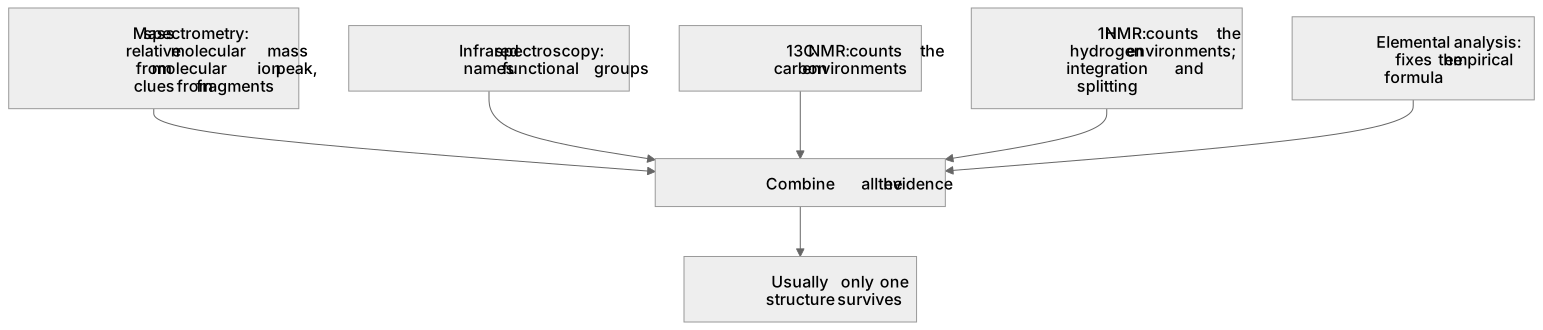
No single instrument hands you a structure, which is why examiners set questions that give three at once. Mass spectrometry gives the relative molecular mass from the molecular ion peak, plus clues from the fragments. Infrared spectroscopy names functional groups: a broad absorption around 3230 to 3550 cm⁻¹ says an alcohol O-H, one near 1680 to 1750 cm⁻¹ says a carbonyl. ¹³C NMR counts the carbon environments. ¹H NMR counts the hydrogen environments, and its integration and splitting say how many hydrogens sit in each and what is next door. Elemental analysis fixes the empirical formula. Put the molecular formula, the functional groups and the environments together and usually only one structure survives.
What earns the marks
- Using infrared to identify a functional group, quoting the wavenumber range from the Data Booklet.
- Using the number of peaks in a ¹³C NMR spectrum to give the number of carbon environments.
- Using ¹H NMR integration to give the relative numbers of protons in each environment.
- A final structure consistent with every piece of data quoted, not just with one spectrum.
Common mistakes and how to put them right
Proposing a structure that fits the infrared spectrum but has the wrong number of carbon environments.
Quoting a wavenumber with no functional group attached to it, or a functional group with no wavenumber.
Using the fingerprint region to assign individual functional groups.
Ignoring the molecular formula, and so suggesting a structure with the wrong number of atoms.
Exam tips
- These are often levels-of-response questions, so cover a stage for each technique and let the reasoning run in order from data to structure.
- Quote the actual value you are reading, the wavenumber or the shift, beside every deduction you make.
- Finish with a drawn structure; a description in words rarely secures the top level.
Try the lesson
The start of the Nuclear magnetic resonance spectroscopy (A-level only): Appreciation that scientists have developed a range of analytical techniques which together enable the structures of new compounds to be confirmed. lesson, made from checked teaching notes for this specification point.
Have a go first
A new organic compound is synthesised in a laboratory. Which combination of analytical techniques would best allow its structure to be confirmed?
Listen
No single instrument hands you a structure, which is why examiners set questions that give three at once. Mass spectrometry gives the relative molecular mass from the molecular ion peak, plus clues from the fragments. Infrared spectroscopy names functional groups: a broad absorption around 3230 to 3550 cm⁻¹ says an alcohol O-H, one near 1680 to 1750 cm⁻¹ says a carbonyl. ¹³C NMR counts the carbon environments. ¹H NMR counts the hydrogen environments, and its integration and splitting say how many hydrogens sit in each and what is next door. Elemental analysis fixes the empirical formula. Put the molecular formula, the functional groups and the environments together and usually only one structure survives. A strong answer earns marks for these points. using infrared to identify a functional group, quoting the wavenumber range from the Data Booklet. using the number of peaks in a ¹³C NMR spectrum to give the number of carbon environments. using ¹H NMR integration to give the relative numbers of protons in each environment. a final structure consistent with every piece of data quoted, not just with one spectrum. Exam tip: These are often levels-of-response questions, so cover a stage for each technique and let the reasoning run in order from data to structure.
See it
Key words
Say what each word means before you turn the card.
combining techniques
Try answering aloud or in your head before turning the card.
infrared functional groups
Try answering aloud or in your head before turning the card.
carbon environments
Try answering aloud or in your head before turning the card.
from evidence to structure
Try answering aloud or in your head before turning the card.
See every definition
- combining techniques
- A range of analytical techniques which together enable the structures of new compounds to be confirmed.
- infrared functional groups
- A broad absorption around 3230 to 3550 cm⁻¹ says an alcohol O-H, one near 1680 to 1750 cm⁻¹ says a carbonyl.
- carbon environments
- Counted by ¹³C NMR, using the number of peaks in the spectrum.
- from evidence to structure
- Putting the molecular formula, the functional groups and the environments together so that usually only one structure survives.
Label the diagram
Some boxes have lost their names. Pick the right name for each number.
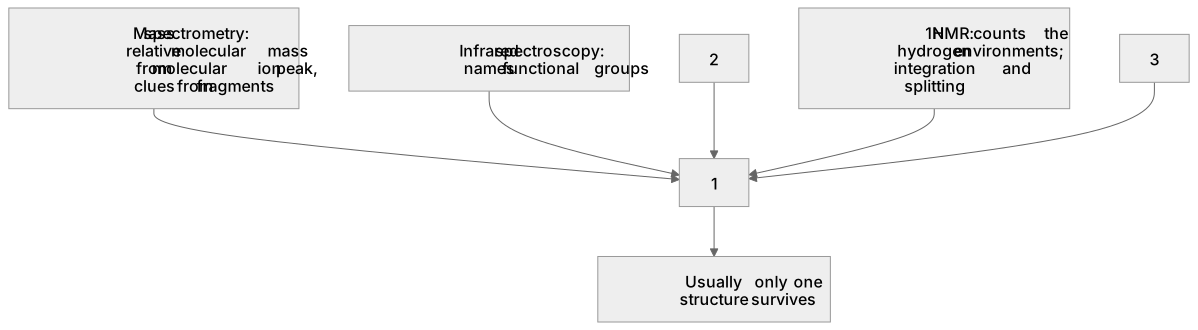
1Box 1
2Box 2
3Box 3
There is more to this lesson
The full lesson goes on to check your understanding and help you earn the marks. Create a free account to carry on, with your progress saved.
A week of Premium from your first lesson · Then the free plan continues · No card, no charge
Test your understanding of Nuclear magnetic resonance spectroscopy (A-level only): Appreciation that scientists have developed a range of analytical techniques which together enable the structures of new compounds to be confirmed.
Active recall beats re-reading. Take an instant quiz now to test what you’ve learned and lock it into long-term memory.
A week of Premium from your first lesson · Then the free plan continues · No card, no charge