AQA · A-Level · Chemistry
Course version: 7405 · Version from Sept 2016
The use of the δ scale for recording chemical shift.
Full specification wording
Nuclear magnetic resonance spectroscopy (A-level only): The use of the δ scale for recording chemical shift.
Chemical shift is quoted on the delta scale in parts per million.
Checked against the AQA 7405 specification (opens in a new tab) on .
- Point 2 of 4
- 4 key terms
Study notes
From the checked teaching notes for this specification point.
The idea
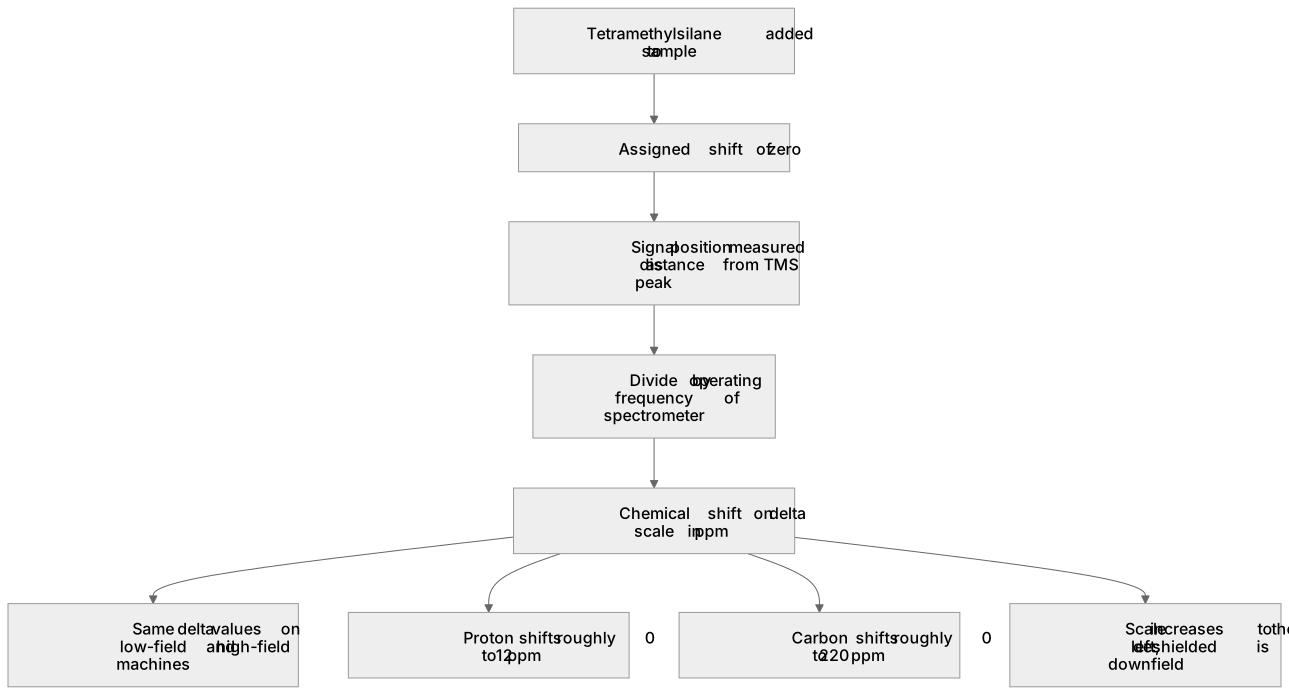
Chemical shift is quoted on the delta scale in parts per million. Zero on that scale is set by tetramethylsilane, added to the sample, and every other signal is reported as its distance from that peak divided by the operating frequency of the spectrometer. Dividing by the operating frequency is the important part, because it makes delta a ratio: a sample run on a low-field machine gives the same delta values as one run at high field, so the Data Booklet tables work for every instrument. Proton shifts run from roughly 0 to 12 ppm, carbon shifts from roughly 0 to 220 ppm. By convention the scale increases to the left, so a deshielded nucleus is described as downfield and tetramethylsilane sits at the right-hand edge.
What earns the marks
- Stating that tetramethylsilane is the standard and is assigned a shift of zero.
- Chemical shift being measured in parts per million.
- Explaining that dividing by the spectrometer frequency makes the value independent of the field used.
- Reading a shift against the Data Booklet table and naming the environment it corresponds to.
Common mistakes and how to put them right
Quoting a chemical shift in hertz rather than in parts per million.
Saying delta values change when a stronger magnet is used.
Treating tetramethylsilane as the solvent rather than as a reference added in small amount.
Reading the proton table when the spectrum is a carbon spectrum, or the reverse.
Exam tips
- Always write ppm after a shift; a bare number is not a chemical shift.
- When a shift is given, find its row in the Data Booklet before writing anything, and quote the environment the table names.
- Remember which end is which: a peak far to the left of the spectrum is strongly deshielded.
Try the lesson
The start of the Nuclear magnetic resonance spectroscopy (A-level only): The use of the δ scale for recording chemical shift. lesson, made from checked teaching notes for this specification point.
Have a go first
On the δ scale used in NMR spectroscopy, what is the chemical shift of the reference standard tetramethylsilane (TMS)?
Listen
Chemical shift is quoted on the delta scale in parts per million. Zero on that scale is set by tetramethylsilane, added to the sample, and every other signal is reported as its distance from that peak divided by the operating frequency of the spectrometer. Dividing by the operating frequency is the important part, because it makes delta a ratio: a sample run on a low-field machine gives the same delta values as one run at high field, so the Data Booklet tables work for every instrument. Proton shifts run from roughly 0 to 12 ppm, carbon shifts from roughly 0 to 220 ppm. By convention the scale increases to the left, so a deshielded nucleus is described as downfield and tetramethylsilane sits at the right-hand edge. A strong answer earns marks for these points. stating that tetramethylsilane is the standard and is assigned a shift of zero. chemical shift being measured in parts per million. explaining that dividing by the spectrometer frequency makes the value independent of the field used. reading a shift against the Data Booklet table and naming the environment it corresponds to. Exam tip: Always write ppm after a shift; a bare number is not a chemical shift.
See it
Key words
Say what each word means before you turn the card.
delta scale
Try answering aloud or in your head before turning the card.
parts per million
Try answering aloud or in your head before turning the card.
tetramethylsilane reference
Try answering aloud or in your head before turning the card.
independence of field strength
Try answering aloud or in your head before turning the card.
See every definition
- delta scale
- The scale on which chemical shift is quoted, in parts per million, increasing to the left.
- parts per million
- The unit in which chemical shift is measured on the delta scale.
- tetramethylsilane reference
- The standard added to the sample, assigned a shift of zero, sitting at the right-hand edge.
- independence of field strength
- Dividing by the operating frequency makes delta a ratio, so a sample run on a low-field machine gives the same delta values as one run at high field.
Label the diagram
Some boxes have lost their names. Pick the right name for each number.
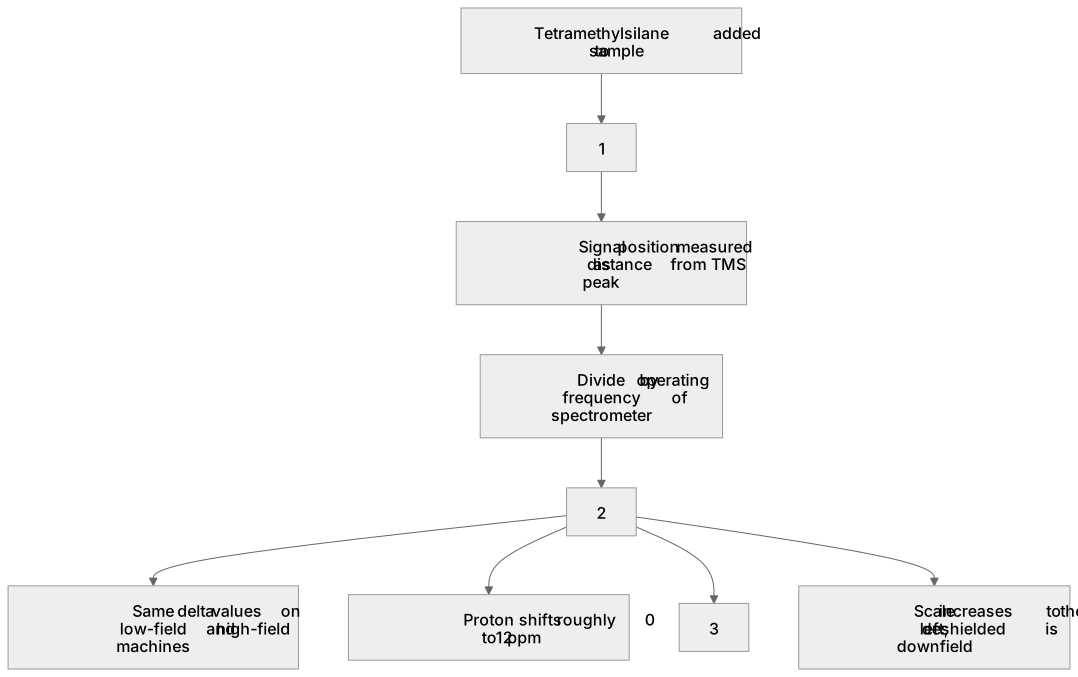
1Box 1
2Box 2
3Box 3
There is more to this lesson
The full lesson goes on to check your understanding and help you earn the marks. Create a free account to carry on, with your progress saved.
A week of Premium from your first lesson · Then the free plan continues · No card, no charge
Test your understanding of Nuclear magnetic resonance spectroscopy (A-level only): The use of the δ scale for recording chemical shift.
Active recall beats re-reading. Take an instant quiz now to test what you’ve learned and lock it into long-term memory.
A week of Premium from your first lesson · Then the free plan continues · No card, no charge