AQA · A-Level · Chemistry
Course version: 7405 · Version from Sept 2016
An asymmetric carbon atom is chiral and gives rise to optical isomers…
Full specification wording
Optical isomerism (A-level only): An asymmetric carbon atom is chiral and gives rise to optical isomers (enantiomers), which exist as non super- imposable mirror images and differ in their effect on plane polarised light.
The two forms are called enantiomers.
Checked against the AQA 7405 specification (opens in a new tab) on .
- Point 2 of 4
- 2 key terms
Study notes
From the checked teaching notes for this specification point.
The idea
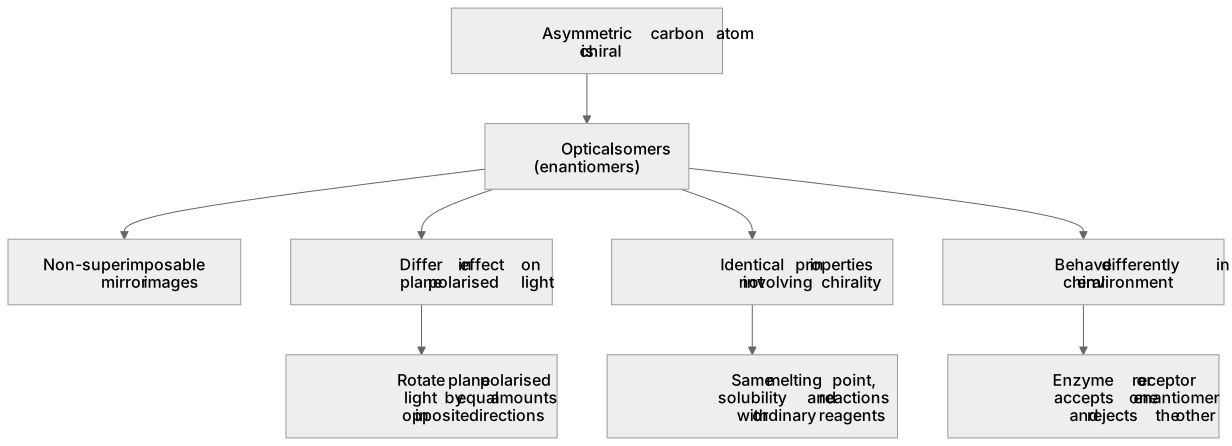
The two forms are called enantiomers. Draw them by putting two bonds in the plane of the paper, one on a wedge coming towards you and one on a dashed line going away, then draw the mirror image on the other side of a mirror line. However you rotate one, it will not superimpose on the other. Physically they are identical in every property that does not itself involve chirality, so they have the same melting point, the same solubility and the same reactions with ordinary reagents. Two things do differ: they rotate the plane of plane polarised light by equal amounts in opposite directions, one clockwise and one anticlockwise, and they behave differently in a chiral environment, which is why an enzyme or a receptor accepts one enantiomer and rejects the other.
What earns the marks
- Drawing the two enantiomers as three-dimensional mirror images either side of a mirror line.
- Using a wedge and a dashed bond to show the arrangement in space.
- Saying the two structures cannot be superimposed.
- Saying they rotate plane polarised light by equal amounts in opposite directions.
Common mistakes and how to put them right
Drawing the second structure as the first one rotated, so the two are actually the same molecule.
Drawing flat structures with no wedge or dashed bond and calling them enantiomers.
Saying one enantiomer rotates the plane of polarised light and the other does not.
Assuming an enzyme acts equally well on both enantiomers of a substrate, which AQA sets as an incorrect statement.
Exam tips
- Draw the mirror line first, then build the second structure group by group as a reflection.
- Check your pair by mentally rotating one; if it lands on the other, redraw it.
- Say "equal but opposite" about the rotation, since both halves of the phrase carry credit.
Try the lesson
The start of the Optical isomerism (A-level only): An asymmetric carbon atom is chiral and gives rise to optical isomers (enantiomers), which exist as non super- imposable mirror images and differ in their effect on plane polarised light. lesson, made from checked teaching notes for this specification point.
Have a go first
Which feature must a carbon atom in an organic molecule have for it to be described as an asymmetric carbon atom?
Listen
The two forms are called enantiomers. Draw them by putting two bonds in the plane of the paper, one on a wedge coming towards you and one on a dashed line going away, then draw the mirror image on the other side of a mirror line. However you rotate one, it will not superimpose on the other. Physically they are identical in every property that does not itself involve chirality, so they have the same melting point, the same solubility and the same reactions with ordinary reagents. Two things do differ: they rotate the plane of plane polarised light by equal amounts in opposite directions, one clockwise and one anticlockwise, and they behave differently in a chiral environment, which is why an enzyme or a receptor accepts one enantiomer and rejects the other. A strong answer earns marks for these points. drawing the two enantiomers as three-dimensional mirror images either side of a mirror line. using a wedge and a dashed bond to show the arrangement in space. saying the two structures cannot be superimposed. saying they rotate plane polarised light by equal amounts in opposite directions. Exam tip: Draw the mirror line first, then build the second structure group by group as a reflection.
See it
Key words
Say what each word means before you turn the card.
enantiomers
Try answering aloud or in your head before turning the card.
non-superimposable
Try answering aloud or in your head before turning the card.
See every definition
- enantiomers
- Optical isomers that exist as non-superimposable mirror images and differ in their effect on plane polarised light.
- non-superimposable
- However you rotate one, it will not superimpose on the other.
Label the diagram
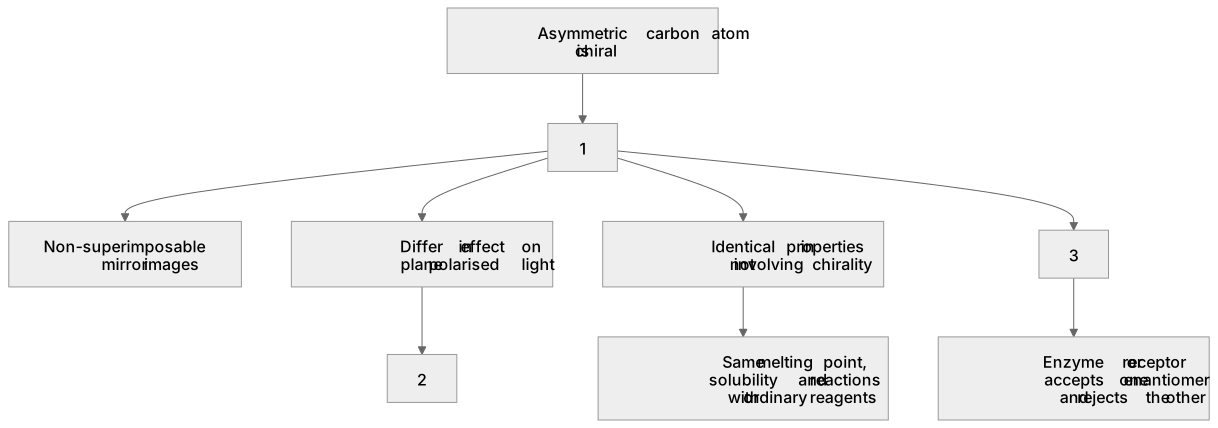
Some boxes have lost their names. Pick the right name for each number.
1Box 1
2Box 2
3Box 3
There is more to this lesson
The full lesson goes on to check your understanding and help you earn the marks. Create a free account to carry on, with your progress saved.
A week of Premium from your first lesson · Then the free plan continues · No card, no charge
Test your understanding of Optical isomerism (A-level only): An asymmetric carbon atom is chiral and gives rise to optical isomers (enantiomers), which exist as non super- imposable mirror images and differ in their effect on plane polarised light.
Active recall beats re-reading. Take an instant quiz now to test what you’ve learned and lock it into long-term memory.
A week of Premium from your first lesson · Then the free plan continues · No card, no charge