AQA · A-Level · Chemistry
Course version: 7405 · Version from Sept 2016
Students should be able to: draw the structural formulas and displayed…
Full specification wording
Optical isomerism (A-level only): Students should be able to: draw the structural formulas and displayed formulas of enantiomers understand how racemic mixtures (racemates) are formed and why they are optically inactive.
For the drawing, a displayed formula shows every atom and every bond; for enantiomers you must also show the arrangement in space, so put two bonds in the plane, one on a wedge and one dashed, and…
Checked against the AQA 7405 specification (opens in a new tab) on .
- Point 4 of 4
- 4 key terms
Study notes
From the checked teaching notes for this specification point.
The idea
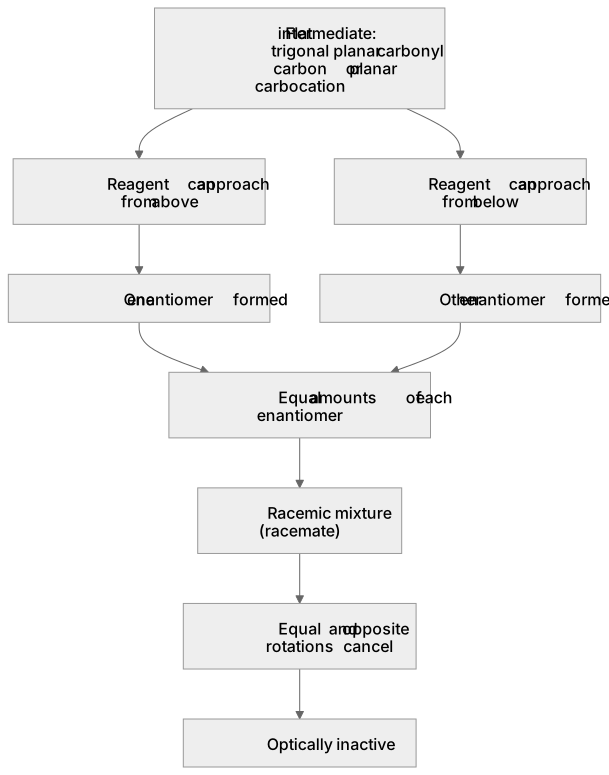
For the drawing, a displayed formula shows every atom and every bond; for enantiomers you must also show the arrangement in space, so put two bonds in the plane, one on a wedge and one dashed, and reflect the whole thing across a mirror line. For the formation, look for a flat intermediate. In nucleophilic addition to a carbonyl the carbon under attack is trigonal planar, and in a substitution proceeding through a carbocation the positive carbon is planar too. A reagent can approach such a species from above or from below with equal probability, so the two enantiomers are produced in equal amounts. That equal production is exactly what makes the product racemic, and the equal and opposite rotations then cancel.
What earns the marks
- A displayed formula showing every bond and atom around the chiral carbon.
- A pair of structures drawn as mirror images using a wedge and a dashed bond.
- Identifying the planar intermediate, such as a carbocation or a carbonyl carbon.
- Saying attack is equally likely from above or below, giving equal amounts of each enantiomer.
- Saying the equal and opposite rotations cancel, so the racemate is optically inactive.
Common mistakes and how to put them right
Drawing the second structure as a rotation of the first, so both are the same enantiomer.
Omitting the wedge and dashed bonds, leaving no three-dimensional information.
Describing the intermediate as tetrahedral when the argument depends on it being planar.
Saying the reagent attacks from the less hindered side, which would give unequal amounts.
Exam tips
- Say planar and then say attack from either side; the two statements are usually separate marks.
- Displayed formulae must show all bonds, so do not abbreviate a methyl group to CH₃ when displayed is asked for.
- Finish the argument at the cancellation of rotations, not just at the equal mixture.
Try the lesson
The start of the Optical isomerism (A-level only): Students should be able to: draw the structural formulas and displayed formulas of enantiomers understand how racemic mixtures (racemates) are formed and why they are optically inactive. lesson, made from checked teaching notes for this specification point.
Have a go first
Which statement describes the relationship between the two enantiomers of butan-2-ol, CH₃CH(OH)CH₂CH₃?
Listen
For the drawing, a displayed formula shows every atom and every bond; for enantiomers you must also show the arrangement in space, so put two bonds in the plane, one on a wedge and one dashed, and reflect the whole thing across a mirror line. For the formation, look for a flat intermediate. In nucleophilic addition to a carbonyl the carbon under attack is trigonal planar, and in a substitution proceeding through a carbocation the positive carbon is planar too. A reagent can approach such a species from above or from below with equal probability, so the two enantiomers are produced in equal amounts. That equal production is exactly what makes the product racemic, and the equal and opposite rotations then cancel. A strong answer earns marks for these points. a displayed formula showing every bond and atom around the chiral carbon. a pair of structures drawn as mirror images using a wedge and a dashed bond. identifying the planar intermediate, such as a carbocation or a carbonyl carbon. saying attack is equally likely from above or below, giving equal amounts of each enantiomer. Exam tip: Say planar and then say attack from either side; the two statements are usually separate marks.
See it
Key words
Say what each word means before you turn the card.
displayed formula
Try answering aloud or in your head before turning the card.
planar intermediate
Try answering aloud or in your head before turning the card.
attack from either side
Try answering aloud or in your head before turning the card.
why racemates are inactive
Try answering aloud or in your head before turning the card.
See every definition
- displayed formula
- A formula that shows every atom and every bond, and for enantiomers also shows the arrangement in space with two bonds in the plane, one on a wedge and one dashed.
- planar intermediate
- A flat species such as a trigonal planar carbonyl carbon under attack or a planar positive carbon in a carbocation.
- attack from either side
- A reagent can approach a planar species from above or from below with equal probability, so the two enantiomers are produced in equal amounts.
- why racemates are inactive
- The two enantiomers are produced in equal amounts, and their equal and opposite rotations then cancel.
Label the diagram
Some boxes have lost their names. Pick the right name for each number.
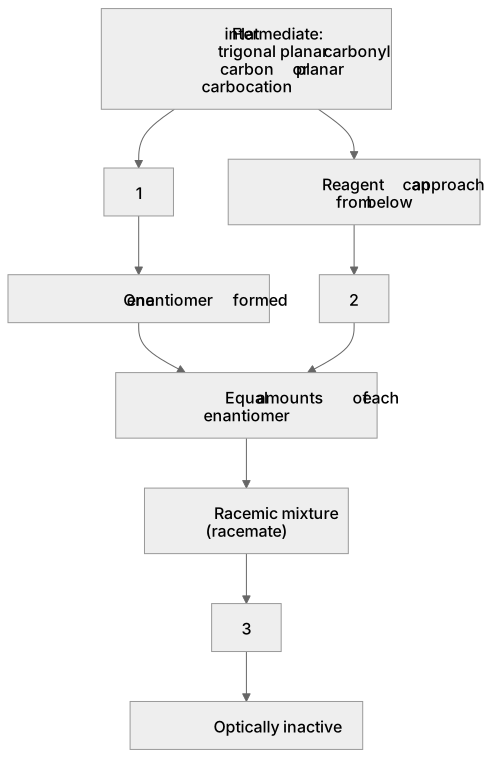
1Box 1
2Box 2
3Box 3
There is more to this lesson
The full lesson goes on to check your understanding and help you earn the marks. Create a free account to carry on, with your progress saved.
A week of Premium from your first lesson · Then the free plan continues · No card, no charge
Test your understanding of Optical isomerism (A-level only): Students should be able to: draw the structural formulas and displayed formulas of enantiomers understand how racemic mixtures (racemates) are formed and why they are optically inactive.
Active recall beats re-reading. Take an instant quiz now to test what you’ve learned and lock it into long-term memory.
A week of Premium from your first lesson · Then the free plan continues · No card, no charge