AQA · A-Level · Chemistry
Course version: 7405 · Version from Sept 2016
Students should be able to: explain why chemists aim to design processes…
Full specification wording
Organic synthesis (A-level only): Students should be able to: explain why chemists aim to design processes that do not require a solvent and that use non- hazardous starting materials explain why chemists aim to design production methods with fewer steps that have a high percentage atom economy use reactions in this specification to devise a synthesis, with up to four steps, for an organic compound.
Percentage atom economy is the relative formula mass of the desired product divided by the total relative formula mass of all the reactants, multiplied by one hundred.
Checked against the AQA 7405 specification (opens in a new tab) on .
- Point 2 of 2
- 3 key terms
Study notes
From the checked teaching notes for this specification point.
The idea
Percentage atom economy is the relative formula mass of the desired product divided by the total relative formula mass of all the reactants, multiplied by one hundred. For a balanced equation the products give the same total. An addition reaction reaches one hundred per cent, because every atom of the reactants ends up in the product; substitution and elimination cannot, because something always leaves. A high atom economy means less waste to treat and less raw material bought for the same output. Working without a solvent removes volatile organic compounds from the air, removes the energy cost of recovering the solvent, and removes an entire separation stage. Non-hazardous starting materials cut the risk to workers and to the environment. Fewer steps mean a higher overall yield, fewer separations, less energy and lower cost, which is why routes are designed backwards from the target.
What earns the marks
- A correct atom economy expression, the relative formula mass of the desired product over the total relative formula mass of all the reactants, multiplied by one hundred.
- Stating that an addition reaction has an atom economy of one hundred per cent, and why.
- Each valid reagent and condition in a devised route, up to the number of steps allowed.
- The structure of the intermediate at each stage of a devised route.
- A reason such as less waste, lower energy demand or fewer separation stages.
Common mistakes and how to put them right
Confusing atom economy with percentage yield, so working from the mass actually obtained.
Leaving a reactant out of the denominator, which makes the atom economy come out too high.
Answering that it is better for the environment without mentioning waste, energy or hazard.
Devising a route that needs more steps than the question allows.
Naming a reagent but no conditions, so the step could not actually be carried out.
Exam tips
- Plan a synthesis backwards from the target: ask what functional group the final step must have started from.
- Set a devised route out as a scheme of structures joined by arrows, with reagents and conditions written over each arrow.
- Quote a number where you can; an atom economy calculation earns more than a sentence of general praise for green chemistry.
Try the lesson
The start of the Organic synthesis (A-level only): Students should be able to: explain why chemists aim to design processes that do not require a solvent and that use non- hazardous starting materials explain why chemists aim to design production methods with fewer steps that have a high percentage atom economy use reactions in this specification to devise a synthesis, with up to four steps, for an organic compound. lesson, made from checked teaching notes for this specification point.
Have a go first
Why do chemists aim to design industrial processes that do not require a solvent?
Listen
Percentage atom economy is the relative formula mass of the desired product divided by the total relative formula mass of all the reactants, multiplied by one hundred. For a balanced equation the products give the same total. An addition reaction reaches one hundred per cent, because every atom of the reactants ends up in the product; substitution and elimination cannot, because something always leaves. A high atom economy means less waste to treat and less raw material bought for the same output. Working without a solvent removes volatile organic compounds from the air, removes the energy cost of recovering the solvent, and removes an entire separation stage. Non-hazardous starting materials cut the risk to workers and to the environment. Fewer steps mean a higher overall yield, fewer separations, less energy and lower cost, which is why routes are designed backwards from the target. A strong answer earns marks for these points. a correct atom economy expression, the relative formula mass of the desired product over the total relative formula mass of all the reactants, multiplied by one hundred. stating that an addition reaction has an atom economy of one hundred per cent, and why. each valid reagent and condition in a devised route, up to the number of steps allowed. the structure of the intermediate at each stage of a devised route. Exam tip: Plan a synthesis backwards from the target: ask what functional group the final step must have started from.
See it

Key words
Say what each word means before you turn the card.
atom economy
Try answering aloud or in your head before turning the card.
solvent-free processes
Try answering aloud or in your head before turning the card.
hazard reduction
Try answering aloud or in your head before turning the card.
See every definition
- atom economy
- The relative formula mass of the desired product divided by the total relative formula mass of all the reactants, multiplied by one hundred.
- solvent-free processes
- Working without a solvent removes volatile organic compounds from the air, removes the energy cost of recovering the solvent, and removes an entire separation stage.
- hazard reduction
- Non-hazardous starting materials cut the risk to workers and to the environment.
Label the diagram
Some boxes have lost their names. Pick the right name for each number.
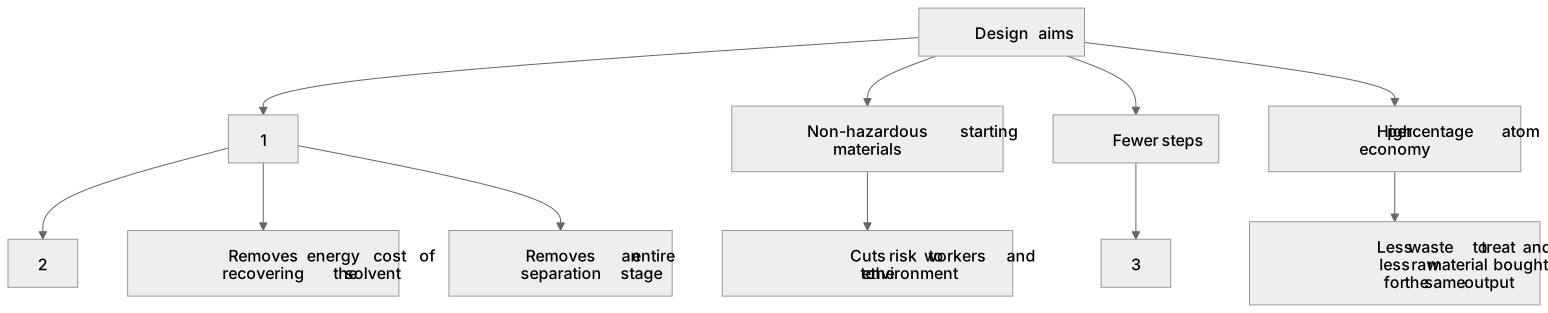
1Box 1
2Box 2
3Box 3
There is more to this lesson
The full lesson goes on to check your understanding and help you earn the marks. Create a free account to carry on, with your progress saved.
A week of Premium from your first lesson · Then the free plan continues · No card, no charge
Test your understanding of Organic synthesis (A-level only): Students should be able to: explain why chemists aim to design processes that do not require a solvent and that use non- hazardous starting materials explain why chemists aim to design production methods with fewer steps that have a high percentage atom economy use reactions in this specification to devise a synthesis, with up to four steps, for an organic compound.
Active recall beats re-reading. Take an instant quiz now to test what you’ve learned and lock it into long-term memory.
A week of Premium from your first lesson · Then the free plan continues · No card, no charge