AQA · A-Level · Chemistry
Course version: 7405 · Version from Sept 2016
The synthesis of an organic compound can involve several steps.
Full specification wording
Organic synthesis (A-level only): The synthesis of an organic compound can involve several steps.
Most targets cannot be reached in one reaction, so you plan a route through intermediates, changing one functional group at a time.
Checked against the AQA 7405 specification (opens in a new tab) on .
- Point 1 of 2
Study notes
From the checked teaching notes for this specification point.
The idea
Most targets cannot be reached in one reaction, so you plan a route through intermediates, changing one functional group at a time. One route that recurs is nitration of benzene using concentrated nitric acid with concentrated sulfuric acid, followed by reduction of the nitro group using tin and hydrochloric acid to give an aromatic amine. Another is halogenoalkane to nitrile with potassium cyanide in ethanol, which lengthens the carbon chain by one carbon, then reduction to an amine or hydrolysis to a carboxylic acid. Yields compound badly: three steps at seventy per cent each leave only thirty-four per cent overall, because the fractions multiply rather than average. Steps that give mixtures, such as an amine reacting further with a halogenoalkane, cost the most.
What earns the marks
- Each reagent named in full, so concentrated nitric acid and concentrated sulfuric acid rather than nitric acid alone.
- Tin and hydrochloric acid, or iron and hydrochloric acid, as the system that reduces a nitro group.
- The structure of each intermediate along the route.
- Multiplying the fractional yields of the separate steps to give the overall yield.
Common mistakes and how to put them right
Omitting the word concentrated from nitric or sulfuric acid, which loses the reagent mark.
Adding or averaging the percentage yields of the steps instead of multiplying them.
Quoting a catalyst as though it were a reagent, or naming something that could not be taken from a bottle.
Expecting a single product when an amine reacts with a halogenoalkane, where further substitution gives a mixture.
Writing a route that changes two functional groups in one step with no reagent that could do it.
Exam tips
- Write reagents in full, with concentration or state where it matters; an incomplete reagent is penalised even when the chemistry is right.
- Draw every intermediate, because structure marks are awarded step by step even when a later step is wrong.
- For a yield calculation work in decimals and multiply, converting back to a percentage only at the end.
Try the lesson
The start of the Organic synthesis (A-level only): The synthesis of an organic compound can involve several steps. lesson, made from checked teaching notes for this specification point.
Have a go first
A three-step synthesis converts compound X into compound Y. The percentage yields of the three steps are 80.0%, 70.0% and 50.0%. What is the overall percentage yield of the synthesis?
Listen
Most targets cannot be reached in one reaction, so you plan a route through intermediates, changing one functional group at a time. One route that recurs is nitration of benzene using concentrated nitric acid with concentrated sulfuric acid, followed by reduction of the nitro group using tin and hydrochloric acid to give an aromatic amine. Another is halogenoalkane to nitrile with potassium cyanide in ethanol, which lengthens the carbon chain by one carbon, then reduction to an amine or hydrolysis to a carboxylic acid. Yields compound badly: three steps at seventy per cent each leave only thirty-four per cent overall, because the fractions multiply rather than average. Steps that give mixtures, such as an amine reacting further with a halogenoalkane, cost the most. A strong answer earns marks for these points. each reagent named in full, so concentrated nitric acid and concentrated sulfuric acid rather than nitric acid alone. tin and hydrochloric acid, or iron and hydrochloric acid, as the system that reduces a nitro group. the structure of each intermediate along the route. multiplying the fractional yields of the separate steps to give the overall yield. Exam tip: Write reagents in full, with concentration or state where it matters; an incomplete reagent is penalised even when the chemistry is right.
See it
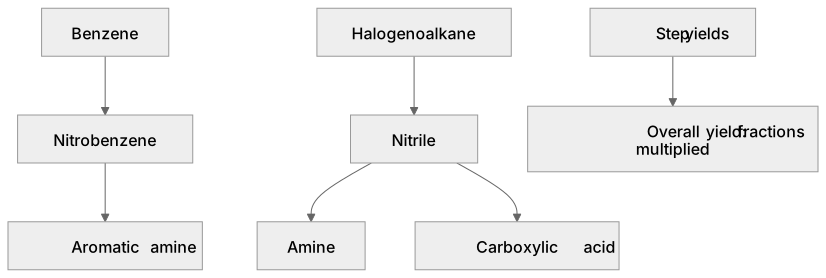
Label the diagram
Some boxes have lost their names. Pick the right name for each number.
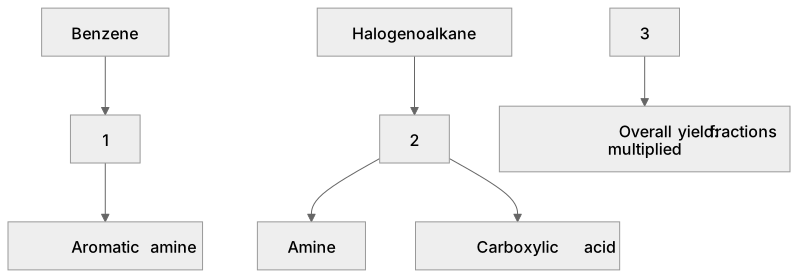
1Box 1
2Box 2
3Box 3
There is more to this lesson
The full lesson goes on to check your understanding and help you earn the marks. Create a free account to carry on, with your progress saved.
A week of Premium from your first lesson · Then the free plan continues · No card, no charge
Test your understanding of Organic synthesis (A-level only): The synthesis of an organic compound can involve several steps.
Active recall beats re-reading. Take an instant quiz now to test what you’ve learned and lock it into long-term memory.
A week of Premium from your first lesson · Then the free plan continues · No card, no charge