AQA · A-Level · Chemistry
Course version: 7405 · Version from Sept 2016
Acidified potassium dichromate(VI) is a suitable oxidising agent.
Full specification wording
Oxidation of alcohols: Acidified potassium dichromate(VI) is a suitable oxidising agent.
The oxidising agent is potassium dichromate(VI) solution acidified with dilute sulfuric acid.
Checked against the AQA 7405 specification (opens in a new tab) on .
- Point 5 of 6
- 4 key terms
Study notes
From the checked teaching notes for this specification point.
The idea
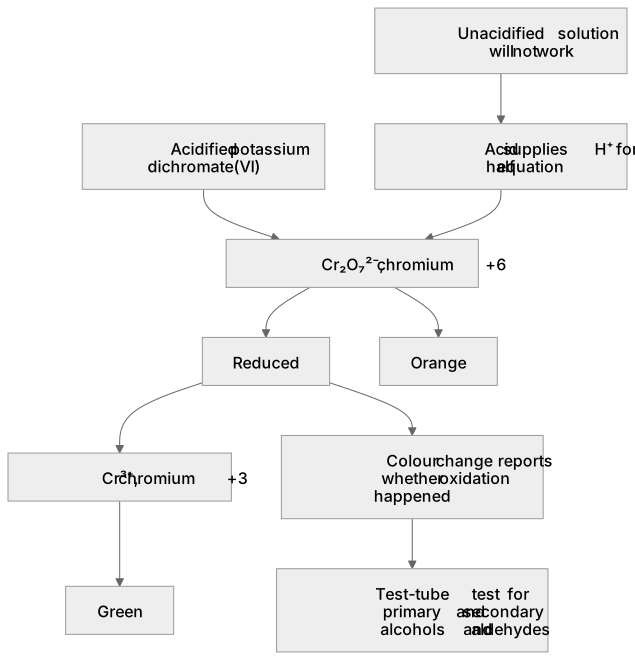
The oxidising agent is potassium dichromate(VI) solution acidified with dilute sulfuric acid. The orange dichromate ion, Cr₂O₇²⁻, in which chromium is in the +6 state, is reduced to the green Cr³⁺ ion: Cr₂O₇²⁻ + 14H⁺ + 6e⁻ → 2Cr³⁺ + 7H₂O. The acid supplies the hydrogen ions that half equation needs, so an unacidified solution will not work and the word acidified must appear in your answer. In organic equations you are allowed to write the oxidant simply as [O], which keeps the focus on the organic change. Because the colour change reports on whether oxidation happened, the same reagent doubles as the test-tube test for primary and secondary alcohols and for aldehydes.
What earns the marks
- Naming acidified potassium dichromate(VI), stating that it is acidified.
- The colour change from orange to green.
- Identifying the change as chromium going from the +6 to the +3 oxidation state.
- Using [O] correctly in a balanced organic equation.
Common mistakes and how to put them right
Writing "potassium dichromate" without acidified, which loses the reagent mark.
Giving the colour change as orange to blue, or yellow to green.
Saying the dichromate is reduced to chromium metal rather than to Cr³⁺.
Calling the dichromate a catalyst while also using it as the oxidising agent.
Exam tips
- AQA treats a reagent as something you could take out of a bottle, so name the acid as well as the dichromate.
- Learn the two colours as a pair, orange and green, and always say which is the starting colour.
- Use [O] to balance organic oxidation equations, then check oxygen and hydrogen separately.
Try the lesson
The start of the Oxidation of alcohols: Acidified potassium dichromate(VI) is a suitable oxidising agent. lesson, made from checked teaching notes for this specification point.
Have a go first
What colour change is seen when acidified potassium dichromate(VI) oxidises an alcohol?
Listen
The oxidising agent is potassium dichromate(VI) solution acidified with dilute sulfuric acid. The orange dichromate ion, Cr₂O₇²⁻, in which chromium is in the +6 state, is reduced to the green Cr³⁺ ion: Cr₂O₇²⁻ + 14H⁺ + 6e⁻ → 2Cr³⁺ + 7H₂O. The acid supplies the hydrogen ions that half equation needs, so an unacidified solution will not work and the word acidified must appear in your answer. In organic equations you are allowed to write the oxidant simply as [O], which keeps the focus on the organic change. Because the colour change reports on whether oxidation happened, the same reagent doubles as the test-tube test for primary and secondary alcohols and for aldehydes. A strong answer earns marks for these points. naming acidified potassium dichromate(VI), stating that it is acidified. the colour change from orange to green. identifying the change as chromium going from the +6 to the +3 oxidation state. using [O] correctly in a balanced organic equation. Exam tip: AQA treats a reagent as something you could take out of a bottle, so name the acid as well as the dichromate.
See it
Key words
Say what each word means before you turn the card.
acidified potassium dichromate(VI)
Try answering aloud or in your head before turning the card.
orange to green
Try answering aloud or in your head before turning the card.
chromium +6 to +3
Try answering aloud or in your head before turning the card.
[O] as shorthand oxidant
Try answering aloud or in your head before turning the card.
See every definition
- acidified potassium dichromate(VI)
- A suitable oxidising agent, being potassium dichromate(VI) solution acidified with dilute sulfuric acid.
- orange to green
- The colour change seen when the orange dichromate ion is reduced to the green Cr³⁺ ion.
- chromium +6 to +3
- The change in oxidation state identified when the dichromate ion is reduced to the Cr³⁺ ion.
- [O] as shorthand oxidant
- A way of writing the oxidant in organic equations that keeps the focus on the organic change.
Label the diagram
Some boxes have lost their names. Pick the right name for each number.
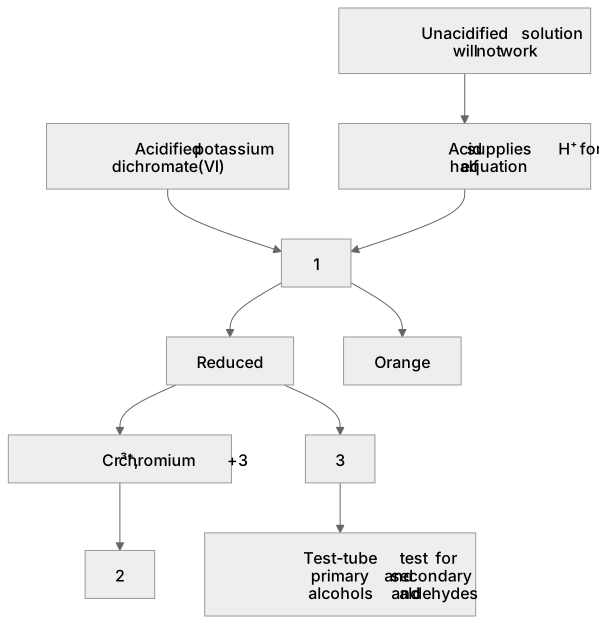
1Box 1
2Box 2
3Box 3
There is more to this lesson
The full lesson goes on to check your understanding and help you earn the marks. Create a free account to carry on, with your progress saved.
A week of Premium from your first lesson · Then the free plan continues · No card, no charge
Test your understanding of Oxidation of alcohols: Acidified potassium dichromate(VI) is a suitable oxidising agent.
Active recall beats re-reading. Take an instant quiz now to test what you’ve learned and lock it into long-term memory.
A week of Premium from your first lesson · Then the free plan continues · No card, no charge