AQA · A-Level · Chemistry
Course version: 7405 · Version from Sept 2016
Students should be able to: write equations for these oxidation reactions…
Full specification wording
Oxidation of alcohols: Students should be able to: write equations for these oxidation reactions (equations showing [O] as oxidant are acceptable) explain how the method used to oxidise a primary alcohol determines whether an aldehyde or carboxylic acid is obtained use chemical tests to distinguish between aldehydes and ketones including Fehling’s solution and Tollens’ reagent.
Three skills are combined here.
Checked against the AQA 7405 specification (opens in a new tab) on .
- Point 6 of 6
- 4 key terms
Study notes
From the checked teaching notes for this specification point.
The idea
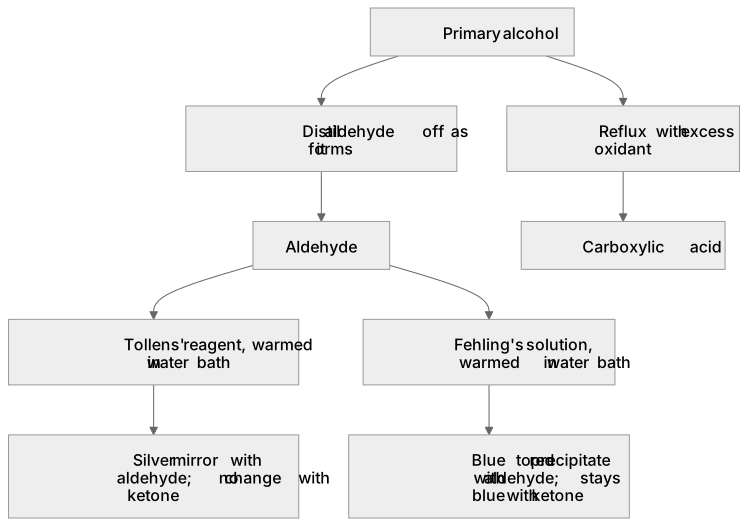
Three skills are combined here. Write oxidation equations with [O], remembering that turning an alcohol into a carbonyl compound releases water, but turning an aldehyde into a carboxylic acid does not. Explain the method: distil the aldehyde off as it forms to isolate it, or reflux with excess oxidant to reach the acid. Then distinguish the aldehyde from the ketone. Tollens' reagent, ammoniacal silver nitrate, gives a silver mirror with an aldehyde and no change with a ketone; Fehling's solution, a blue copper(II) complex, gives a red precipitate with an aldehyde and stays blue with a ketone. Both tests must be warmed in a water bath: AQA has set a candidate method in which cooling Fehling's solution was the deliberate error.
What earns the marks
- A balanced equation using [O] with water shown only where it is formed.
- Saying distillation as the aldehyde forms gives the aldehyde and reflux with excess oxidant gives the acid.
- Tollens' reagent giving a silver mirror with an aldehyde and no change with a ketone.
- Fehling's solution turning from blue to a red precipitate, warmed in a water bath.
Common mistakes and how to put them right
Cooling the Fehling's or Tollens' tube instead of warming it, an error AQA has specifically penalised.
Describing the Fehling's precipitate as brown or green rather than red.
Expecting a positive Tollens' result from a ketone.
Adding water to the aldehyde to carboxylic acid equation, where none is produced.
Exam tips
- Warm gently in a water bath, never over a flame, because the organic liquids are flammable.
- Give the observation for both compounds being distinguished, including the one that does not react.
- Match the method to the product asked for before writing any equation.
Try the lesson
The start of the Oxidation of alcohols: Students should be able to: write equations for these oxidation reactions (equations showing [O] as oxidant are acceptable) explain how the method used to oxidise a primary alcohol determines whether an aldehyde or carboxylic acid is obtained use chemical tests to distinguish between aldehydes and ketones including Fehling’s solution and Tollens’ reagent. lesson, made from checked teaching notes for this specification point.
Have a go first
Which observation shows that Tollens’ reagent has been reduced by an aldehyde?
Listen
Three skills are combined here. Write oxidation equations with [O], remembering that turning an alcohol into a carbonyl compound releases water, but turning an aldehyde into a carboxylic acid does not. Explain the method: distil the aldehyde off as it forms to isolate it, or reflux with excess oxidant to reach the acid. Then distinguish the aldehyde from the ketone. Tollens' reagent, ammoniacal silver nitrate, gives a silver mirror with an aldehyde and no change with a ketone; Fehling's solution, a blue copper(II) complex, gives a red precipitate with an aldehyde and stays blue with a ketone. Both tests must be warmed in a water bath: AQA has set a candidate method in which cooling Fehling's solution was the deliberate error. A strong answer earns marks for these points. a balanced equation using [O] with water shown only where it is formed. saying distillation as the aldehyde forms gives the aldehyde and reflux with excess oxidant gives the acid. Tollens' reagent giving a silver mirror with an aldehyde and no change with a ketone. Fehling's solution turning from blue to a red precipitate, warmed in a water bath. Exam tip: Warm gently in a water bath, never over a flame, because the organic liquids are flammable.
See it
Key words
Say what each word means before you turn the card.
equations using [O]
Try answering aloud or in your head before turning the card.
distillation against reflux
Try answering aloud or in your head before turning the card.
Tollens' silver mirror
Try answering aloud or in your head before turning the card.
Fehling's red precipitate
Try answering aloud or in your head before turning the card.
See every definition
- equations using [O]
- Equations showing [O] as oxidant are acceptable, with water shown only where it is formed.
- distillation against reflux
- Distillation as the aldehyde forms gives the aldehyde, while reflux with excess oxidant gives the acid.
- Tollens' silver mirror
- Ammoniacal silver nitrate gives a silver mirror with an aldehyde and no change with a ketone.
- Fehling's red precipitate
- A blue copper(II) complex gives a red precipitate with an aldehyde and stays blue with a ketone.
Label the diagram
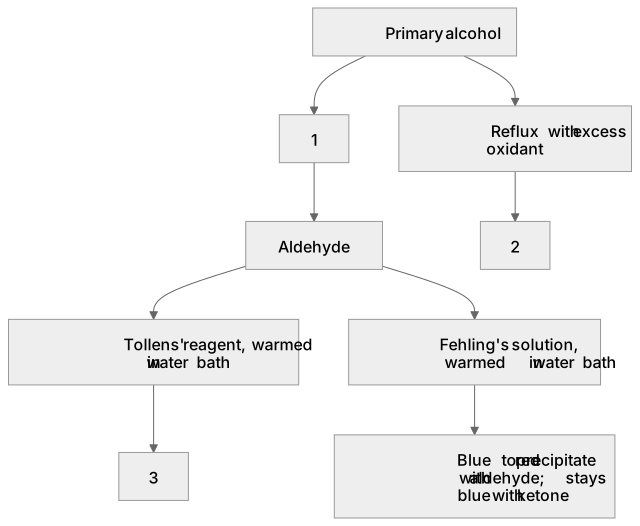
Some boxes have lost their names. Pick the right name for each number.
1Box 1
2Box 2
3Box 3
There is more to this lesson
The full lesson goes on to check your understanding and help you earn the marks. Create a free account to carry on, with your progress saved.
A week of Premium from your first lesson · Then the free plan continues · No card, no charge
Test your understanding of Oxidation of alcohols: Students should be able to: write equations for these oxidation reactions (equations showing [O] as oxidant are acceptable) explain how the method used to oxidise a primary alcohol determines whether an aldehyde or carboxylic acid is obtained use chemical tests to distinguish between aldehydes and ketones including Fehling’s solution and Tollens’ reagent.
Active recall beats re-reading. Take an instant quiz now to test what you’ve learned and lock it into long-term memory.
A week of Premium from your first lesson · Then the free plan continues · No card, no charge