AQA · A-Level · Chemistry
Course version: 7405 · Version from Sept 2016
Chemists have now developed alternative chlorine-free compounds.
Full specification wording
Ozone depletion: Chemists have now developed alternative chlorine-free compounds.
The replacements work by removing the source of the problem: with no carbon–chlorine bond, ultraviolet light cannot release a chlorine radical, so no catalytic cycle can start.
Checked against the AQA 7405 specification (opens in a new tab) on .
- Point 5 of 6
- 4 key terms
Study notes
From the checked teaching notes for this specification point.
The idea
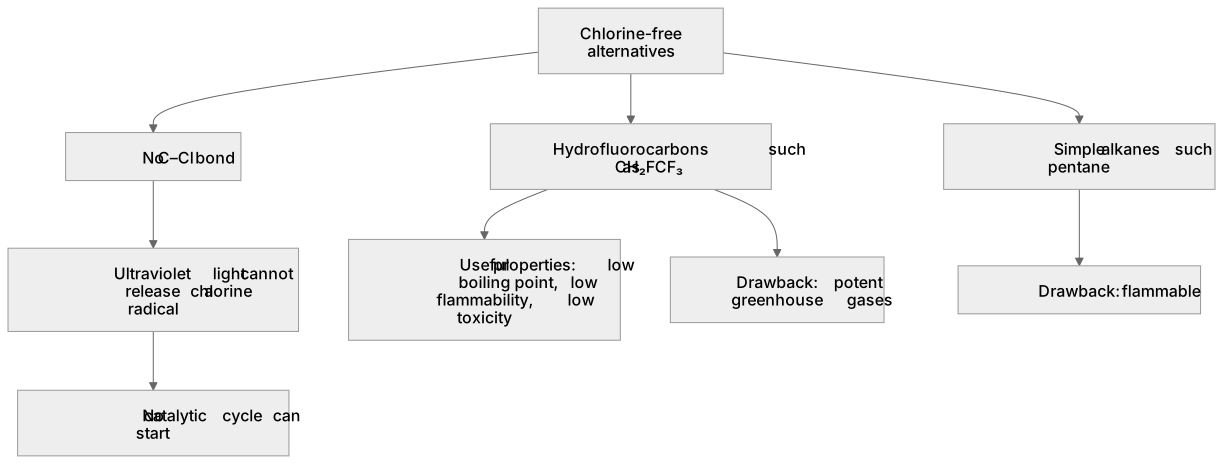
The replacements work by removing the source of the problem: with no carbon–chlorine bond, ultraviolet light cannot release a chlorine radical, so no catalytic cycle can start. Hydrofluorocarbons such as CH₂FCF₃ keep the useful properties of the old refrigerants, low boiling point, low flammability and low toxicity. While they contain C–F, C–H, and C–C bonds, they crucially lack C–Cl bonds; the C–F bonds are too strong to break in the stratosphere. Simple alkanes such as pentane are used in domestic fridges for the same reason, since they contain no C–Cl bonds at all. Neither answer is perfect: hydrofluorocarbons are potent greenhouse gases and hydrocarbons are flammable, so the choice trades one environmental or safety cost against another.
What earns the marks
- Naming a chlorine-free alternative, such as pentane or a hydrofluorocarbon.
- Stating it contains no C–Cl bond, so no chlorine radicals are formed.
- Stating a property that lets it replace the original compound, such as a suitable boiling point.
- A drawback, such as flammability of alkanes or the greenhouse effect of hydrofluorocarbons.
Common mistakes and how to put them right
Saying the replacement is safe because it contains fluorine, when the point is the absence of chlorine.
Naming a hydrochlorofluorocarbon as chlorine-free when it still contains C–Cl bonds.
Presenting the alternatives as having no environmental cost at all.
Explaining the benefit in terms of the compound being less toxic rather than releasing no chlorine radicals.
Exam tips
- Anchor the answer on the missing C–Cl bond; that single phrase carries the explanation mark.
- Have one named example ready, pentane or a hydrofluorocarbon, rather than a vague "modern compound".
- If the question says "evaluate" or "discuss", you must give a disadvantage as well as the advantage.
Try the lesson
The start of the Ozone depletion: Chemists have now developed alternative chlorine-free compounds. lesson, made from checked teaching notes for this specification point.
Have a go first
Why do the chlorine-free compounds developed as replacements for CFCs cause less ozone depletion?
Listen
The replacements work by removing the source of the problem: with no carbon–chlorine bond, ultraviolet light cannot release a chlorine radical, so no catalytic cycle can start. Hydrofluorocarbons such as CH₂FCF₃ keep the useful properties of the old refrigerants, low boiling point, low flammability and low toxicity. While they contain C–F, C–H, and C–C bonds, they crucially lack C–Cl bonds; the C–F bonds are too strong to break in the stratosphere. Simple alkanes such as pentane are used in domestic fridges for the same reason, since they contain no C–Cl bonds at all. Neither answer is perfect: hydrofluorocarbons are potent greenhouse gases and hydrocarbons are flammable, so the choice trades one environmental or safety cost against another. A strong answer earns marks for these points. naming a chlorine-free alternative, such as pentane or a hydrofluorocarbon. stating it contains no C–Cl bond, so no chlorine radicals are formed. stating a property that lets it replace the original compound, such as a suitable boiling point. a drawback, such as flammability of alkanes or the greenhouse effect of hydrofluorocarbons. Exam tip: Anchor the answer on the missing C–Cl bond; that single phrase carries the explanation mark.
See it
Key words
Say what each word means before you turn the card.
chlorine-free replacements
Try answering aloud or in your head before turning the card.
no C–Cl bond
Try answering aloud or in your head before turning the card.
hydrofluorocarbons and alkanes
Try answering aloud or in your head before turning the card.
trade-offs in replacement
Try answering aloud or in your head before turning the card.
See every definition
- chlorine-free replacements
- Alternative compounds developed by chemists that contain no carbon–chlorine bond, so ultraviolet light cannot release a chlorine radical and no catalytic cycle can start.
- no C–Cl bond
- The absence of a carbon–chlorine bond means ultraviolet light cannot release a chlorine radical, so no catalytic cycle can start.
- hydrofluorocarbons and alkanes
- Hydrofluorocarbons such as CH₂FCF₃ and simple alkanes such as pentane are used as replacements because they contain no C–Cl bonds at all.
- trade-offs in replacement
- Hydrofluorocarbons are potent greenhouse gases and hydrocarbons are flammable, so the choice trades one environmental or safety cost against another.
Label the diagram
Some boxes have lost their names. Pick the right name for each number.
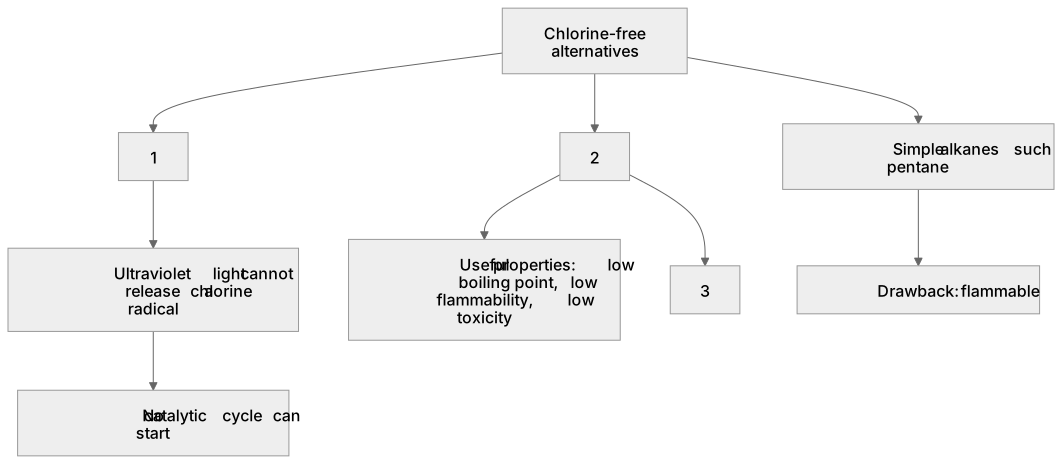
1Box 1
2Box 2
3Box 3
There is more to this lesson
The full lesson goes on to check your understanding and help you earn the marks. Create a free account to carry on, with your progress saved.
A week of Premium from your first lesson · Then the free plan continues · No card, no charge
Test your understanding of Ozone depletion: Chemists have now developed alternative chlorine-free compounds.
Active recall beats re-reading. Take an instant quiz now to test what you’ve learned and lock it into long-term memory.
A week of Premium from your first lesson · Then the free plan continues · No card, no charge