AQA · A-Level · Chemistry
Course version: 7405 · Version from Sept 2016
Chlorine atoms are formed in the upper atmosphere when ultraviolet…
Full specification wording
Ozone depletion: Chlorine atoms are formed in the upper atmosphere when ultraviolet radiation causes C–Cl bonds in chlorofluorocarbons (CFCs) to break.
Chlorofluoroalkanes were chosen as refrigerants and solvents because they are unreactive, non-flammable and non-toxic.
Checked against the AQA 7405 specification (opens in a new tab) on .
- Point 2 of 6
- 4 key terms
Study notes
From the checked teaching notes for this specification point.
The idea
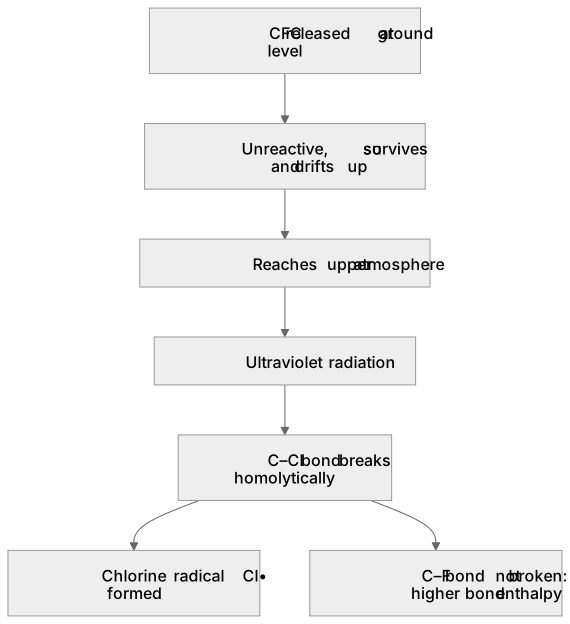
Chlorofluoroalkanes were chosen as refrigerants and solvents because they are unreactive, non-flammable and non-toxic. That stability is exactly the problem: nothing destroys them at ground level, so over years they drift up into the stratosphere. There the ultraviolet radiation is energetic enough to break a bond homolytically, one electron going to each atom. It is the C–Cl bond that breaks, not C–F, because C–Cl has the lower bond enthalpy; if a question supplies the two values, quote both, but it is the comparison that carries the mark. For dichlorodifluoromethane the step is CCl₂F₂ → •CClF₂ + Cl•. The species released is a chlorine atom with an unpaired electron, written Cl•, not a chloride ion; the whole catalytic cycle that follows depends on that.
What earns the marks
- Homolytic fission of the C–Cl bond caused by ultraviolet radiation.
- Showing the product as a chlorine radical, Cl•, with the dot.
- Stating that C–Cl breaks in preference to C–F because it has the lower bond enthalpy.
- Explaining that the compound is unreactive enough to survive until it reaches the upper atmosphere.
Common mistakes and how to put them right
Breaking the C–F bond, which is stronger and therefore not the one that breaks.
Writing Cl⁻ instead of Cl•, which turns a radical mechanism into an ionic one.
Describing the fission as heterolytic, giving a pair of ions.
Saying the chlorofluorocarbon molecule itself destroys ozone, rather than the radical released from it.
Exam tips
- Where the question supplies the two bond enthalpies, quote both to justify which bond breaks; it is the comparison that earns the mark.
- Write every radical with its dot, including in the equation for the fission step.
- Link the stability of the compound to the fact that it reaches the stratosphere at all.
Try the lesson
The start of the Ozone depletion: Chlorine atoms are formed in the upper atmosphere when ultraviolet radiation causes C–Cl bonds in chlorofluorocarbons (CFCs) to break. lesson, made from checked teaching notes for this specification point.
Have a go first
How are chlorine atoms formed from chlorofluorocarbons (CFCs) in the upper atmosphere?
Listen
Chlorofluoroalkanes were chosen as refrigerants and solvents because they are unreactive, non-flammable and non-toxic. That stability is exactly the problem: nothing destroys them at ground level, so over years they drift up into the stratosphere. There the ultraviolet radiation is energetic enough to break a bond homolytically, one electron going to each atom. It is the C–Cl bond that breaks, not C–F, because C–Cl has the lower bond enthalpy; if a question supplies the two values, quote both, but it is the comparison that carries the mark. For dichlorodifluoromethane the step is CCl₂F₂ → •CClF₂ + Cl•. The species released is a chlorine atom with an unpaired electron, written Cl•, not a chloride ion; the whole catalytic cycle that follows depends on that. A strong answer earns marks for these points. homolytic fission of the C–Cl bond caused by ultraviolet radiation. showing the product as a chlorine radical, Cl•, with the dot. stating that C–Cl breaks in preference to C–F because it has the lower bond enthalpy. explaining that the compound is unreactive enough to survive until it reaches the upper atmosphere. Exam tip: Where the question supplies the two bond enthalpies, quote both to justify which bond breaks; it is the comparison that earns the mark.
See it
Key words
Say what each word means before you turn the card.
chlorofluorocarbons
Try answering aloud or in your head before turning the card.
homolytic fission by ultraviolet
Try answering aloud or in your head before turning the card.
C–Cl weaker than C–F
Try answering aloud or in your head before turning the card.
chlorine radical
Try answering aloud or in your head before turning the card.
See every definition
- chlorofluorocarbons
- Compounds whose C–Cl bonds are broken by ultraviolet radiation in the upper atmosphere.
- homolytic fission by ultraviolet
- Breaking of a bond by ultraviolet radiation with one electron going to each atom.
- C–Cl weaker than C–F
- The carbon–chlorine bond has the lower bond enthalpy, so it breaks in preference to the carbon–fluorine bond.
- chlorine radical
- A chlorine atom with an unpaired electron, written Cl•, not a chloride ion.
Label the diagram
Some boxes have lost their names. Pick the right name for each number.
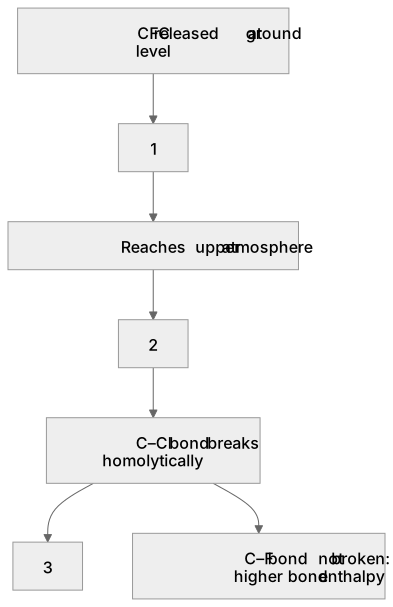
1Box 1
2Box 2
3Box 3
There is more to this lesson
The full lesson goes on to check your understanding and help you earn the marks. Create a free account to carry on, with your progress saved.
A week of Premium from your first lesson · Then the free plan continues · No card, no charge
Test your understanding of Ozone depletion: Chlorine atoms are formed in the upper atmosphere when ultraviolet radiation causes C–Cl bonds in chlorofluorocarbons (CFCs) to break.
Active recall beats re-reading. Take an instant quiz now to test what you’ve learned and lock it into long-term memory.
A week of Premium from your first lesson · Then the free plan continues · No card, no charge