AQA · A-Level · Chemistry
Course version: 7405 · Version from Sept 2016
Chlorine atoms catalyse the decomposition of ozone and contribute to the…
Full specification wording
Ozone depletion: Chlorine atoms catalyse the decomposition of ozone and contribute to the hole in the ozone layer.
A single chlorine radical destroys ozone over and over.
Checked against the AQA 7405 specification (opens in a new tab) on .
- Point 3 of 6
- 4 key terms
Study notes
From the checked teaching notes for this specification point.
The idea
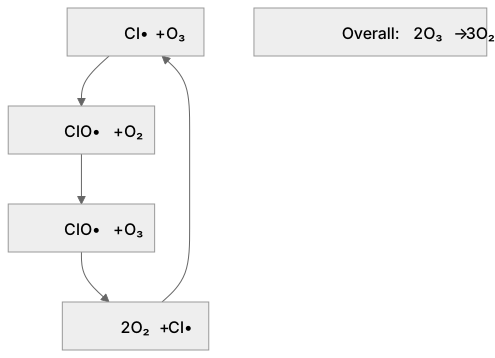
A single chlorine radical destroys ozone over and over. The two steps are Cl• + O₃ → ClO• + O₂ and ClO• + O₃ → 2O₂ + Cl•. Add them and the radicals cancel, leaving 2O₃ → 3O₂. The chlorine radical is regenerated in the second step, so it is a catalyst, not a reactant, and one atom can remove of the order of 10⁵ ozone molecules before it is finally removed from the cycle. ClO• is the intermediate: it is made and used up inside the cycle, so it appears in neither the overall equation nor the catalyst role. Because catalyst and reactants are all gases in the same phase, this is homogeneous catalysis; AQA has set ozone decomposition as the odd one out in a list of heterogeneous processes.
What earns the marks
- The first step, Cl• + O₃ → ClO• + O₂.
- The second step, ClO• + O₃ → 2O₂ + Cl•.
- The overall equation 2O₃ → 3O₂ with the radicals cancelled.
- Stating that Cl• is regenerated and so acts as a catalyst.
- Describing this as homogeneous catalysis, all species being gases.
Common mistakes and how to put them right
Writing Cl⁻ and ClO⁻ in place of the radicals Cl• and ClO•.
Leaving Cl• in the overall equation, which would make it a reactant rather than a catalyst.
Calling ClO• the catalyst and Cl• the intermediate, which reverses the two roles.
Describing the decomposition of ozone by chlorine radicals as heterogeneous catalysis.
Exam tips
- Add the two steps on paper and strike out species appearing on both sides; what survives is the overall equation.
- Say explicitly that the chlorine radical is regenerated; "it is a catalyst" alone often does not score the reason.
- Check the dots are on both Cl and ClO in every equation you write.
Try the lesson
The start of the Ozone depletion: Chlorine atoms catalyse the decomposition of ozone and contribute to the hole in the ozone layer. lesson, made from checked teaching notes for this specification point.
Have a go first
What is the role of chlorine atoms in the decomposition of ozone in the upper atmosphere?
Listen
A single chlorine radical destroys ozone over and over. The two steps are Cl• + O₃ → ClO• + O₂ and ClO• + O₃ → 2O₂ + Cl•. Add them and the radicals cancel, leaving 2O₃ → 3O₂. The chlorine radical is regenerated in the second step, so it is a catalyst, not a reactant, and one atom can remove of the order of 10⁵ ozone molecules before it is finally removed from the cycle. ClO• is the intermediate: it is made and used up inside the cycle, so it appears in neither the overall equation nor the catalyst role. Because catalyst and reactants are all gases in the same phase, this is homogeneous catalysis; AQA has set ozone decomposition as the odd one out in a list of heterogeneous processes. A strong answer earns marks for these points. the first step, Cl• + O₃ → ClO• + O₂. the second step, ClO• + O₃ → 2O₂ + Cl•. the overall equation 2O₃ → 3O₂ with the radicals cancelled. stating that Cl• is regenerated and so acts as a catalyst. Exam tip: Add the two steps on paper and strike out species appearing on both sides; what survives is the overall equation.
See it
Key words
Say what each word means before you turn the card.
catalytic cycle
Try answering aloud or in your head before turning the card.
ClO• intermediate
Try answering aloud or in your head before turning the card.
overall equation
Try answering aloud or in your head before turning the card.
homogeneous catalysis
Try answering aloud or in your head before turning the card.
See every definition
- catalytic cycle
- A single chlorine radical destroys ozone over and over, being regenerated in the second step so that it acts as a catalyst rather than a reactant.
- ClO• intermediate
- It is made and used up inside the cycle, so it appears in neither the overall equation nor the catalyst role.
- overall equation
- Adding the two steps and cancelling the radicals leaves 2O₃ → 3O₂.
- homogeneous catalysis
- Catalyst and reactants are all gases in the same phase.
Label the diagram
Some boxes have lost their names. Pick the right name for each number.
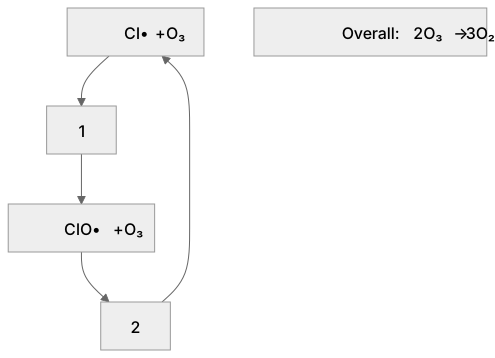
1Box 1
2Box 2
There is more to this lesson
The full lesson goes on to check your understanding and help you earn the marks. Create a free account to carry on, with your progress saved.
A week of Premium from your first lesson · Then the free plan continues · No card, no charge
Test your understanding of Ozone depletion: Chlorine atoms catalyse the decomposition of ozone and contribute to the hole in the ozone layer.
Active recall beats re-reading. Take an instant quiz now to test what you’ve learned and lock it into long-term memory.
A week of Premium from your first lesson · Then the free plan continues · No card, no charge