AQA · A-Level · Chemistry
Course version: 7405 · Version from Sept 2016
Primary aliphatic amines can be prepared by the reaction of ammonia with…
Full specification wording
Preparation (A-level only): Primary aliphatic amines can be prepared by the reaction of ammonia with halogenoalkanes and by the reduction of nitriles.
Two routes exist, each with distinct features.
Checked against the AQA 7405 specification (opens in a new tab) on .
- Point 1 of 2
- 4 key terms
Study notes
From the checked teaching notes for this specification point.
The idea
Two routes exist, each with distinct features. Heating a halogenoalkane with excess ammonia dissolved in ethanol in a sealed tube gives a primary amine. However, this amine is a nucleophile and attacks more halogenoalkane, yielding a mixture of primary, secondary, tertiary amines, and quaternary ammonium salts. A large excess of ammonia favours the primary amine. Alternatively, reducing a nitrile avoids this mixture: RCN + 4[H] gives RCH₂NH₂, using LiAlH₄ in dry ether, or hydrogen over a nickel catalyst. Note that nitrile reduction maintains the carbon count (RCN to RCH₂NH₂); the chain lengthening by one carbon occurs in the prior step when forming the nitrile from a halogenoalkane.
What earns the marks
- Stating a large excess of ammonia is used to favour the primary amine.
- Identifying further substitution products: secondary/tertiary amines and quaternary salts.
- Naming a reducing agent, LiAlH₄ in dry ether or hydrogen with a nickel catalyst.
- The equation using 4[H], showing the amine has the same number of carbon atoms as the nitrile.
Common mistakes and how to put them right
Claiming nitrile reduction adds a carbon atom, when the chain lengthening actually occurs during nitrile formation.
Using aqueous sodium hydroxide with the halogenoalkane, which gives an alcohol instead.
Claiming the ammonia route gives only the primary amine.
Using lithium tetrahydridoaluminate in water, which would destroy the reagent.
Exam tips
- Remember that RCN and RCH2NH2 have the same number of carbons; the extra carbon was added when the nitrile was made.
- Ethanolic ammonia in a sealed tube is the wording AQA expects; 'aqueous ammonia' changes the product.
Try the lesson
The start of the Preparation (A-level only): Primary aliphatic amines can be prepared by the reaction of ammonia with halogenoalkanes and by the reduction of nitriles. lesson, made from checked teaching notes for this specification point.
Have a go first
Which reagent is reacted with a halogenoalkane to prepare a primary aliphatic amine?
Listen
Two routes exist, each with distinct features. Heating a halogenoalkane with excess ammonia dissolved in ethanol in a sealed tube gives a primary amine. However, this amine is a nucleophile and attacks more halogenoalkane, yielding a mixture of primary, secondary, tertiary amines, and quaternary ammonium salts. A large excess of ammonia favours the primary amine. Alternatively, reducing a nitrile avoids this mixture: RCN + 4[H] gives RCH₂NH₂, using LiAlH₄ in dry ether, or hydrogen over a nickel catalyst. Note that nitrile reduction maintains the carbon count (RCN to RCH₂NH₂); the chain lengthening by one carbon occurs in the prior step when forming the nitrile from a halogenoalkane. A strong answer earns marks for these points. stating a large excess of ammonia is used to favour the primary amine. identifying further substitution products: secondary/tertiary amines and quaternary salts. naming a reducing agent, LiAlH₄ in dry ether or hydrogen with a nickel catalyst. the equation using 4[H], showing the amine has the same number of carbon atoms as the nitrile. Exam tip: Remember that RCN and RCH2NH2 have the same number of carbons; the extra carbon was added when the nitrile was made.
See it
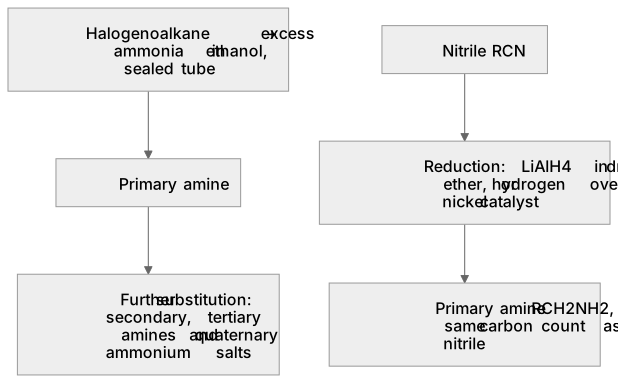
Key words
Say what each word means before you turn the card.
excess ammonia
Try answering aloud or in your head before turning the card.
further substitution
Try answering aloud or in your head before turning the card.
nitrile reduction
Try answering aloud or in your head before turning the card.
carbon chain length
Try answering aloud or in your head before turning the card.
See every definition
- excess ammonia
- A large excess of ammonia favours the primary amine when a halogenoalkane is heated with ammonia dissolved in ethanol in a sealed tube.
- further substitution
- The primary amine is a nucleophile and attacks more halogenoalkane, yielding a mixture of primary, secondary, tertiary amines and quaternary ammonium salts.
- nitrile reduction
- Reducing a nitrile avoids the mixture, using LiAlH₄ in dry ether, or hydrogen over a nickel catalyst, with RCN + 4[H] giving RCH₂NH₂.
- carbon chain length
- Nitrile reduction maintains the carbon count, as the chain lengthening by one carbon occurs in the prior step when forming the nitrile from a halogenoalkane.
Label the diagram
Some boxes have lost their names. Pick the right name for each number.
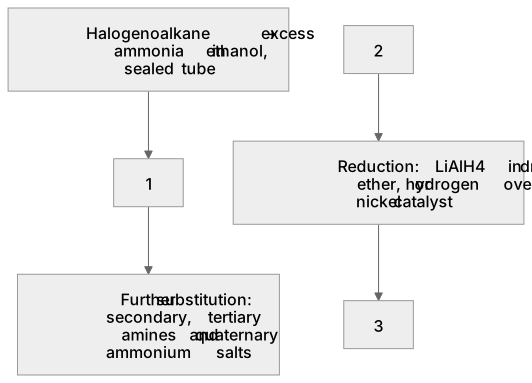
1Box 1
2Box 2
3Box 3
There is more to this lesson
The full lesson goes on to check your understanding and help you earn the marks. Create a free account to carry on, with your progress saved.
A week of Premium from your first lesson · Then the free plan continues · No card, no charge
Test your understanding of Preparation (A-level only): Primary aliphatic amines can be prepared by the reaction of ammonia with halogenoalkanes and by the reduction of nitriles.
Active recall beats re-reading. Take an instant quiz now to test what you’ve learned and lock it into long-term memory.
A week of Premium from your first lesson · Then the free plan continues · No card, no charge