AQA · A-Level · Chemistry
Course version: 7405 · Version from Sept 2016
Amino acids can be separated and identified by thin-layer chromatography.
Full specification wording
Proteins (A-level only): Amino acids can be separated and identified by thin-layer chromatography.
Thin-layer chromatography separates amino acid mixtures between two phases.
Checked against the AQA 7405 specification (opens in a new tab) on .
- Point 5 of 7
- 4 key terms
Study notes
From the checked teaching notes for this specification point.
The idea
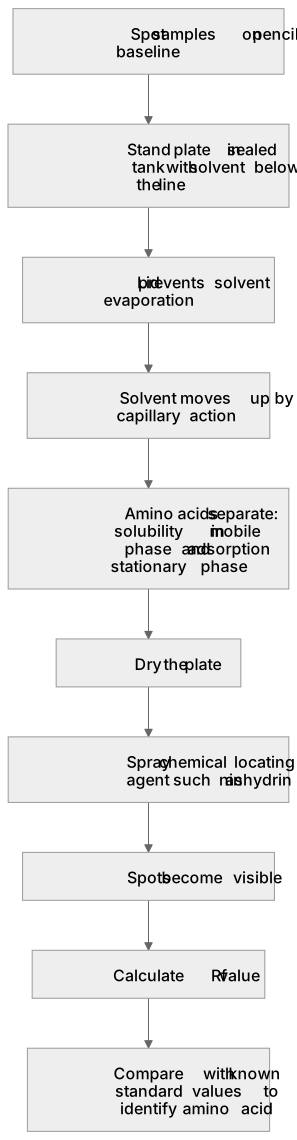
Thin-layer chromatography separates amino acid mixtures between two phases. The stationary phase is silica or alumina; the mobile phase is a solvent moving up by capillary action. Samples are spotted on a pencil baseline. The plate stands in a sealed tank with solvent below the line. A lid prevents solvent evaporation. Amino acids separate based on their relative solubility in the mobile phase and adsorption to the stationary phase. Because amino acids are colourless, a chemical locating agent like ninhydrin is sprayed onto the dried plate to make spots visible. Identification is achieved by calculating the Rf value (distance moved by spot divided by distance moved by solvent front) and comparing it to known standard values.
What earns the marks
- State that separation depends on the balance between solubility in the mobile phase and retention (adsorption) on the stationary phase.
- Identify that a pencil baseline must be drawn above the solvent level to prevent spots dissolving into the reservoir.
- Explain that a chemical locating agent, such as ninhydrin, is required to visualise colourless amino acid spots.
- Describe how to identify an amino acid by calculating its Rf value and comparing it against a database of known standard values.
Common mistakes and how to put them right
Drawing the baseline in ink, which separates and obscures the amino acids.
Put it right by specifying a pencil baseline.
Stating UV light is a locating agent for amino acids.
Put it right: Explicitly stating a chemical locating agent like ninhydrin is needed, as UV light is a physical visualisation method.
Explaining separation by solubility alone.
Put it right by referencing both solubility in the mobile phase and adsorption to the stationary phase.
Exam tips
- Always name both phases in your explanation: mention solubility in the mobile phase and adsorption to the stationary phase.
- When asked how to identify the separated amino acids, explicitly state the formula for Rf value and mention comparing it to known standards.
Try the lesson
The start of the Proteins (A-level only): Amino acids can be separated and identified by thin-layer chromatography. lesson, made from checked teaching notes for this specification point.
Have a go first
In thin-layer chromatography of amino acids, what is the stationary phase?
Listen
Thin-layer chromatography separates amino acid mixtures between two phases. The stationary phase is silica or alumina; the mobile phase is a solvent moving up by capillary action. Samples are spotted on a pencil baseline. The plate stands in a sealed tank with solvent below the line. A lid prevents solvent evaporation. Amino acids separate based on their relative solubility in the mobile phase and adsorption to the stationary phase. Because amino acids are colourless, a chemical locating agent like ninhydrin is sprayed onto the dried plate to make spots visible. Identification is achieved by calculating the Rf value (distance moved by spot divided by distance moved by solvent front) and comparing it to known standard values. A strong answer earns marks for these points. State that separation depends on the balance between solubility in the mobile phase and retention (adsorption) on the stationary phase. Identify that a pencil baseline must be drawn above the solvent level to prevent spots dissolving into the reservoir. Explain that a chemical locating agent, such as ninhydrin, is required to visualise colourless amino acid spots. Describe how to identify an amino acid by calculating its Rf value and comparing it against a database of known standard values. A common slip: Drawing the baseline in ink, which separates and obscures the amino acids. Instead, specifying a pencil baseline. Exam tip: Always name both phases in your explanation: mention solubility in the mobile phase and adsorption to the stationary phase.
See it
Key words
Say what each word means before you turn the card.
stationary phase
Try answering aloud or in your head before turning the card.
mobile phase
Try answering aloud or in your head before turning the card.
locating agent
Try answering aloud or in your head before turning the card.
Rf value
Try answering aloud or in your head before turning the card.
See every definition
- stationary phase
- Silica or alumina, on which amino acids are retained by adsorption.
- mobile phase
- A solvent that moves up by capillary action, in which amino acids have relative solubility.
- locating agent
- A chemical such as ninhydrin sprayed onto the dried plate to make colourless amino acid spots visible.
- Rf value
- Distance moved by spot divided by distance moved by solvent front, compared to known standard values to identify an amino acid.
Label the diagram
Some boxes have lost their names. Pick the right name for each number.
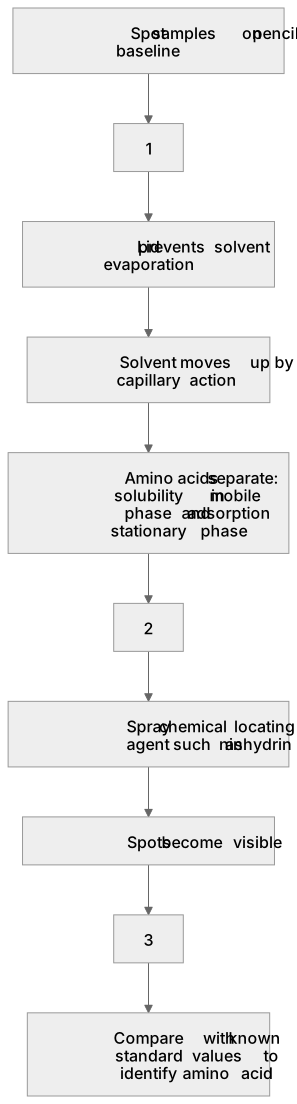
1Box 1
2Box 2
3Box 3
There is more to this lesson
The full lesson goes on to check your understanding and help you earn the marks. Create a free account to carry on, with your progress saved.
A week of Premium from your first lesson · Then the free plan continues · No card, no charge
Test your understanding of Proteins (A-level only): Amino acids can be separated and identified by thin-layer chromatography.
Active recall beats re-reading. Take an instant quiz now to test what you’ve learned and lock it into long-term memory.
A week of Premium from your first lesson · Then the free plan continues · No card, no charge