AQA · A-Level · Chemistry
Course version: 7405 · Version from Sept 2016
Hydrolysis of the peptide link produces the constituent amino acids.
Full specification wording
Proteins (A-level only): Hydrolysis of the peptide link produces the constituent amino acids.
Hydrolysis is condensation run backwards: a molecule of water is put back across every peptide link, cutting the -CO-NH- bond and returning the individual amino acids.
Checked against the AQA 7405 specification (opens in a new tab) on .
- Point 4 of 7
- 4 key terms
Study notes
From the checked teaching notes for this specification point.
The idea
Hydrolysis is condensation run backwards: a molecule of water is put back across every peptide link, cutting the -CO-NH- bond and returning the individual amino acids. It is slow, so the protein is heated under reflux for several hours with about 6 mol dm⁻³ hydrochloric acid. The conditions change the form the products take. In that excess of acid every amine group is protonated, so the amino acids come out as their cations. Hydrolysis with hot aqueous alkali instead gives the carboxylate salts and free -NH₂ groups. A chain of n residues gives n amino acids and consumes n − 1 molecules of water. The mixture is then usually separated and identified by thin-layer chromatography.
What earns the marks
- Heating under reflux with about 6 mol dm⁻³ hydrochloric acid for several hours.
- One molecule of water added for each peptide link broken.
- The amino acids drawn as their protonated cations under acidic conditions.
- All the residues in the chain being released, not only one or two.
Common mistakes and how to put them right
Drawing the neutral amino acid as the product of hydrolysis in excess hydrochloric acid.
Drawing only one of the fragments when the peptide contained three residues.
Adding water across the C=O bond rather than across the C-N bond of the link.
Assuming the R groups are altered or lost during hydrolysis.
Exam tips
- Mark the C-N bond of each link with a line before you cut; that stops you splitting the molecule in the wrong place.
- Read the conditions in the stem: acid gives cations, alkali gives anions, and the neutral form is only right if the question says so.
Try the lesson
The start of the Proteins (A-level only): Hydrolysis of the peptide link produces the constituent amino acids. lesson, made from checked teaching notes for this specification point.
Have a go first
Which reagent is used to hydrolyse the peptide links in a protein so that the constituent amino acids are produced?
Listen
Hydrolysis is condensation run backwards: a molecule of water is put back across every peptide link, cutting the -CO-NH- bond and returning the individual amino acids. It is slow, so the protein is heated under reflux for several hours with about 6 mol dm⁻³ hydrochloric acid. The conditions change the form the products take. In that excess of acid every amine group is protonated, so the amino acids come out as their cations. Hydrolysis with hot aqueous alkali instead gives the carboxylate salts and free -NH₂ groups. A chain of n residues gives n amino acids and consumes n − 1 molecules of water. The mixture is then usually separated and identified by thin-layer chromatography. A strong answer earns marks for these points. heating under reflux with about 6 mol dm⁻³ hydrochloric acid for several hours. one molecule of water added for each peptide link broken. the amino acids drawn as their protonated cations under acidic conditions. all the residues in the chain being released, not only one or two. Exam tip: Mark the C-N bond of each link with a line before you cut; that stops you splitting the molecule in the wrong place.
See it
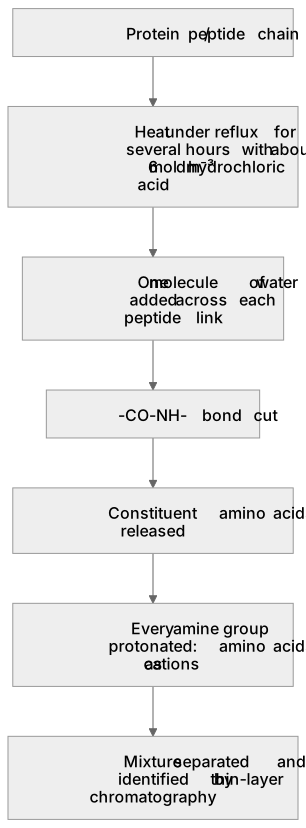
Put it in order
Put these steps in the order they happen.
- 1. Mixture separated and identified by thin-layer chromatography
- 2. Every amine group protonated: amino acids as cations
- 3. One molecule of water added across each peptide link
- 4. Constituent amino acids released
- 5. Protein / peptide chain
- 6. Heat under reflux for several hours with about 6 mol dm⁻³ hydrochloric acid
- 7. -CO-NH- bond cut
Key words
Say what each word means before you turn the card.
hydrolysis of the peptide link
Try answering aloud or in your head before turning the card.
reflux with hydrochloric acid
Try answering aloud or in your head before turning the card.
product form and pH
Try answering aloud or in your head before turning the card.
analysis of the mixture
Try answering aloud or in your head before turning the card.
See every definition
- hydrolysis of the peptide link
- A molecule of water is put back across every peptide link, cutting the -CO-NH- bond and returning the individual amino acids.
- reflux with hydrochloric acid
- The protein is heated under reflux for several hours with about 6 mol dm⁻³ hydrochloric acid because the process is slow.
- product form and pH
- In excess acid every amine group is protonated so the amino acids come out as their cations, while hot aqueous alkali gives the carboxylate salts and free -NH₂ groups.
- analysis of the mixture
- The mixture is then usually separated and identified by thin-layer chromatography.
Label the diagram
Some boxes have lost their names. Pick the right name for each number.
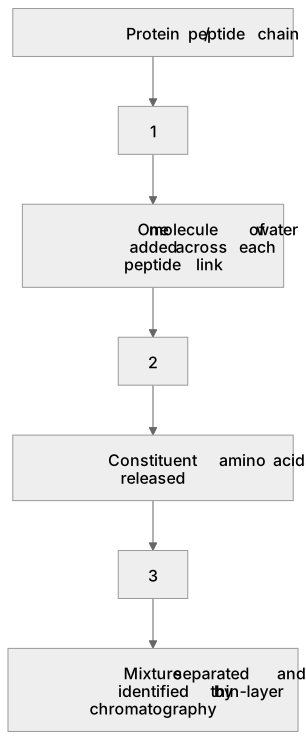
1Box 1
2Box 2
3Box 3
There is more to this lesson
The full lesson goes on to check your understanding and help you earn the marks. Create a free account to carry on, with your progress saved.
A week of Premium from your first lesson · Then the free plan continues · No card, no charge
Test your understanding of Proteins (A-level only): Hydrolysis of the peptide link produces the constituent amino acids.
Active recall beats re-reading. Take an instant quiz now to test what you’ve learned and lock it into long-term memory.
A week of Premium from your first lesson · Then the free plan continues · No card, no charge