AQA · A-Level · Chemistry
Course version: 7405 · Version from Sept 2016
Proteins are sequences of amino acids joined by peptide links.
Full specification wording
Proteins (A-level only): Proteins are sequences of amino acids joined by peptide links.
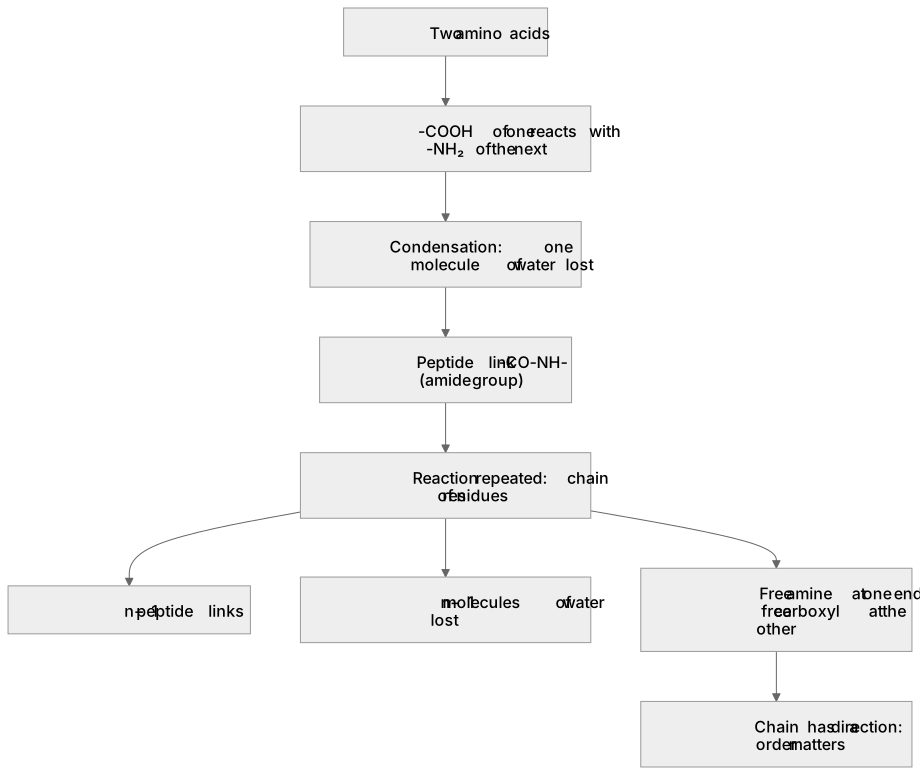
Two amino acids join by condensation: the -COOH of one reacts with the -NH₂ of the next, a molecule of water is lost, and what is left is -CO-NH-, the peptide link, which is an amide group.
Checked against the AQA 7405 specification (opens in a new tab) on .
- Point 1 of 7
- 4 key terms
Study notes
From the checked teaching notes for this specification point.
The idea
Two amino acids join by condensation: the -COOH of one reacts with the -NH₂ of the next, a molecule of water is lost, and what is left is -CO-NH-, the peptide link, which is an amide group. A protein is that reaction repeated hundreds of times, so the chain has a free amine at one end and a free carboxyl at the other, giving it a direction. Order matters: glycine joined to alanine is a different dipeptide from alanine joined to glycine, because the peptide link points the other way. Three amino acids give a tripeptide with two links, and in general a chain of n residues contains n − 1 peptide links and lost n − 1 molecules of water when it formed.
What earns the marks
- The peptide link drawn as a C=O joined directly to an N-H.
- Stating one molecule of water is lost for each peptide link formed.
- Explicitly showing the hydrogen on the nitrogen of the peptide link in both displayed and skeletal structures.
- Building the amino acid residues in the exact order the sequence specifies.
Common mistakes and how to put them right
Joining two -NH₂ groups, or two -COOH groups, to each other.
Put it right by ensuring the -COOH of one amino acid reacts with the -NH₂ of the adjacent amino acid.
Leaving the hydrogen off the nitrogen of a peptide link in a skeletal formula.
Put it right by drawing the H attached to the N atom, as hydrogens on heteroatoms must be shown.
Treating a dipeptide and its reverse as the same compound.
Put it right by recognising that sequence direction matters (e.g., Gly-Ala is structurally different to Ala-Gly).
Keeping the -OH on the carbonyl carbon so no water has actually been lost.
Put it right by removing the -OH from the carboxyl group and one -H from the amine group.
Exam tips
- Write the sequence out left to right with the amine end first, then join them in that order to avoid reversing the peptide link.
- In both displayed and skeletal formulae, the H on the peptide nitrogen must be explicitly drawn because hydrogens attached to heteroatoms (like N or O) cannot be omitted.
Try the lesson
The start of the Proteins (A-level only): Proteins are sequences of amino acids joined by peptide links. lesson, made from checked teaching notes for this specification point.
Have a go first
Which bond joins amino acids together in a protein chain?
Listen
Two amino acids join by condensation: the -COOH of one reacts with the -NH₂ of the next, a molecule of water is lost, and what is left is -CO-NH-, the peptide link, which is an amide group. A protein is that reaction repeated hundreds of times, so the chain has a free amine at one end and a free carboxyl at the other, giving it a direction. Order matters: glycine joined to alanine is a different dipeptide from alanine joined to glycine, because the peptide link points the other way. Three amino acids give a tripeptide with two links, and in general a chain of n residues contains n − 1 peptide links and lost n − 1 molecules of water when it formed. A strong answer earns marks for these points. the peptide link drawn as a C=O joined directly to an N-H. stating one molecule of water is lost for each peptide link formed. explicitly showing the hydrogen on the nitrogen of the peptide link in both displayed and skeletal structures. building the amino acid residues in the exact order the sequence specifies. A common slip: Joining two -NH₂ groups, or two -COOH groups, to each other. Instead, ensuring the -COOH of one amino acid reacts with the -NH₂ of the adjacent amino acid. Exam tip: Write the sequence out left to right with the amine end first, then join them in that order to avoid reversing the peptide link.
See it
Key words
Say what each word means before you turn the card.
peptide link
Try answering aloud or in your head before turning the card.
condensation
Try answering aloud or in your head before turning the card.
amide group
Try answering aloud or in your head before turning the card.
sequence and direction
Try answering aloud or in your head before turning the card.
See every definition
- peptide link
- The -CO-NH- left when the -COOH of one amino acid reacts with the -NH₂ of the next and a molecule of water is lost.
- condensation
- The joining of two amino acids in which the -COOH of one reacts with the -NH₂ of the next and a molecule of water is lost.
- amide group
- The -CO-NH- that is left after the -COOH of one amino acid reacts with the -NH₂ of the next and water is lost.
- sequence and direction
- Order matters, because glycine joined to alanine is a different dipeptide from alanine joined to glycine as the peptide link points the other way.
Label the diagram
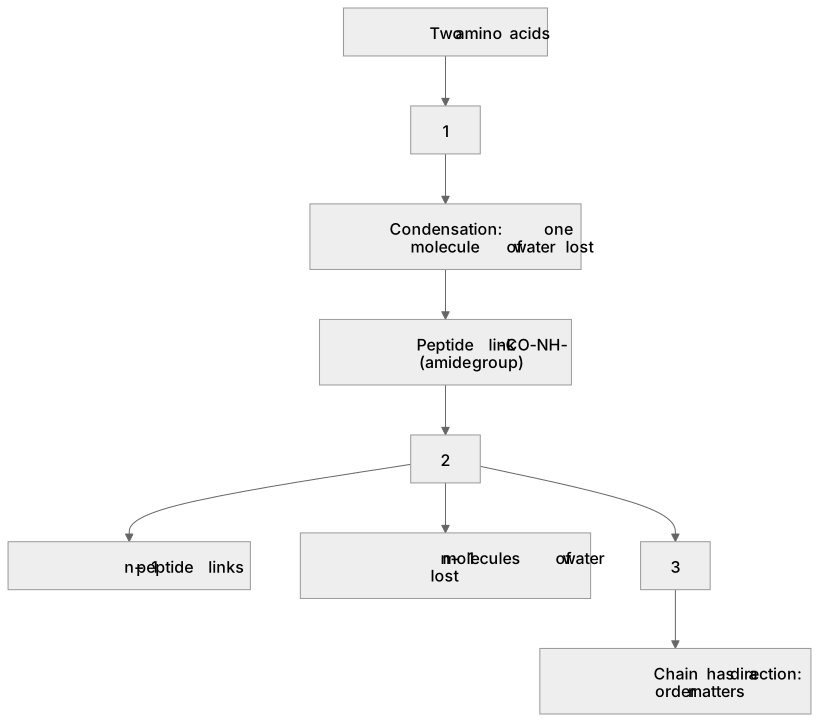
Some boxes have lost their names. Pick the right name for each number.
1Box 1
2Box 2
3Box 3
There is more to this lesson
The full lesson goes on to check your understanding and help you earn the marks. Create a free account to carry on, with your progress saved.
A week of Premium from your first lesson · Then the free plan continues · No card, no charge
Test your understanding of Proteins (A-level only): Proteins are sequences of amino acids joined by peptide links.
Active recall beats re-reading. Take an instant quiz now to test what you’ve learned and lock it into long-term memory.
A week of Premium from your first lesson · Then the free plan continues · No card, no charge