AQA · A-Level · Chemistry
Course version: 7405 · Version from Sept 2016
The importance of hydrogen bonding and sulfur–sulfur bonds in proteins.
Full specification wording
Proteins (A-level only): The importance of hydrogen bonding and sulfur–sulfur bonds in proteins.
Two very different attractions hold a protein in shape.
Checked against the AQA 7405 specification (opens in a new tab) on .
- Point 2 of 7
- 4 key terms
Study notes
From the checked teaching notes for this specification point.
The idea
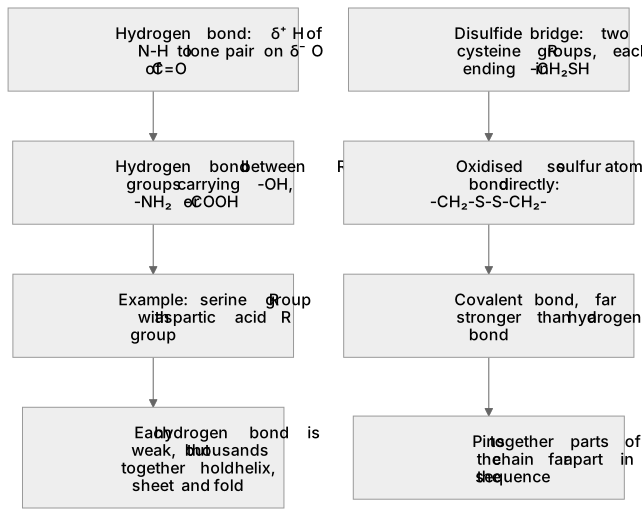
Two very different attractions hold a protein in shape. A hydrogen bond forms between the δ⁺ hydrogen of an N-H and a lone pair on the δ⁻ oxygen of a C=O, or between R groups that carry -OH, -NH₂ or -COOH, as a serine R group does with an aspartic acid R group. Each one is weak, but a protein has thousands and together they hold the helix, the sheet and much of the fold. A disulfide bridge is different in kind: two cysteine R groups, each ending in -CH₂SH, are oxidised so their sulfur atoms bond directly, giving -CH₂-S-S-CH₂-. That is a covalent bond, so it is far stronger than a hydrogen bond and pins together parts of the chain that are far apart in the sequence.
What earns the marks
- Naming cysteine as the amino acid whose R groups form the disulfide bridge.
- Hydrogen bonding between R groups such as those of serine and aspartic acid.
- Stating that the disulfide bridge is the stronger interaction.
- The reason, that a disulfide bridge is a covalent bond whereas a hydrogen bond is not.
Common mistakes and how to put them right
Calling a disulfide bridge a hydrogen bond because it holds two parts of a chain together.
Drawing a hydrogen bond to the hydrogen atom of a C=O rather than to a lone pair on the oxygen.
Describing hydrogen bonds as covalent.
Claiming any pair of R groups can form an S-S bridge, when only cysteine has the -SH group.
Exam tips
- Use the data booklet to read the R groups before you decide what interaction is possible; the R group is what the mark depends on.
- A diagram showing at least -S-S- can earn the disulfide mark on its own.
Try the lesson
The start of the Proteins (A-level only): The importance of hydrogen bonding and sulfur–sulfur bonds in proteins. lesson, made from checked teaching notes for this specification point.
Have a go first
Which type of bond holds the α-helix and β-pleated sheet shapes of a protein in place?
Listen
Two very different attractions hold a protein in shape. A hydrogen bond forms between the δ⁺ hydrogen of an N-H and a lone pair on the δ⁻ oxygen of a C=O, or between R groups that carry -OH, -NH₂ or -COOH, as a serine R group does with an aspartic acid R group. Each one is weak, but a protein has thousands and together they hold the helix, the sheet and much of the fold. A disulfide bridge is different in kind: two cysteine R groups, each ending in -CH₂SH, are oxidised so their sulfur atoms bond directly, giving -CH₂-S-S-CH₂-. That is a covalent bond, so it is far stronger than a hydrogen bond and pins together parts of the chain that are far apart in the sequence. A strong answer earns marks for these points. naming cysteine as the amino acid whose R groups form the disulfide bridge. hydrogen bonding between R groups such as those of serine and aspartic acid. stating that the disulfide bridge is the stronger interaction. the reason, that a disulfide bridge is a covalent bond whereas a hydrogen bond is not. Exam tip: Use the data booklet to read the R groups before you decide what interaction is possible; the R group is what the mark depends on.
See it
Key words
Say what each word means before you turn the card.
hydrogen bonding
Try answering aloud or in your head before turning the card.
disulfide bridge
Try answering aloud or in your head before turning the card.
cysteine R groups
Try answering aloud or in your head before turning the card.
covalent versus intermolecular
Try answering aloud or in your head before turning the card.
See every definition
- hydrogen bonding
- A bond forms between the δ⁺ hydrogen of an N-H and a lone pair on the δ⁻ oxygen of a C=O, or between R groups carrying -OH, -NH₂ or -COOH.
- disulfide bridge
- Two cysteine R groups, each ending in -CH₂SH, are oxidised so their sulfur atoms bond directly, giving -CH₂-S-S-CH₂-.
- cysteine R groups
- Each ends in -CH₂SH, and two of them are oxidised so their sulfur atoms bond directly.
- covalent versus intermolecular
- A disulfide bridge is a covalent bond, so it is far stronger than a hydrogen bond, which is not covalent.
Label the diagram
Some boxes have lost their names. Pick the right name for each number.
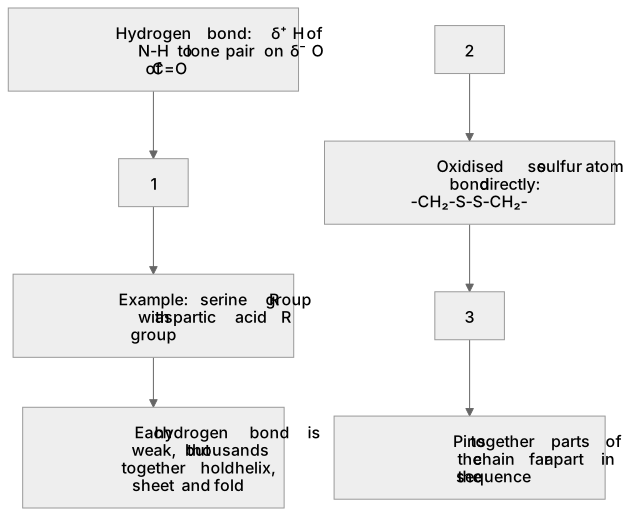
1Box 1
2Box 2
3Box 3
There is more to this lesson
The full lesson goes on to check your understanding and help you earn the marks. Create a free account to carry on, with your progress saved.
A week of Premium from your first lesson · Then the free plan continues · No card, no charge
Test your understanding of Proteins (A-level only): The importance of hydrogen bonding and sulfur–sulfur bonds in proteins.
Active recall beats re-reading. Take an instant quiz now to test what you’ve learned and lock it into long-term memory.
A week of Premium from your first lesson · Then the free plan continues · No card, no charge