AQA · A-Level · Chemistry
Course version: 7405 · Version from Sept 2016
Free-radical mechanisms: the unpaired electron in a radical is represented…
Full specification wording
Reaction mechanisms: Free-radical mechanisms: the unpaired electron in a radical is represented by a dot the use of curly arrows is not required for radical mechanisms.
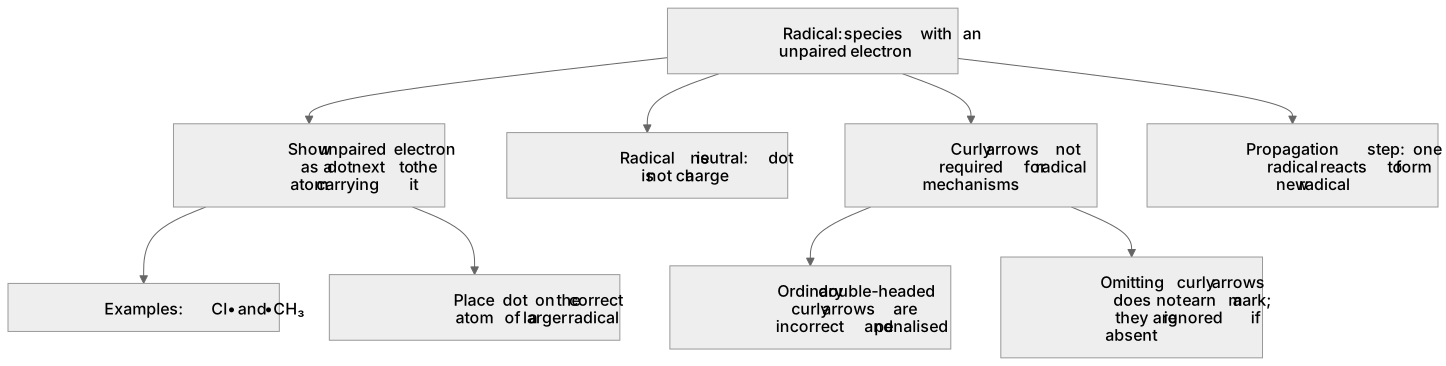
A radical is a species with an unpaired electron, shown by a dot placed next to the atom carrying it, as in Cl• or •CH₃.
Checked against the AQA 7405 specification (opens in a new tab) on .
- Point 2 of 5
- 2 key terms
Study notes
From the checked teaching notes for this specification point.
The idea
A radical is a species with an unpaired electron, shown by a dot placed next to the atom carrying it, as in Cl• or •CH₃. The dot is essential notation. Missing a radical dot is penalised, although usually only once within a set of linked questions. Curly arrows are not required for radical mechanisms. This is a deliberate concession: an ordinary curly arrow shows a pair of electrons moving, which is the wrong picture for a single electron. While half-headed arrows may be used, they are not expected. Crucially, omitting curly arrows does not earn a mark; they are simply ignored if absent. However, using ordinary double-headed curly arrows in a radical mechanism is incorrect and will be penalised.
What earns the marks
- Showing the unpaired electron as a dot on every radical in the mechanism.
- Identifying the correct radical species at each stage, such as Cl• in initiation and •CH₃ in propagation.
- Placing the dot on the correct atom of a larger radical to show where the unpaired electron resides.
- Writing a balanced equation for a propagation step showing one radical reacting to form a new radical.
Common mistakes and how to put them right
Omitting the radical dot, which is penalised even though usually only once per set of linked questions.
Drawing ordinary double-headed curly arrows in a radical mechanism, which is penalised.
Writing Cl₂ with a dot instead of showing two separate Cl• radicals after homolysis.
Giving a radical a charge, since a radical is neutral and a dot is not a charge.
Exam tips
- Put the dot on every radical as you write each equation rather than adding them all at the end.
- Leave curly arrows out of radical mechanisms entirely; while omitting them doesn't earn a mark, including double-headed ones will lose you one.
Try the lesson
The start of the Reaction mechanisms: Free-radical mechanisms: the unpaired electron in a radical is represented by a dot the use of curly arrows is not required for radical mechanisms. lesson, made from checked teaching notes for this specification point.
Have a go first
How is the unpaired electron in a chlorine radical represented when the radical is written in an equation?
Listen
A radical is a species with an unpaired electron, shown by a dot placed next to the atom carrying it, as in Cl• or •CH₃. The dot is essential notation. Missing a radical dot is penalised, although usually only once within a set of linked questions. Curly arrows are not required for radical mechanisms. This is a deliberate concession: an ordinary curly arrow shows a pair of electrons moving, which is the wrong picture for a single electron. While half-headed arrows may be used, they are not expected. Crucially, omitting curly arrows does not earn a mark; they are simply ignored if absent. However, using ordinary double-headed curly arrows in a radical mechanism is incorrect and will be penalised. A strong answer earns marks for these points. Showing the unpaired electron as a dot on every radical in the mechanism. Identifying the correct radical species at each stage, such as Cl• in initiation and •CH₃ in propagation. Placing the dot on the correct atom of a larger radical to show where the unpaired electron resides. Writing a balanced equation for a propagation step showing one radical reacting to form a new radical. Exam tip: Put the dot on every radical as you write each equation rather than adding them all at the end.
See it
Key words
Say what each word means before you turn the card.
radical dot notation
Try answering aloud or in your head before turning the card.
no curly arrows required
Try answering aloud or in your head before turning the card.
See every definition
- radical dot notation
- The unpaired electron in a radical is represented by a dot placed next to the atom carrying it.
- no curly arrows required
- Curly arrows are not required for radical mechanisms, and omitting them does not earn a mark; they are simply ignored if absent.
Label the diagram
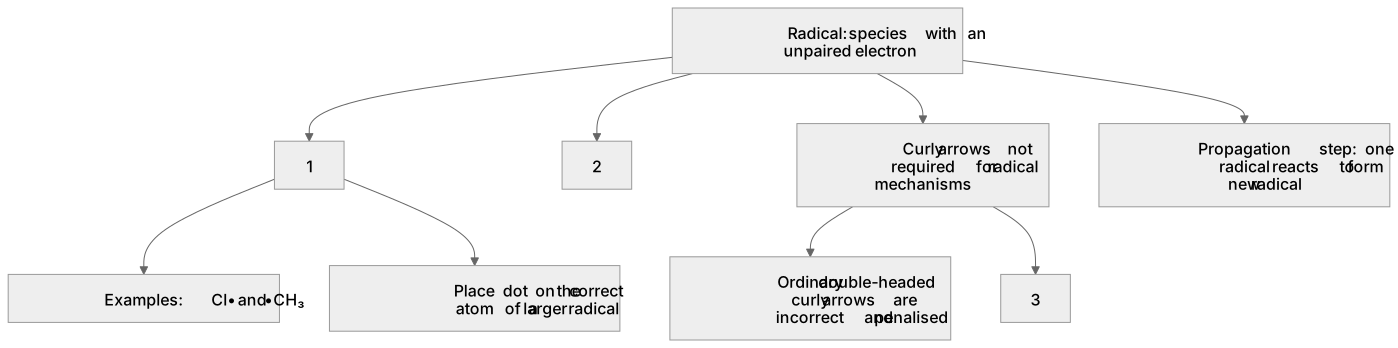
Some boxes have lost their names. Pick the right name for each number.
1Box 1
2Box 2
3Box 3
There is more to this lesson
The full lesson goes on to check your understanding and help you earn the marks. Create a free account to carry on, with your progress saved.
A week of Premium from your first lesson · Then the free plan continues · No card, no charge
Test your understanding of Reaction mechanisms: Free-radical mechanisms: the unpaired electron in a radical is represented by a dot the use of curly arrows is not required for radical mechanisms.
Active recall beats re-reading. Take an instant quiz now to test what you’ve learned and lock it into long-term memory.
A week of Premium from your first lesson · Then the free plan continues · No card, no charge