AQA · A-Level · Chemistry
Course version: 7405 · Version from Sept 2016
Students should be able to: write balanced equations for the steps in a…
Full specification wording
Reaction mechanisms: Students should be able to: write balanced equations for the steps in a free- radical mechanism.
There are three kinds of step and each has a defining test.
Checked against the AQA 7405 specification (opens in a new tab) on .
- Point 3 of 5
- 3 key terms
Study notes
From the checked teaching notes for this specification point.
The idea
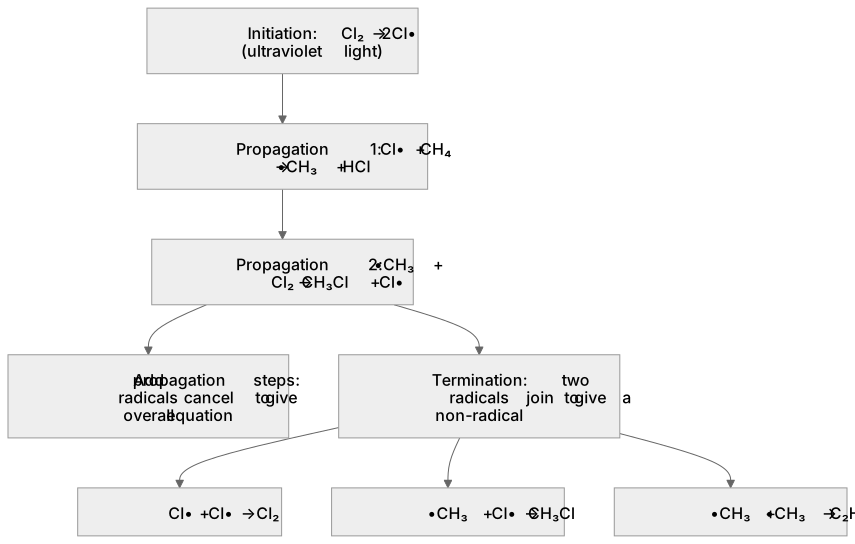
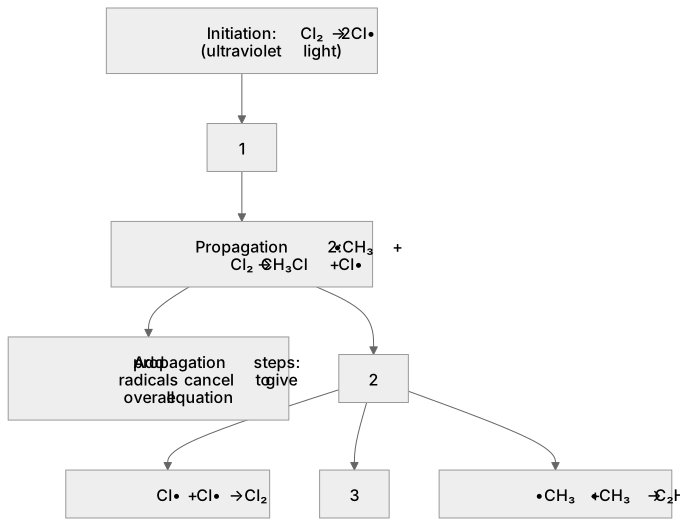
There are three kinds of step and each has a defining test. Initiation makes radicals from a non-radical and needs ultraviolet light: Cl₂ → 2Cl•. Propagation steps each have one radical in and one radical out, so the radical count is unchanged and the chain continues: Cl• + CH₄ → •CH₃ + HCl, then •CH₃ + Cl₂ → CH₃Cl + Cl•. Adding the two propagation steps together gives the overall equation, with the radicals cancelling. Termination joins two radicals to give a non-radical, removing radicals from the system: Cl• + Cl• → Cl₂, or •CH₃ + Cl• → CH₃Cl, or •CH₃ + •CH₃ → C₂H₆. The same pattern describes ozone depletion, where Cl• + O₃ → ClO• + O₂ and ClO• + O₃ → Cl• + 2O₂.
What earns the marks
- An initiation equation forming two radicals from a covalent molecule, with ultraviolet light stated.
- Each propagation step having exactly one radical on each side.
- A termination step combining two radicals to give a single non-radical product.
- A balanced overall equation obtained by adding the propagation steps.
Common mistakes and how to put them right
Writing a propagation step with no radical on one side, so the chain cannot continue.
Giving Cl• + CH₄ → CH₃Cl + H• as a propagation step, which breaks the wrong bond and produces the wrong radical.
Using Cl₂ rather than Cl• as the attacking species in a propagation step.
Labelling •CH₃ + •CH₃ → C₂H₆ as propagation when it removes radicals and is termination.
Exam tips
- Count radicals on each side: one in and one out is propagation, two in and none out is termination.
- Write ultraviolet light or sunlight beside the initiation step, because the condition often carries the mark.
- State symbols are generally ignored, so spend your time balancing rather than on phases.
Try the lesson
The start of the Reaction mechanisms: Students should be able to: write balanced equations for the steps in a free- radical mechanism. lesson, made from checked teaching notes for this specification point.
Have a go first
Chlorine reacts with methane in ultraviolet light by a free-radical mechanism. Which equation represents the initiation step?
Listen
There are three kinds of step and each has a defining test. Initiation makes radicals from a non-radical and needs ultraviolet light: Cl₂ → 2Cl•. Propagation steps each have one radical in and one radical out, so the radical count is unchanged and the chain continues: Cl• + CH₄ → •CH₃ + HCl, then •CH₃ + Cl₂ → CH₃Cl + Cl•. Adding the two propagation steps together gives the overall equation, with the radicals cancelling. Termination joins two radicals to give a non-radical, removing radicals from the system: Cl• + Cl• → Cl₂, or •CH₃ + Cl• → CH₃Cl, or •CH₃ + •CH₃ → C₂H₆. The same pattern describes ozone depletion, where Cl• + O₃ → ClO• + O₂ and ClO• + O₃ → Cl• + 2O₂. A strong answer earns marks for these points. an initiation equation forming two radicals from a covalent molecule, with ultraviolet light stated. each propagation step having exactly one radical on each side. a termination step combining two radicals to give a single non-radical product. a balanced overall equation obtained by adding the propagation steps. Exam tip: Count radicals on each side: one in and one out is propagation, two in and none out is termination.
See it
Key words
Say what each word means before you turn the card.
initiation
Try answering aloud or in your head before turning the card.
propagation
Try answering aloud or in your head before turning the card.
termination
Try answering aloud or in your head before turning the card.
See every definition
- initiation
- A step that makes radicals from a non-radical and needs ultraviolet light.
- propagation
- A step with one radical in and one radical out, so the radical count is unchanged and the chain continues.
- termination
- A step that joins two radicals to give a non-radical, removing radicals from the system.
Label the diagram
Some boxes have lost their names. Pick the right name for each number.
1Box 1
2Box 2
3Box 3
There is more to this lesson
The full lesson goes on to check your understanding and help you earn the marks. Create a free account to carry on, with your progress saved.
A week of Premium from your first lesson · Then the free plan continues · No card, no charge
Test your understanding of Reaction mechanisms: Students should be able to: write balanced equations for the steps in a free- radical mechanism.
Active recall beats re-reading. Take an instant quiz now to test what you’ve learned and lock it into long-term memory.
A week of Premium from your first lesson · Then the free plan continues · No card, no charge