AQA · A-Level · Chemistry
Course version: 7405 · Version from Sept 2016
Students should be able to: outline mechanisms by drawing the structures…
Full specification wording
Reaction mechanisms: Students should be able to: outline mechanisms by drawing the structures of the species involved and curly arrows to represent the movement of electron pairs.
Outlining a mechanism earns marks in identifiable pieces, so draw all of them.
Checked against the AQA 7405 specification (opens in a new tab) on .
- Point 5 of 5
- 3 key terms
Study notes
From the checked teaching notes for this specification point.
The idea
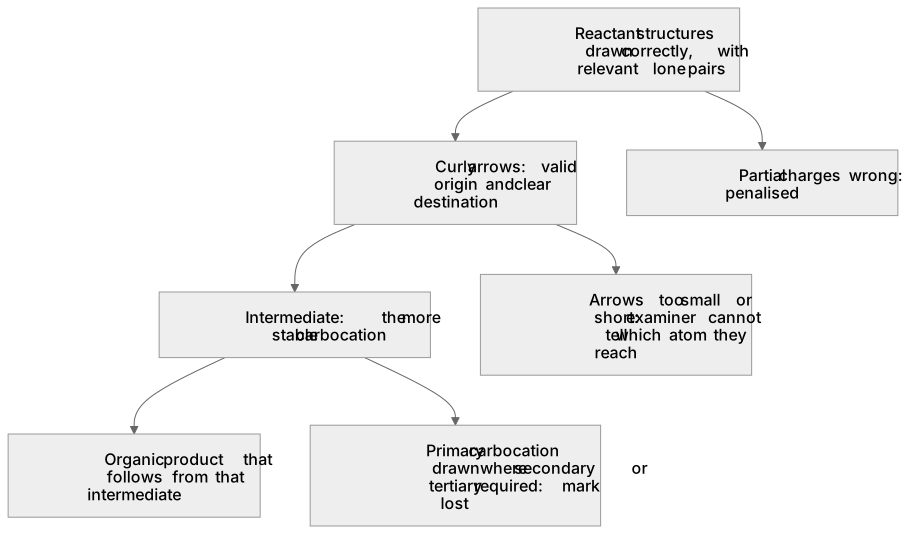
Outlining a mechanism earns marks in identifiable pieces, so draw all of them. One mark is usually for the structures of the reactant species, drawn correctly with any relevant lone pairs. One mark goes to each curly arrow, judged on where it starts. A further mark goes to the structure of the intermediate: in electrophilic addition that is the carbocation, and a mark scheme will refuse the mark if you have drawn the primary carbocation where the secondary or tertiary one is required for the major product. Partial charges are usually ignored unless they are wrong, in which case they cost you. Displayed or other structural formulae are both allowed, so choose whichever makes the electron movement clearest and draw it large.
What earns the marks
- Drawing the structures of the reacting species correctly, including relevant lone pairs.
- Each curly arrow drawn with a valid origin and a clear destination.
- The correct structure of the intermediate, such as the more stable carbocation.
- The organic product that follows from that intermediate.
Common mistakes and how to put them right
Drawing the primary carbocation when the major product requires the secondary or tertiary one, which loses that mark outright.
Showing partial charges in the wrong direction, which is penalised even though correct ones are usually ignored.
Drawing arrows so small or so short that the examiner cannot tell which atom they reach.
Omitting the lone pair on the intermediate when the mark scheme requires it to be shown.
Exam tips
- Draw large, because cramped mechanisms lose arrow marks for ambiguity rather than for chemistry.
- Check which carbocation the required product needs before committing to an intermediate.
- Leave partial charges off rather than guess them, since wrong ones are penalised and right ones are often ignored.
Try the lesson
The start of the Reaction mechanisms: Students should be able to: outline mechanisms by drawing the structures of the species involved and curly arrows to represent the movement of electron pairs. lesson, made from checked teaching notes for this specification point.
Have a go first
In a curly-arrow mechanism, what does a curly arrow represent?
Listen
Outlining a mechanism earns marks in identifiable pieces, so draw all of them. One mark is usually for the structures of the reactant species, drawn correctly with any relevant lone pairs. One mark goes to each curly arrow, judged on where it starts. A further mark goes to the structure of the intermediate: in electrophilic addition that is the carbocation, and a mark scheme will refuse the mark if you have drawn the primary carbocation where the secondary or tertiary one is required for the major product. Partial charges are usually ignored unless they are wrong, in which case they cost you. Displayed or other structural formulae are both allowed, so choose whichever makes the electron movement clearest and draw it large. A strong answer earns marks for these points. drawing the structures of the reacting species correctly, including relevant lone pairs. each curly arrow drawn with a valid origin and a clear destination. the correct structure of the intermediate, such as the more stable carbocation. the organic product that follows from that intermediate. Exam tip: Draw large, because cramped mechanisms lose arrow marks for ambiguity rather than for chemistry.
See it
Key words
Say what each word means before you turn the card.
outlining mechanisms
Try answering aloud or in your head before turning the card.
one mark per curly arrow
Try answering aloud or in your head before turning the card.
intermediate structures
Try answering aloud or in your head before turning the card.
See every definition
- outlining mechanisms
- Drawing the structures of the species involved and curly arrows to represent the movement of electron pairs.
- one mark per curly arrow
- Each arrow is judged on where it starts, with a valid origin and a clear destination.
- intermediate structures
- The species formed between reactants and products, such as the carbocation in electrophilic addition, whose correct structure earns a mark.
Label the diagram
Some boxes have lost their names. Pick the right name for each number.
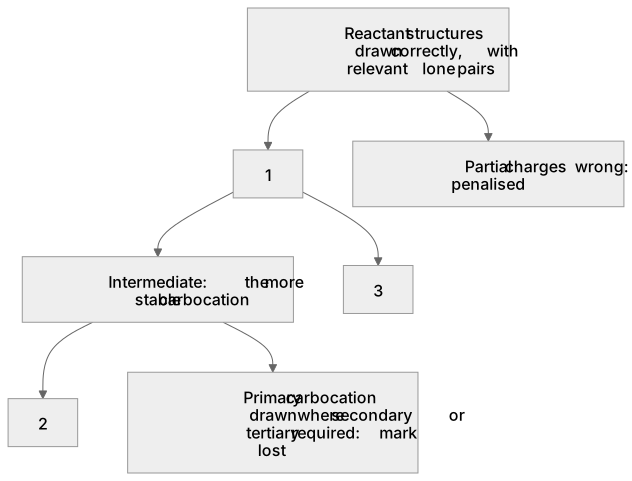
1Box 1
2Box 2
3Box 3
There is more to this lesson
The full lesson goes on to check your understanding and help you earn the marks. Create a free account to carry on, with your progress saved.
A week of Premium from your first lesson · Then the free plan continues · No card, no charge
Test your understanding of Reaction mechanisms: Students should be able to: outline mechanisms by drawing the structures of the species involved and curly arrows to represent the movement of electron pairs.
Active recall beats re-reading. Take an instant quiz now to test what you’ve learned and lock it into long-term memory.
A week of Premium from your first lesson · Then the free plan continues · No card, no charge