AQA · A-Level · Chemistry
Course version: 7405 · Version from Sept 2016
Other mechanisms: the formation of a covalent bond is shown by a curly…
Full specification wording
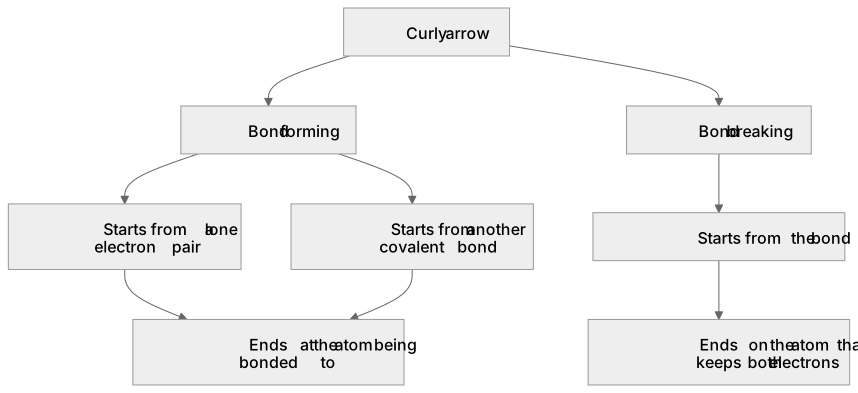
Reaction mechanisms: Other mechanisms: the formation of a covalent bond is shown by a curly arrow that starts from a lone electron pair or from another covalent bond the breaking of a covalent bond is shown by a curly arrow starting from the bond.
A curly arrow tracks a pair of electrons, and where it starts matters more than where it points.
Checked against the AQA 7405 specification (opens in a new tab) on .
- Point 4 of 5
- 4 key terms
Study notes
From the checked teaching notes for this specification point.
The idea
A curly arrow tracks a pair of electrons, and where it starts matters more than where it points. To make a bond, the arrow starts on a lone pair or on an existing bond such as a C=C, and ends at the atom being bonded to; AQA allows the head to reach the atom, sit alongside it, or go more than half way towards it. To break a bond, the arrow starts on the bond itself and ends on the atom that keeps both electrons. Arrows that start on a negative charge, on an atom, or in mid-air gain no credit and are penalised. Skeletal formulae are acceptable in mechanisms, but where a C–H bond breaks both that hydrogen and its bond must be drawn, or the arrow has nothing legitimate to start from.
What earns the marks
- Each curly arrow starting from a lone pair or from a bond rather than from an atom or a charge.
- A bond breaking arrow that starts on the bond and ends on the atom taking both electrons.
- The correct structure of the intermediate produced by those arrows.
- Drawing the C–H bond and the hydrogen explicitly when that bond is the one that breaks.
Common mistakes and how to put them right
Starting the arrow at the negative sign of an ion such as OH⁻ instead of at the lone pair on the oxygen.
Starting an arrow at an atom rather than at a lone pair or a bond, which is penalised each time it occurs.
Using a skeletal formula and then drawing an arrow from a C–H bond that has not been shown.
Drawing a bond breaking arrow pointing towards the bond rather than away from it.
Exam tips
- Draw the lone pair in before you draw the arrow, so that the arrow has a legitimate origin.
- Take the arrowhead at least half way to the target atom, because short arrows are read as ambiguous.
- If a C–H bond is involved, abandon skeletal notation for that part and draw the hydrogen in.
Try the lesson
The start of the Reaction mechanisms: Other mechanisms: the formation of a covalent bond is shown by a curly arrow that starts from a lone electron pair or from another covalent bond the breaking of a covalent bond is shown by a curly arrow starting from the bond. lesson, made from checked teaching notes for this specification point.
Have a go first
In a mechanism diagram, a curly arrow starts at a lone pair on a nitrogen atom and points to a carbon atom. What does this arrow represent?
Listen
A curly arrow tracks a pair of electrons, and where it starts matters more than where it points. To make a bond, the arrow starts on a lone pair or on an existing bond such as a C=C, and ends at the atom being bonded to; AQA allows the head to reach the atom, sit alongside it, or go more than half way towards it. To break a bond, the arrow starts on the bond itself and ends on the atom that keeps both electrons. Arrows that start on a negative charge, on an atom, or in mid-air gain no credit and are penalised. Skeletal formulae are acceptable in mechanisms, but where a C–H bond breaks both that hydrogen and its bond must be drawn, or the arrow has nothing legitimate to start from. A strong answer earns marks for these points. each curly arrow starting from a lone pair or from a bond rather than from an atom or a charge. a bond breaking arrow that starts on the bond and ends on the atom taking both electrons. the correct structure of the intermediate produced by those arrows. drawing the C–H bond and the hydrogen explicitly when that bond is the one that breaks. Exam tip: Draw the lone pair in before you draw the arrow, so that the arrow has a legitimate origin.
See it
Key words
Say what each word means before you turn the card.
curly arrow conventions
Try answering aloud or in your head before turning the card.
bond breaking arrows
Try answering aloud or in your head before turning the card.
penalised representations
Try answering aloud or in your head before turning the card.
skeletal formulae in mechanisms
Try answering aloud or in your head before turning the card.
See every definition
- curly arrow conventions
- The formation of a covalent bond is shown by a curly arrow that starts from a lone electron pair or from another covalent bond.
- bond breaking arrows
- The breaking of a covalent bond is shown by a curly arrow starting from the bond.
- penalised representations
- Arrows that start on a negative charge, on an atom, or in mid-air gain no credit and are penalised.
- skeletal formulae in mechanisms
- Skeletal formulae are acceptable in mechanisms, but where a C–H bond breaks both that hydrogen and its bond must be drawn.
Label the diagram
Some boxes have lost their names. Pick the right name for each number.
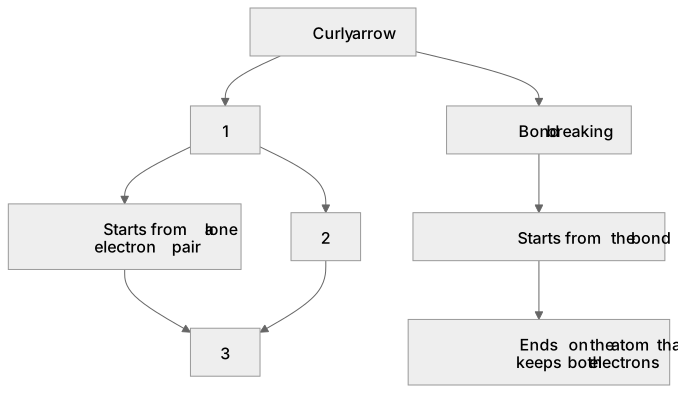
1Box 1
2Box 2
3Box 3
There is more to this lesson
The full lesson goes on to check your understanding and help you earn the marks. Create a free account to carry on, with your progress saved.
A week of Premium from your first lesson · Then the free plan continues · No card, no charge
Test your understanding of Reaction mechanisms: Other mechanisms: the formation of a covalent bond is shown by a curly arrow that starts from a lone electron pair or from another covalent bond the breaking of a covalent bond is shown by a curly arrow starting from the bond.
Active recall beats re-reading. Take an instant quiz now to test what you’ve learned and lock it into long-term memory.
A week of Premium from your first lesson · Then the free plan continues · No card, no charge